
Vietnamese plywood suppliers usually accept a 30% T/T deposit with the 70% balance paid against a scanned copy of the bill of lading, or an irrevocable letter of credit at sight. Both tie the larger payment to proof that your container has shipped. This guide compares every payment instrument a plywood buyer meets, explains which documents release the money and lists the checks that protect a first order, from Minh Thanh Plywood, a manufacturer in Phu Tho that works on exactly these terms.
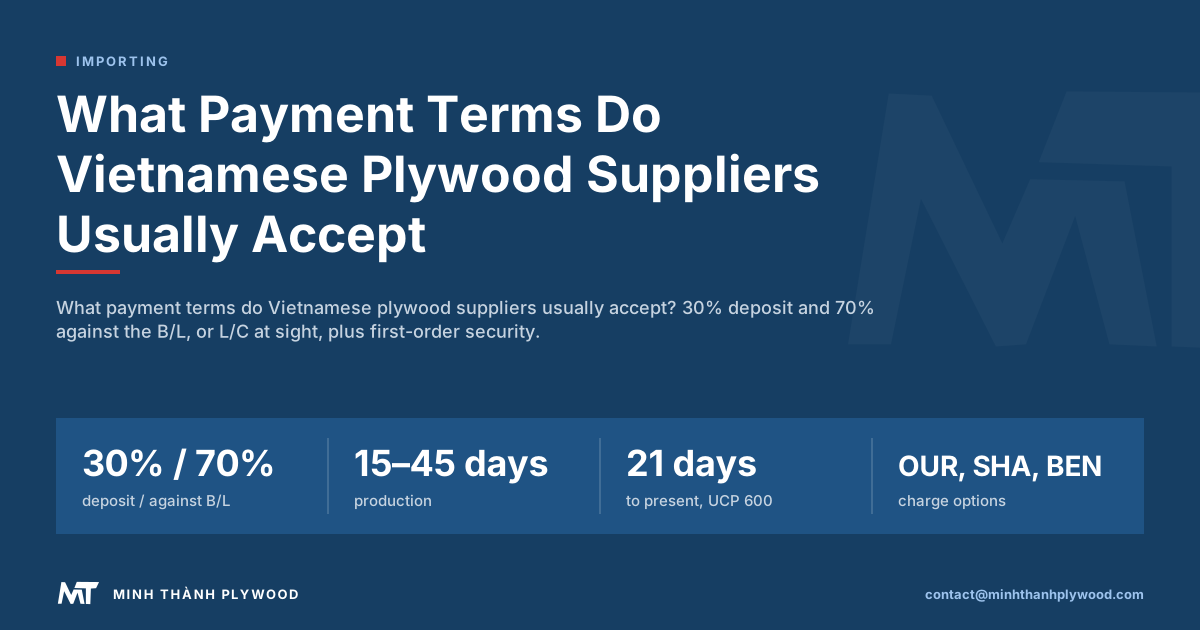
What payment terms do Vietnamese plywood suppliers usually accept?
Vietnamese plywood suppliers usually accept two payment terms: a 30% T/T deposit with the 70% balance against a scanned copy of the bill of lading, and an irrevocable letter of credit (L/C) at sight. Minh Thanh Plywood works on exactly these two.
| Term | When the buyer pays | What protects the buyer | What protects the seller |
|---|---|---|---|
| 30% T/T deposit, 70% against scanned B/L | Deposit at order, balance after shipment | The larger payment comes after loading | Deposit covers materials; original B/L held until paid |
| Irrevocable L/C at sight | Bank pays when documents comply | Bank checks the documents before paying | Buyer’s bank commits to pay |
Both terms link the main payment to the shipment. The buyer sees the goods loaded before paying most of the price, and the seller sees a deposit or a bank undertaking before buying veneer and glue.
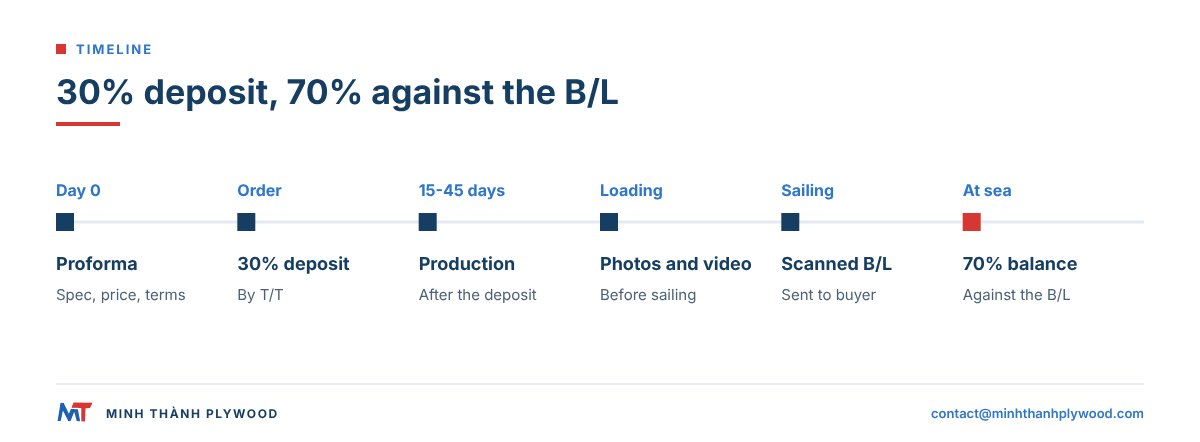
How does a 30% deposit and 70% against the B/L work?
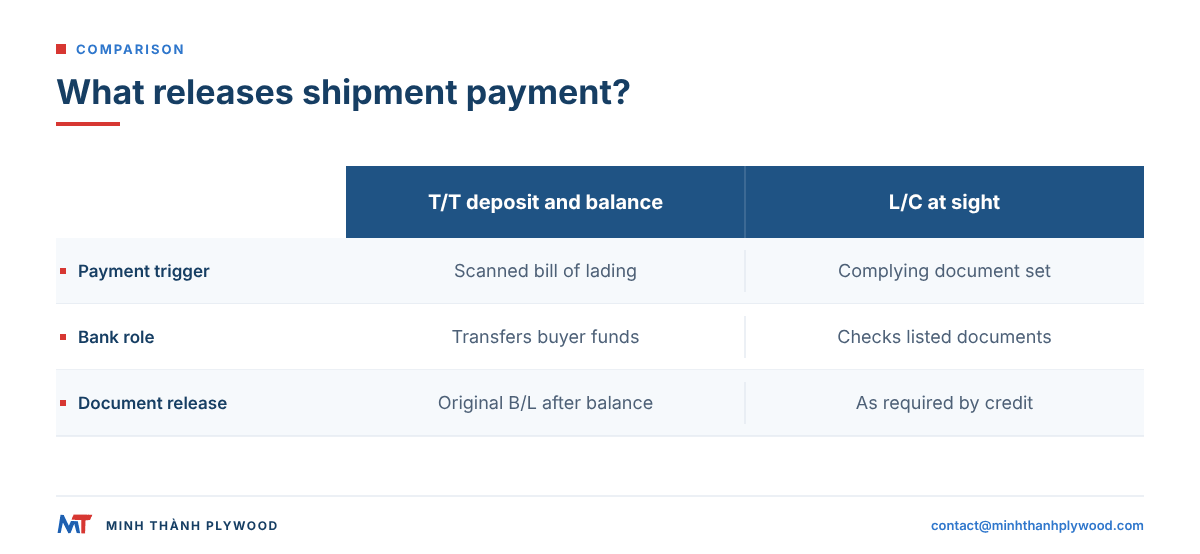
The 30% deposit starts production, and the 70% balance is paid when the supplier sends the scanned bill of lading after loading. The original B/L is released once the balance arrives.
- Proforma invoice signed: specification, quantity, price, Incoterm, payment terms and shipment window.
- 30% deposit by T/T: the mill books the order into production.
- Production: 15–45 days after the deposit at Minh Thanh, depending on quantity and specification.
- Pre-loading photos and video: the buyer sees the packed order before the container leaves.
- Loading and sailing: the shipping line issues the B/L.
- Scanned B/L sent: with the draft commercial invoice, packing list and certificate of origin.
- 70% balance by T/T: paid against the scanned B/L.
- Original B/L or telex release: the documents go to the buyer, who collects the goods at the port of discharge.
The sea voyage gives the buyer time to pay. From Hai Phong, typical days at sea are 25–35 to the Mediterranean and 30–40 to Northern Europe, so the balance and the documents arrive well before the container does.
Which payment instruments do plywood importers meet?
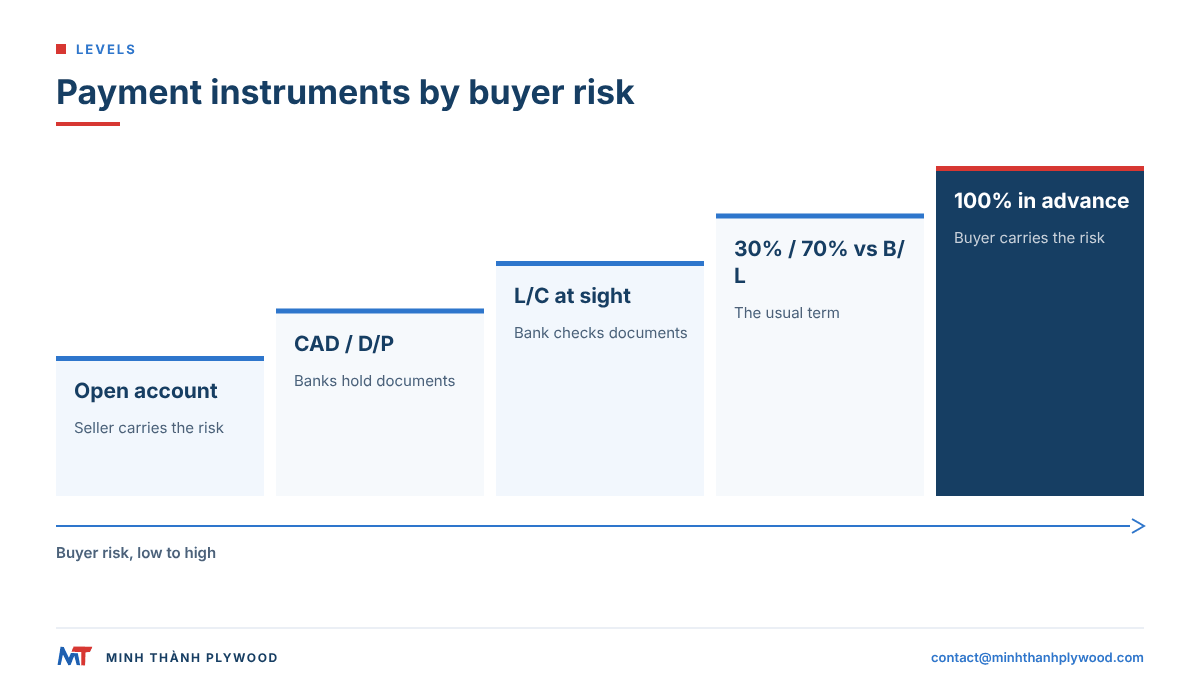
Plywood importers meet seven payment instruments, from full advance payment to open account. The table ranks them by who carries the risk.
| Instrument | How it works | Risk to buyer | Risk to seller | Use for plywood |
|---|---|---|---|---|
| 100% T/T in advance | Buyer pays all before production | High | None | Avoid for a first order |
| T/T deposit + balance against B/L copy | 30% at order, 70% after loading | Medium on the deposit | Low | The usual term |
| L/C at sight | Bank pays on complying documents | Low | Low | First or large orders |
| Usance L/C | Bank pays at a later date | Low | Medium | When the buyer needs credit |
| Cash against documents (CAD) | Bank releases documents on payment | Low | Medium | Repeat buyers |
| Documents against payment (D/P) | Collection through banks, paid at sight | Low | Medium | Repeat buyers |
| Open account | Buyer pays after receiving goods | None | High | Long relationships only |
The two middle rows are where nearly all first container orders from Vietnam sit. Terms further down the table move risk to the mill and are usually earned through several completed orders.
What are the typical payment terms for first-time buyers?
The typical payment terms for first-time buyers are a 30% T/T deposit and the 70% balance against the scanned B/L. A buyer who wants a bank in the middle opens an irrevocable L/C at sight instead.
A first order carries risk for both sides. The buyer does not yet know the mill’s quality, and the mill does not yet know the buyer’s payment record. The deposit-and-balance term splits that risk: the deposit is limited to what the mill spends on materials, and the balance waits until the goods are on board.
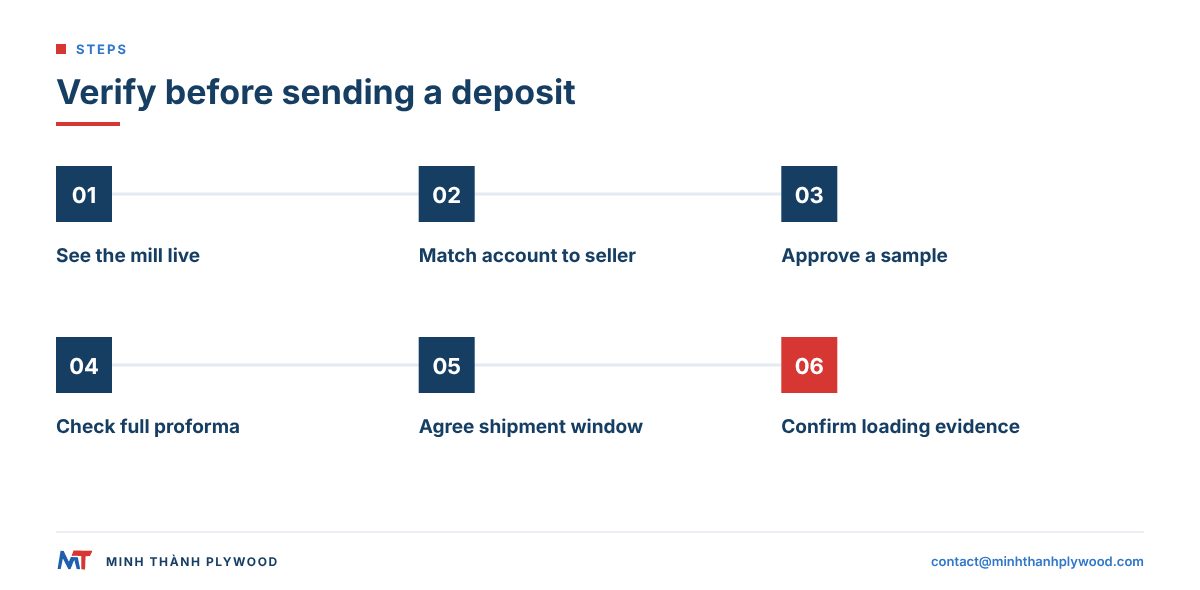
Protect the deposit with these checks before you send it:
- The seller is a manufacturer with its own press line, shown live on video.
- The bank account is in the seller’s registered name, in the same country as the factory.
- A sample has been approved in writing, and its reference is on the proforma invoice.
- The proforma invoice repeats the full specification, tolerances, packing and documents.
- The shipment window and the pre-loading photos are written into the order.
Our guide to plywood samples explains how the approved sample becomes the order standard.
When is a letter of credit at sight worth it?
A letter of credit at sight is worth it when the order is large, when it is the first order with a mill, or when your bank finances the purchase. The bank pays the seller only against documents that match the credit exactly.
Letters of credit follow the ICC’s Uniform Customs and Practice for Documentary Credits, UCP 600. Under UCP 600 the documents must be presented within 21 days after the shipment date unless the credit says otherwise, and the bank checks them on their face, not the goods.
What an L/C costs and asks of the buyer:
- Bank fees: issuing, amendment and, if requested, confirmation fees at the buyer’s bank, plus advising and negotiation fees at the seller’s bank.
- Collateral or a credit line: the issuing bank usually blocks funds or uses part of the buyer’s facility.
- Exact wording: product description, quantity, ports, latest shipment date and the document list must match the proforma invoice.
What those fees come to, using the ranges a trade-finance guide published in 2026 (banks set their own tariffs, so ask yours):
| L/C charge | Typical range | Usually paid by |
|---|---|---|
| Issuance, at the buyer’s bank | 0.10% to 0.30% of the credit per quarter of tenor | Buyer |
| Negotiation or acceptance, at the seller’s bank | 0.10% to 0.25%, charged once | Seller |
| Amendment | US$50 to US$200 flat per change | Whoever asks for it |
| Discrepancy on a document set | US$60 to US$125 per set | Seller |
| All-in cost | 1.0% to 3.5% of the credit per year, by tenor | Split |
Because the fees are partly flat, an L/C weighs more on a small order. One long-running Chinese plywood supplier guide says sellers prefer to avoid an L/C below US$20,000 and favour it above US$40,000 (plywood.cc). A single 40HC of furniture plywood at the October 2026 starting price of US$350/m³ is about US$18,570 (about 53 m³, 990 sheets on a Styrax core at 18 mm).
That is why a first container is normally paid as a 30% deposit and 70% against the scanned B/L, and an L/C at sight is the choice for a larger or repeat programme or when your bank finances the purchase. Minh Thanh accepts an irrevocable L/C at sight as the alternative on any order.
The main L/C risk for a buyer is a discrepancy that delays payment and the release of documents. Send the draft L/C to the mill before issuing it, so both sides agree every line.
Which documents release payment for a plywood shipment?
Under T/T terms the scanned bill of lading releases the balance; under an L/C, the full document set listed in the credit releases payment. The standard export set from a Vietnamese mill is the same in both cases.
| Document | Issued by | Role in payment |
|---|---|---|
| Commercial invoice | Seller | States the amount due |
| Packing list | Seller | Sheets, packs, m³ and weights |
| Bill of lading | Shipping line | Proof of shipment; the original carries title to the goods |
| Certificate of origin (EUR.1 for the EU) | Vietnamese authority | Origin for customs duty |
| Phytosanitary and fumigation certificates | Vietnamese authorities | Plant-health status where required |
| Insurance certificate | Insurer, on CIF orders | Cover during the voyage |
| Compliance files (CARB P2 / TSCA, test reports, EUDR, PPWR) | Mill | Supplied on order; not usually payment documents |
The compliance files answer your market’s rules, such as the US TSCA Title VI formaldehyde standard in 40 CFR 770.10 and, for EU orders, Regulation (EU) 2023/1115 on deforestation-free products; they travel with the order but do not release payment. Plywood itself is processed wood and is not subject to ISPM 15, the international standard for wood packaging, so a phytosanitary certificate is only needed where the destination asks for one.
Ask for the draft documents before the vessel sails. A spelling difference between the L/C and the invoice, or between the invoice and the B/L, is the most common reason a bank refuses documents.
How do FOB, CFR and CIF change the payment?
The Incoterm changes what the price covers, not when you pay. Under FOB, CFR and CIF the risk passes to the buyer when the goods are loaded on board at the Vietnamese port, which is why the balance is tied to the B/L issued at loading.
| Incoterm | Price includes | Buyer arranges | Extra payment document |
|---|---|---|---|
| FOB Hai Phong | Goods loaded on board | Freight, insurance | None |
| CFR | Goods plus sea freight | Insurance | Freight shown on the B/L |
| CIF | Goods, freight and insurance | Destination costs | Insurance certificate |
The rules are set out in the ICC’s Incoterms 2020. Under FOB the buyer’s forwarder books the vessel, so the B/L date depends on that booking; agree the shipment window with both the mill and the forwarder. Minh Thanh quotes FOB Hai Phong, CFR or CIF.
Which currency should you pay in, and how long is a price valid?
Vietnamese plywood is usually quoted and paid in US dollars. A quote in euros is possible as a separate agreement, but compare quotes in one currency on the same date.
The validity of a plywood price is written on the quotation. Veneer, glue, energy and freight costs move, so mills keep validity short and fix the price on the proforma invoice. Once the deposit is paid, the proforma price applies to that order.
Three habits keep currency and validity from costing money:
- Convert at the date of the quote, not the date of payment, when comparing suppliers.
- Pay the deposit within the quote’s validity, so the price does not need to be requoted.
- Hedge with your bank if the balance is large and your own sales are in another currency.
Who pays the bank charges on a T/T?
The SWIFT charge code on the transfer decides who pays the bank charges. Plywood proformas usually ask for the full invoice amount to arrive, so the buyer sends with OUR or adds the charges.
| Code | Buyer pays | Seller pays | Result |
|---|---|---|---|
| OUR | All charges, including intermediary banks | Nothing | Full amount arrives |
| SHA | Own bank’s charges | Receiving and intermediary charges | Amount arrives short |
| BEN | Nothing | All charges | Amount arrives shorter |
A balance that arrives short by the intermediary bank’s fee delays the release of the original B/L until the difference is settled. Check the code with your bank before sending the deposit.
Can trade credit insurance protect a deposit?
Trade credit insurance does not usually protect a buyer’s deposit. It protects a seller against a buyer who fails to pay for goods already delivered.
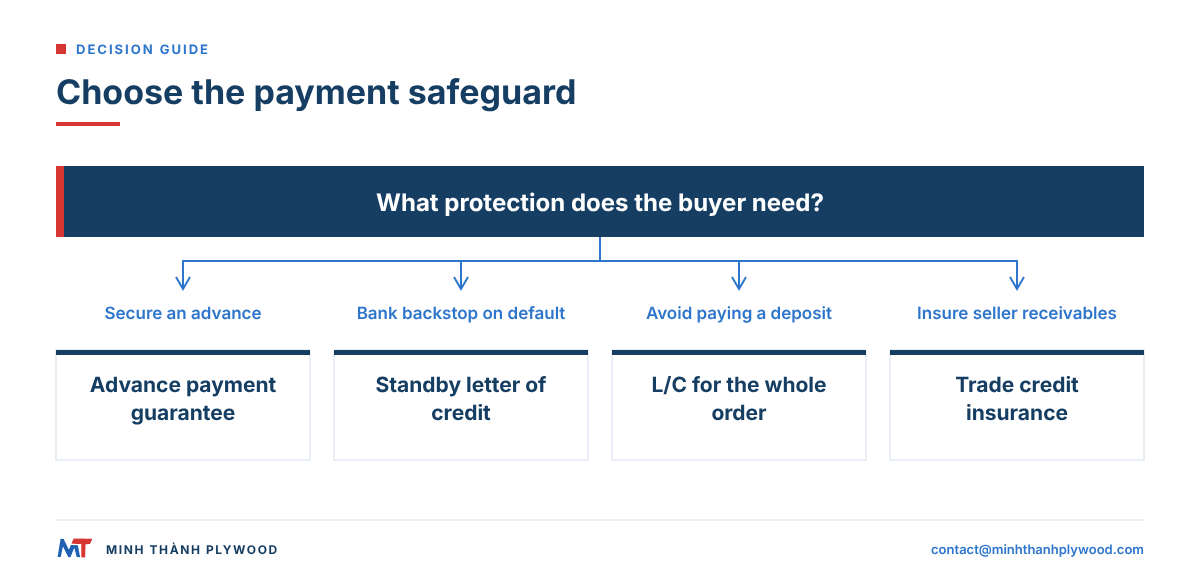
A buyer who wants security on an advance payment has three tools:
- Advance payment guarantee: a guarantee issued by the seller’s bank that repays the deposit if the goods are not shipped.
- Standby letter of credit: a bank undertaking in the buyer’s favour, drawn only if the seller fails to perform.
- Letter of credit for the whole order: no deposit at all, with payment only against shipping documents.
Each tool costs fees and needs the bank’s approval on both sides. For a single container, most buyers find verification and an approved sample cheaper and quicker than a guarantee.
How do you avoid payment fraud when buying plywood?
Avoid payment fraud by paying only to the bank account on the signed proforma invoice, in the seller’s own name, and by confirming any change by phone. Changed bank details sent by email are the most common fraud in international trade.
- Check the account name against the seller’s registered company name.
- Check the country of the bank against the country of the factory.
- Call back on a phone number you already have, never one in the email that announces the change.
- Treat urgency as a warning: “pay today or lose the slot” is a pressure tactic.
- Send a small test amount on the first payment to a new account if your bank allows it.
A real mill names its company, shows its factory live and keeps one bank account for its exports. Our guide to comparing plywood quotations adds the seller checks to the price comparison.
What red flags should you watch for in payment terms?
The red flags are terms that move all the risk to the buyer, or details that do not match the seller. Stop and ask when you see any of these:
- 100% payment in advance on a first order.
- A deposit far above 30% without a clear reason, such as a special face veneer bought only for you.
- A bank account in a third country or in a personal name.
- No proforma invoice, or a proforma without the specification.
- Refusal of an L/C when you offer one for a large first order.
- No photos or video before the balance is due.
None of these proves fraud alone. Each one is a question the seller should answer in writing before money moves.
How do payment terms change after the first order?
Payment terms usually get easier for the buyer as the relationship grows. After several orders paid on time, mills consider cash against documents, D/P collections or a longer period for the balance.
What earns better terms:
- A clean payment record: deposits and balances paid on the agreed days.
- Regular volume: repeat containers on a known schedule.
- Stable specifications: fewer changes mean lower risk of a dispute.
Agree any change on the proforma invoice of the next order. Terms discussed by phone and not written down cause most disputes over payment timing.
What does this mean for an order with Minh Thanh Plywood?
Minh Thanh Plywood works on a 30% deposit and the 70% balance against the scanned B/L, by T/T, or on an irrevocable L/C at sight. These terms apply to every order, including the first.
| Term | Minh Thanh Plywood |
|---|---|
| Deposit | 30% by T/T, at order |
| Balance | 70% against the scanned B/L |
| Alternative | Irrevocable L/C at sight |
| Production | 15–45 days after the deposit |
| Incoterms | FOB Hai Phong, CFR or CIF |
| Minimum order | 1×40HC, mixed specifications by agreement |
| Before loading | Photos and video of every shipment |
| Documents | Commercial invoice, packing list, B/L, certificate of origin (EUR.1 for the EU), phytosanitary and fumigation certificates, insurance with CIF |
We make top-grade furniture and interior plywood in Ha Hoa, Phu Tho, with Europe as our main market, and a capacity of 50,000+ m³ per year. Free samples. See our trade terms for the order steps and our furniture plywood for the panels behind them.
What should you send to agree payment terms?
Send the specification and your preferred payment term in the same message, so the proforma invoice comes back complete. A short request looks like this:
Product: 18 mm birch-faced plywood, Styrax core, UF glue at E0 emission, D/D, sanded · Quantity: 1×40HC · Incoterm: CIF your port · Payment: 30% T/T deposit, 70% against scanned B/L (or irrevocable L/C at sight) · Documents: certificate of origin, CARB P2 / TSCA certificate, EUDR dossier
Email it to contact@minhthanhplywood.com, or message Lisa on WhatsApp at +84 988 586 601. We reply within hours, Monday to Friday, 08:00–17:00 Vietnam time (UTC+7).
Buyer questions, answered
What payment terms do Vietnamese plywood suppliers usually accept?
Most accept a 30% T/T deposit with the 70% balance against a scanned copy of the bill of lading, or an irrevocable letter of credit at sight. Some accept cash against documents for repeat buyers; open account is rare on a first order.
What are the typical payment terms for first-time buyers?
A first-time buyer usually pays a 30% deposit by T/T after signing the proforma invoice, and the 70% balance when the supplier sends the scanned B/L. Buyers who want bank control of the documents open an irrevocable L/C at sight instead.
Is a 30% deposit safe when buying plywood from Vietnam?
It is the normal term, and it is safe when the seller is verified: a registered manufacturer, a bank account in the same name, a factory you have seen on video and an approved sample. The remaining 70% is only paid once the goods are on board.
When should I use a letter of credit for plywood?
Use an L/C at sight when the order is large, when it is your first order with the mill, or when your bank finances the purchase. It costs more in bank fees than T/T and needs documents prepared exactly to its terms.
Which documents release the balance payment?
Under T/T terms, the scanned bill of lading releases the 70% balance. Under an L/C, the bank pays against the full set it lists, usually the commercial invoice, packing list, B/L, certificate of origin and, for CIF, the insurance certificate.
Can I pay for plywood in euros?
Vietnamese plywood is usually quoted and paid in US dollars. A quote in euros is a separate agreement on the proforma invoice; compare both quotes in one currency on the same date.
How long is a plywood price valid?
A plywood quotation carries its own validity date, because veneer, glue and freight costs move. Confirm the price on the proforma invoice before you pay the deposit; once the deposit is paid, the price on the proforma applies to that order.
Can trade credit insurance cover my deposit to a Vietnamese supplier?
Usually not. Trade credit insurance protects a seller against a buyer who does not pay. To secure a deposit, buyers use an advance payment guarantee or a standby letter of credit from the seller's bank, or pay by letter of credit.
Who pays the bank charges on a T/T payment?
The SWIFT charge code decides it. With OUR the buyer pays all charges; with SHA each side pays its own bank; with BEN the seller pays. Plywood proformas usually ask for the full amount to arrive, so send with OUR or add the charges.
What is the biggest payment risk when importing plywood?
A changed bank account. Fraudsters send emails that look like the supplier's and give new bank details. Pay only to the account on the signed proforma invoice, in the seller's own name, and confirm any change by phone on a number you already have.