
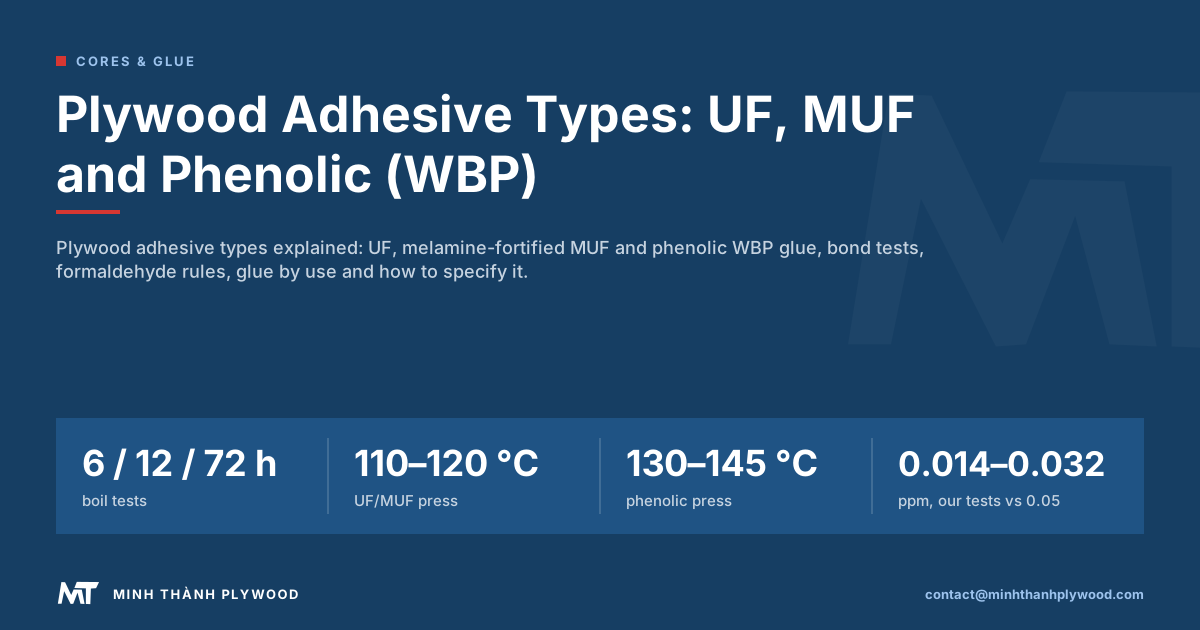
Plywood adhesive is the thermosetting resin pressed between the veneers, and it decides how the panel handles water and how much formaldehyde it gives off. Three resins cover almost all plywood: urea formaldehyde (UF) for interior panels, melamine-fortified UF (MUF) for humid use and phenolic (PF) for exterior and formwork. Minh Thanh Plywood explains each, and how to write the glue on an order.
What is plywood adhesive?
Plywood adhesive is the resin that bonds the veneer layers of a panel into one board under heat and pressure. Once cured in the hot press it cannot be melted again, which is why plywood glues are called thermosetting resins.
The glue does two jobs that buyers specify separately:
- Bond: how well the glue line holds when the panel gets wet, humid or boiled. This decides whether a panel is for indoor furniture, a bathroom cabinet, an exterior stair tread or concrete formwork.
- Emission: how much formaldehyde the finished panel releases into a room. This decides which markets accept it and which certificate it needs.
Three formaldehyde-based resins cover almost all plywood made in Asia and Europe: urea formaldehyde (UF), melamine-fortified urea formaldehyde (MUF) and phenol formaldehyde (PF, phenolic). Newer formaldehyde-free systems exist but are still a small share of export plywood.
What wood glue for plywood should I use to join panels?
To stick plywood to something, the glue is chosen by the joint, not by the resin inside the panel. Pick by the damp class on the tin: wood glues are rated D1 to D4 in EN 204, where D1 is dry interior use, D2 interior with occasional damp, D3 protected exterior and D4 exposed exterior (Würth range read October 2026).
| Job | Glue for plywood | Class or product | Surface and clamping |
|---|---|---|---|
| Indoor furniture joints, edging, dowels | PVA wood glue | D2 for dry rooms; D3 for kitchens and utility rooms | Clamp 30 minutes to 1 hour, as standard PVA is usually clamped; leave a day before loading |
| Damp areas, bathrooms, panel to frame | D4 PVA with hardener, or polyurethane glue | D4 for exposed or frequently wet joints | Polyurethane foams and fills small gaps; clamp until set |
| Subfloors, panel to joist | Construction adhesive plus screws | Gun-applied bead | Glue stops squeaks, screws hold |
| Wet or marine repairs, bamboo or glazed faces | Two-part epoxy | Waterproof when cured | Sand the faces with 80 grit for tooth; clamp from several hours up to 24 hours by product |
| Veneer and laminate onto plywood | Contact adhesive, or PVA in a press | Contact adhesive grips on contact | Sand and dust the face first |
Tiling onto plywood
Tiles on plywood need a stiff, exterior-bonded floor and a flexible adhesive. Tile Mountain’s guide (read October 2026) gives the working numbers:
- Panel: WBP flooring-grade plywood, commonly 15 to 18 mm thick depending on joist spacing and tile weight. Specify the flooring-grade panel accepted by the flooring-system manufacturer.
- Fixing: screws at roughly 300 mm centres in a staggered brick-bond pattern, with a 2 to 3 mm gap around the room’s perimeter.
- Primer: an SBR sealer on the back and edges and a bonding primer on the face.
- Adhesive and grout: a flexible S1-rated adhesive and flexible grout.
- Where not to use it: plywood alone is not a tiling background on walls (BS 5385) or in showers and wet rooms; use a tile backer board with a tanking system there.
To remove dried tile adhesive from plywood, soften it and scrape, then sand back to clean wood before refinishing.
Plywood glue types at a glance
The table puts the three main plywood glue types side by side, with what each means for your order.
| UF (urea formaldehyde) | MUF (melamine-fortified UF), often sold as MR | PF (phenol formaldehyde, phenolic) | |
|---|---|---|---|
| Glue line colour | Light, almost invisible | Light | Dark brown to black |
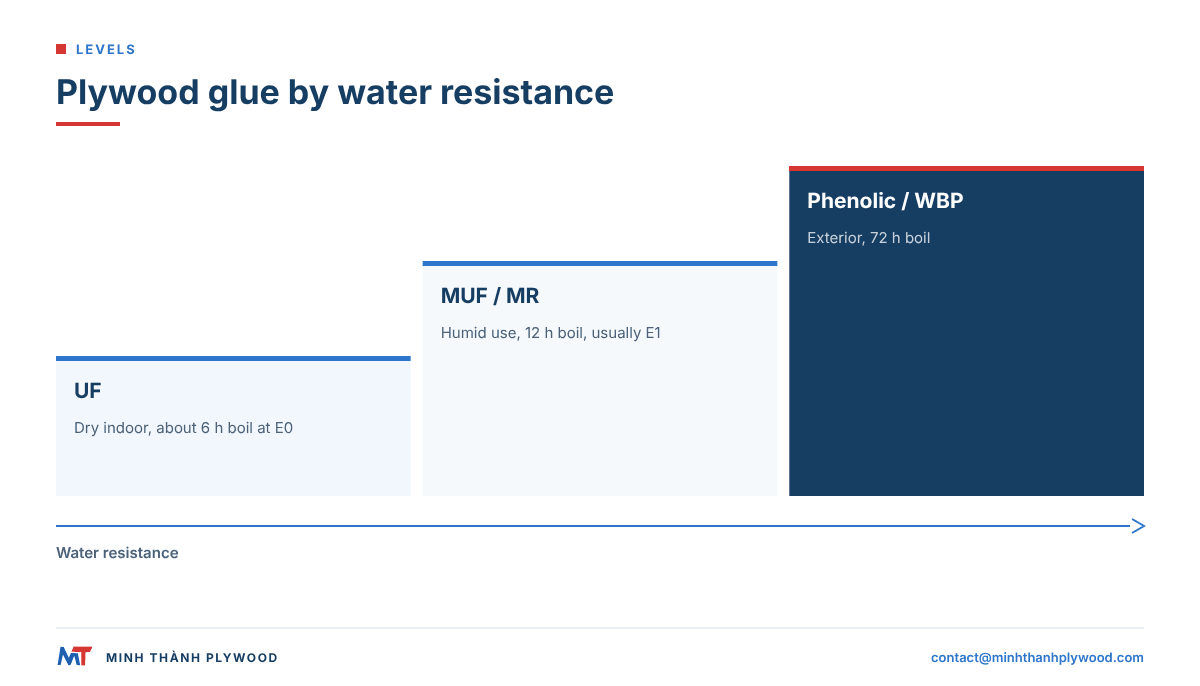
| Water resistance | Dry indoor use | Humid indoor use and short wetting | Exterior and repeated wetting |
| Boil test buyers ask for | About 6 hours at E0 | 12 hours | 72 hours (WBP) |
| Typical uses | Furniture, cabinets, interior panels, packing | Kitchen and bathroom furniture, exterior/CDX-type panels, film-faced formwork | Exterior panels, premium film-faced formwork |
| Hot-press temperature | About 110–120 °C | About 110–120 °C | 130–145 °C |
| Emission | E0 to E2, by formulation | Usually E1 when fortified for a 12-hour boil | Low; phenolic binds formaldehyde tightly |
| Relative cost | Lowest | Middle | Highest |
The boil hours are the shorthand buyers use on orders; the formal bond classes come from the standards described further down. Our WBP plywood guide covers the exterior end of the table in detail.
Urea formaldehyde glue: the interior standard
Urea formaldehyde glue is the standard plywood adhesive for indoor furniture and interior panels. It is light in colour, cures fast and cheaply, and gives a strong dry bond, but the glue line softens with long exposure to water.
What UF glue means for a buyer:
- Use it indoors. Furniture carcasses, wardrobes, shelving, wall panels, drawer parts and doors are its home.
- Specify the emission class with it. UF can be formulated for E0, E1 or E2 emission. For furniture sold in Europe and the United States, the normal build is UF glue at E0 emission, also called UF resin at E0 grade.
- Expect a short boil resistance. UF glue at E0 emission withstands about a 6-hour boil on a test sample, enough for indoor use and not meant for weather.
- Watch the press. UF is pressed at about 110–120 °C; veneer that is too wet or a press cycle that is too short leaves weak glue lines.
At Minh Thanh Plywood, UF glue at E0 emission is the standard for every furniture and interior panel, from birch-faced and EV plywood to thin 3–6 mm panels.
Melamine-fortified UF (MUF) and what “MR” means
Melamine-fortified UF (MUF) is UF glue with melamine added, which tightens the cured resin and makes the glue line far more resistant to water. It is the glue behind most panels sold as MR (moisture-resistant) plywood.
- What it adds: to pass a 12-hour boil, a UF glue has to be fortified with melamine. MUF panels hold up in kitchens, bathrooms, humid stores and on short exposure to rain during building.
- What it costs in emission: a glue fortified enough for a 12-hour boil usually lands at E1 emission rather than E0. If you need both a long boil and E0, say so on the order, because the two pull in opposite directions.
- What “MR” means: MR is a market name, not a resin. In export quotes it almost always means MUF. Some sellers use it for plain UF panels that survive a splash, so ask which resin and which boil test the MR panel passes.
MUF is also the usual glue for exterior/CDX-type panels with utility faces and for mid-range film-faced formwork. Our guide to melamine vs phenolic glue compares the two for exterior use.
Phenolic glue (PF) and what WBP means
Phenolic glue (phenol formaldehyde, PF) is the strongest common plywood adhesive under water and weather. The cured resin is dark brown, insoluble in water and stable through repeated wetting and drying, so it shows as dark lines in the panel edge.
- Pressing: phenolic needs a hotter, longer press, about 130–145 °C, and drier veneer. Not every mill runs it well.
- Boil resistance: buyers usually ask phenolic panels to pass a 72-hour boil, the traditional WBP test under IS 710 and the old British WBP rule.
- Uses: exterior panels, premium film-faced formwork, stair treads, sheathing and any panel that stays wet for long periods.
What WBP means: WBP stands for weather and boil proof. It names a bond performance, proved by a boil test, not one resin. Phenolic glue is the usual way to reach it, and some mills sell melamine-fortified panels as “WBP melamine”. A 72-hour boil on its own does not prove marine grade or the EN 314-2 Class 3 bond; those need their own tests, so write the method on the order, not only the word WBP.
Other plywood adhesives: soy, pMDI and formaldehyde-free systems
A few plywood adhesives carry no added formaldehyde. They are real options, but they are a small share of export plywood today and usually cost more.
- Soy-based adhesives use modified soy protein as the binder, sometimes with a synthetic cross-linker. They are used for interior panels sold as “no added formaldehyde”.
- pMDI (polymeric diphenylmethane diisocyanate) bonds without formaldehyde and resists water well. It is common in OSB and some engineered panels, less so in decorative plywood.
- Low-emission UF and MUF with formaldehyde scavengers are what most mills use to reach E0, and they are the practical choice for most furniture buyers.
If your market or your customer asks for “no added formaldehyde”, state it on the order as a resin requirement and ask for the test method that proves it. For most European and US furniture programmes, UF glue at E0 emission with CARB P2 / TSCA Title VI certification meets the emission requirement; it is not a no-added-formaldehyde resin.
Bond and emission: two lines on the specification
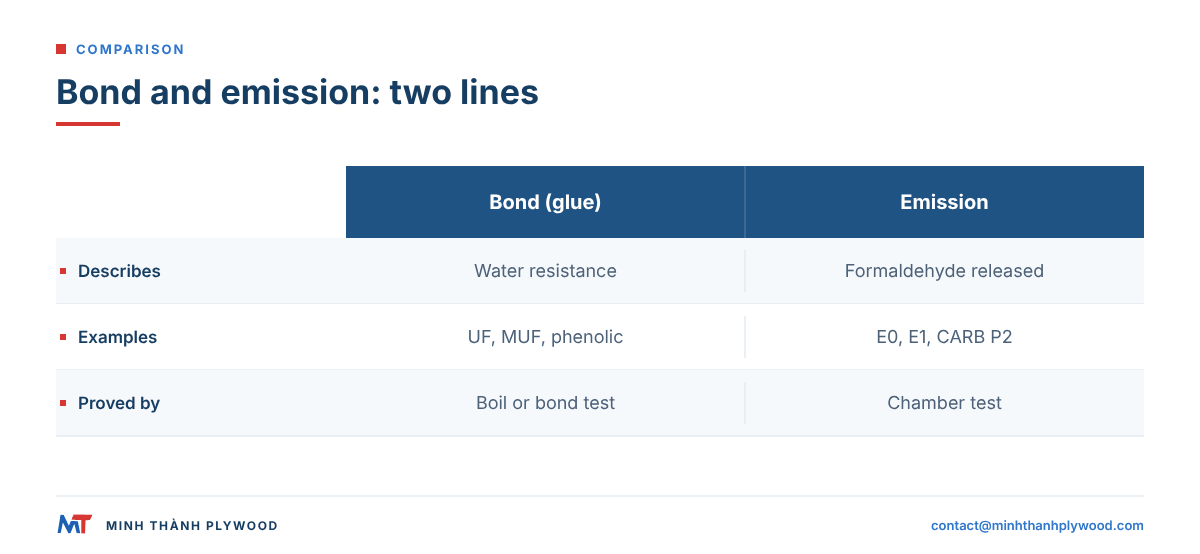
Glue type and emission class are two separate specifications, and an order should carry them on two separate lines. Mixing them up is the commonest glue error in plywood enquiries.
| Line | What it describes | Examples |
|---|---|---|
| Glue (bond) | The resin and how it resists water | UF, MUF/MR, phenolic/WBP; 6-hour, 12-hour or 72-hour boil |
| Emission | How much formaldehyde the panel releases | E0, E1, E2; CARB P2 / TSCA Title VI |
Two consequences follow:
- “E0 glue” is not a specification. Write “UF glue at E0 emission” or “UF resin at E0 grade”. E1 is an emission class, not a glue type.
- E0 has no single global threshold. Different markets define E0 and E1 by different test methods. When a number is written next to E0, it must name its method, for example the ASTM D6007 chamber test behind CARB P2 and TSCA Title VI.
A boil test proves the bond on a sample; it says nothing about emission. A chamber test proves emission; it says nothing about water resistance. Ask for both reports when you need both properties.
Formaldehyde glue in plywood: what the rules limit
Formaldehyde glue in plywood is regulated by emission limits on the finished panel, not by banning the resin. The two rules most export buyers meet are the US TSCA Title VI standard and the EU REACH restriction.
- United States: TSCA Title VI sets 0.05 ppm for hardwood plywood with a veneer core under EPA’s TSCA Title VI guidance. Testing uses ASTM E1333 or an equivalent method such as ASTM D6007. Panels must be labelled TSCA Title VI compliant.
- European Union: Regulation (EU) 2023/1464 (REACH Annex XVII, entry 77, read October 2026) says that after 6 August 2026 furniture and wood-based articles shall not be placed on the market if they release more than 0.062 mg/m³ of formaldehyde under the test conditions of its Appendix 14. Articles exclusively for outdoor use under foreseeable conditions are among the exceptions.
These limits are measured by different methods, in ppm and in mg/m³, and one is not converted into the other. A mill shows compliance with test reports by the method each market uses.
Our results: six ASTM D6007 chamber tests between April 2025 and June 2026 on 9, 15 and 18 mm panels averaged 0.014–0.032 ppm against the 0.05 ppm CARB Phase 2 / TSCA Title VI limit, three by Shanghai Hongjun and three by ICTT Vietnam. Our panels hold CARB P2 / TSCA Title VI certification (ICTT mill no. 23024), and third-party testing to EN 717-1 or another method is arranged through SGS on request. See our E0 and E1 emission page for the full reports.
How is plywood bond quality tested?
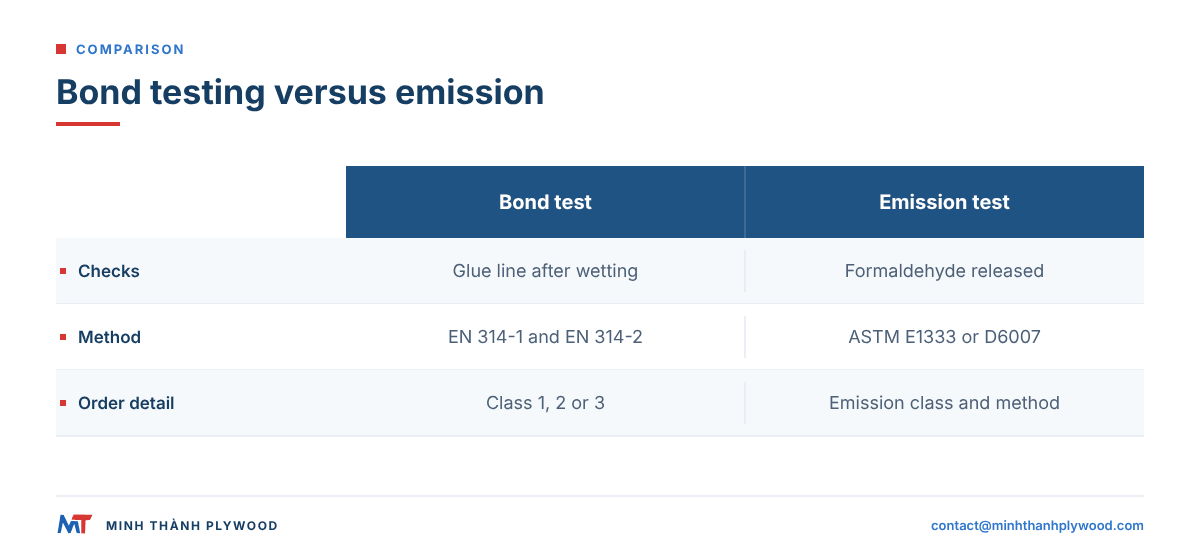
Plywood bond quality is tested by soaking or boiling small samples, then shearing them apart and measuring the strength and the wood left on the glue line. Each market names its classes differently.
| System | Classes | What they mean in short |
|---|---|---|
| EN 314-1 and EN 314-2 (Europe) | Bond class 1, 2, 3 | 1 for dry interior use, 2 for humid conditions, 3 for exterior exposure |
| EN 636 (Europe) | EN 636-1, -2, -3 | Plywood for dry, humid and exterior service conditions |
| HPVA HP-1 (US hardwood plywood) | Type I, Type II | Exterior and interior water resistance of decorative hardwood plywood |
| Buyer shorthand (Asia) | 6-hour, 12-hour, 72-hour boil | Boil resistance of a sample, used on many orders |
EN 636 is the plywood specification listed by BSI, covering plywood for dry, humid or exterior conditions. Bond class 3 or EN 636-3 is the exterior level, usually reached with phenolic glue. Bond class 2 is the humid level that MUF panels are made for. Interior furniture plywood with UF glue sits at the dry-use level. Name the class and the test on your order; the boil hours alone are a useful check but not a certificate.
Which plywood glue for which use?
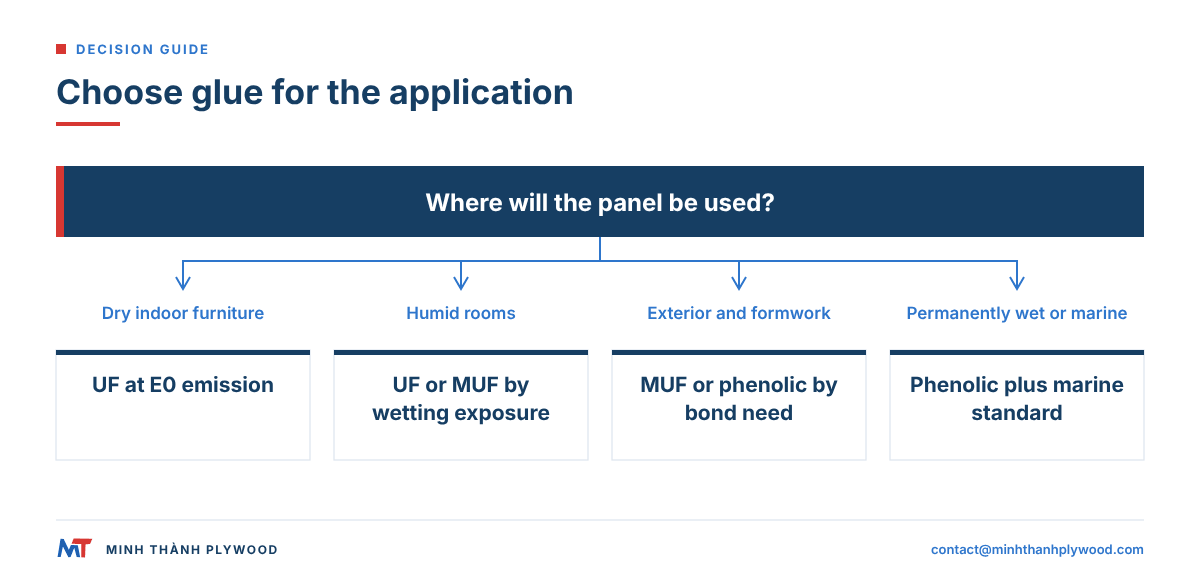
Choose the glue by the wettest condition the panel will meet in its life, then choose the emission class by the market. The table is a starting point for common uses.
| Use | Glue | Emission | Note |
|---|---|---|---|
| Furniture, wardrobes, shelving | UF | E0, CARB P2 / TSCA Title VI | The standard interior build |
| Kitchen cabinets, vanity units | UF at E0, or MUF where splashing is heavy | E0 or E1 | Seal cut edges and holes |
| Lacquered or UV-coated panels | UF | E0 | Core flatness matters more than the glue |
| Exterior stair treads, sheathing, roofing | MUF or phenolic | As required | Exterior/CDX-type panels with utility faces |
| Concrete formwork (film-faced) | MUF or phenolic | Not usually specified | Phenolic for the most reuses |
| Packing, crates, pallets | UF | To the order | Short life, dry use |
| Boats and permanently wet use | Phenolic, to the marine standard | — | A marine panel needs its own standard, not only WBP glue |
For permanently wet or marine uses, read our marine plywood buying guide before you order: the glue is only one part of a marine panel.
What kind of glue is used in formwork plywood?
Formwork plywood uses melamine-fortified UF or phenolic glue, because the panel is wetted, loaded and stripped again and again. The glue and the film together set the number of reuses.
- Melamine-bonded film-faced panels give about 12–15 reuses with proper handling, release agent and edge sealing.
- Phenolic-bonded film-faced panels give up to about 25 reuses under the same conditions.
The number of reuses is a target for a given build and site practice, not a fixed property of the sheet. Edges left unsealed after cutting, panels stored wet and skipped release agent shorten it more than the glue does. Plain UF glue is not used for formwork, and a recycled finger-joint core shortens the life whatever glue is used; our finger joint plywood guide explains why. Prices for film-faced panels are in our film-faced plywood price guide.
What glue is used in Vietnamese plywood: MR, MUF or WBP?
Plywood glue types in Vietnam follow the product line of each mill. Furniture mills press with UF glue at E0 or E1 emission; commercial and packing mills use UF at E1 or E2; film-faced and exterior panels use melamine-fortified or phenolic glue.
- Furniture and interior mills serving Europe, the United States, Japan, Korea and Australia make UF glue at E0 emission the default, with CARB P2 / TSCA Title VI certification for the US market.
- Commercial and packing mills serving price-led markets mostly use UF at E1 or E2 and rarely hold emission certificates.
- Film-faced mills use melamine-fortified glue for mid-range panels and phenolic for premium panels.
- Glue is mixed at the mill. Mills buy resin and blend the glue mix with fillers and hardener for each line; the recipe is part of the mill’s know-how, which is why the same name can hide different glue.
Because the same words cover different glue, the test reports matter more than the name on the quote. A report that names “UF resin at E0 grade” and a chamber result by method tells you more than “E0 glue”.
Which glue does each Minh Thanh product use?
Each Minh Thanh product line has its standard glue, and the MR and phenolic bonds are made to the customer’s specification. The table shows the standard build.
| Product | Standard glue | Emission | On request |
|---|---|---|---|
| Furniture and interior plywood (birch, poplar, EV, okoume, pine, eucalyptus faces) | UF glue at E0 emission | CARB P2 / TSCA Title VI | MR (melamine-fortified) or phenolic bond |
| Thin plywood 3–6 mm | UF glue at E0 emission | CARB P2 / TSCA Title VI | MR (melamine-fortified) or phenolic bond |
| Cut-to-size panels | As the parent panel | As the parent panel | — |
| Commercial and packing plywood | UF glue | To the order | E0 on request |
| Exterior / CDX-type plywood | Melamine-fortified or phenolic (WBP) | To the order | — |
| Film-faced plywood | Melamine-fortified or phenolic | To the order | — |
For US orders, the panels carry the TSCA Title VI label and the test reports identify UF resin at E0 grade. E0 emission is tested periodically, every 3 months. Third-party testing to your own method is arranged through SGS when you need it.
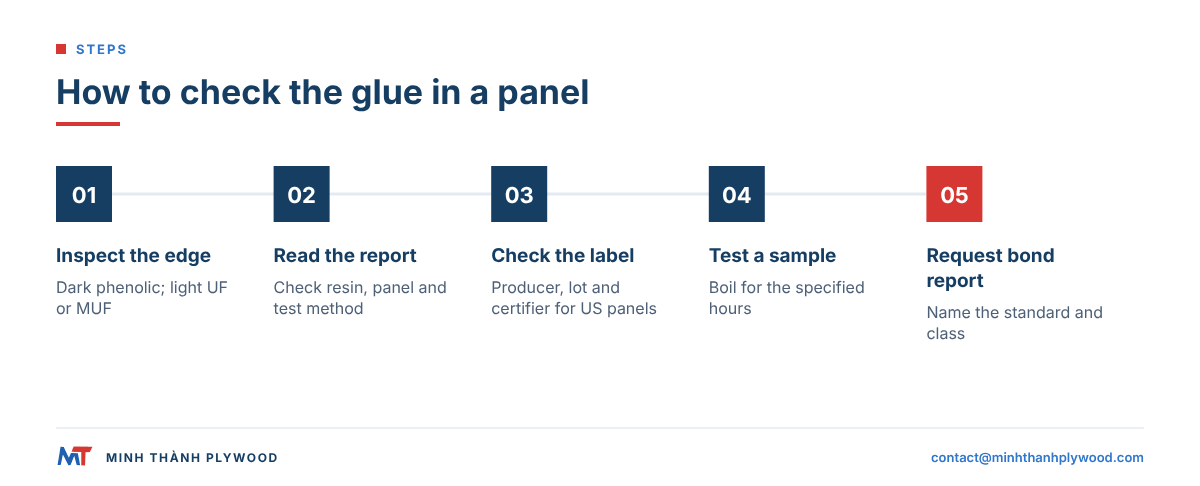
How can you tell which glue is in a plywood panel?
You can tell the glue from the edge, the documents and a simple test. Use all three, because the colour alone only separates phenolic from the rest.
- Look at the glue lines in the edge. Dark brown or black lines mean phenolic; light, nearly invisible lines mean UF or MUF.
- Read the emission test report. It names the panel, the resin and the method; ours name UF resin at E0 grade, the laboratory and the result.
- Check the label. US-bound panels carry a TSCA Title VI label with the producer, lot and certifier number.
- Boil a sample for the hours your order states, then try to split the plies with a chisel. A good bond breaks in the wood, not cleanly along the glue line.
- Ask for the bond test by standard (EN 314 class or the boil test on the order) when the use is humid or exterior.
How to specify plywood glue on your order
Specify the glue as its own line, next to a separate emission line, and add the bond test where the panel will meet water. That gives every mill the same thing to price.
Example lines:
- Furniture panel: 18 mm birch-faced plywood, Styrax core, pressed twice; glue: UF glue at E0 emission; emission: CARB P2 / TSCA Title VI, chamber test report by ASTM D6007; for the EU, test to EN 717-1 through SGS on request.
- Humid-room panel: 18 mm poplar-faced plywood; glue: melamine-fortified UF (MR), 12-hour boil; emission: E1.
- Exterior panel: 18 mm exterior/CDX-type plywood, C/D faces; glue: phenolic (WBP), 72-hour boil; emission: as required by the destination.
Contradictions to avoid: E0 written in the glue box, phenolic glue asked for on a loose-laid packing core, boil hours with no method, and a certificate asked for without naming the market. Send your lines through the furniture plywood page or to contact@minhthanhplywood.com; we reply within hours and send free samples so you can boil and test the glue line yourself.
Buyer questions, answered
Which adhesive is best for plywood?
The best adhesive is the one matched to where the panel is used. UF glue is the standard for indoor furniture and cabinets, melamine-fortified UF suits humid rooms and light exterior exposure, and phenolic glue is the choice for exterior panels and reusable concrete formwork.
What glue is used in Vietnamese plywood?
Vietnamese furniture plywood is mostly bonded with UF glue at E0 or E1 emission. Film-faced and exterior panels use melamine-fortified or phenolic glue. At Minh Thanh Plywood, UF glue at E0 emission is standard for furniture and interior panels, with MR and phenolic bonds made to order.
What is the difference between UF, MUF and phenolic plywood adhesives?
UF is a light-coloured, low-cost resin for dry interior use. MUF adds melamine to UF for better water resistance in humid conditions. Phenolic (PF) is a dark, water-insoluble resin for exterior use that survives long boil tests.
Is MR plywood the same as MUF?
Usually yes. MR (moisture-resistant) is a market name, not a resin; in most export quotes it means a melamine-fortified UF bond. Ask the mill which resin and which boil test the MR panel passes.
Does WBP plywood automatically mean phenolic adhesive?
No. WBP (weather and boil proof) describes a bond that passed a boil test. Phenolic glue is the usual way to reach it, but some mills sell melamine-fortified panels as WBP, so ask for the resin and the test method.
What kind of glue can be used in formwork plywood?
Melamine-fortified UF or phenolic glue. Melamine-bonded film-faced panels give about 12–15 reuses and phenolic-bonded panels up to about 25, with proper handling, release agent and edge sealing.
Is urea formaldehyde glue safe in furniture plywood?
Yes, when the panel meets the emission limit of its market. UF glue at E0 emission, with CARB P2 / TSCA Title VI certification, is the normal build for furniture sold in Europe and the United States.
Is E0 a type of glue?
No. E0 is an emission class, not a glue. A furniture panel is specified as UF glue at E0 emission, which is two separate lines: the resin and the emission class.
Is Vietnamese plywood waterproof?
It depends on the glue. Vietnamese furniture plywood with UF glue is for indoor use; exterior and film-faced panels with melamine-fortified or phenolic glue resist water and boiling, but no plywood is waterproof without sealed edges and a protected face.
What glue should I use to glue plywood to plywood?
A PVA wood glue for indoor joints, a polyurethane wood glue or construction adhesive for damp areas and panel-to-frame work, and epoxy for wet or marine repairs. These are workshop adhesives, different from the resin inside the panel.
Does tile adhesive stick to plywood?
Yes, when the plywood is exterior-bonded, stiff, clean and primed, and the adhesive is a flexible type rated for timber substrates. Many tile makers ask for a cement board or decoupling membrane over plywood floors; follow the adhesive maker's instructions.
How do I know which glue is in my plywood?
Look at the glue lines in the edge: phenolic glue is dark brown to black, UF and MUF are light. Then ask for the emission test report, which names the resin, and boil a sample to the test your order states.