
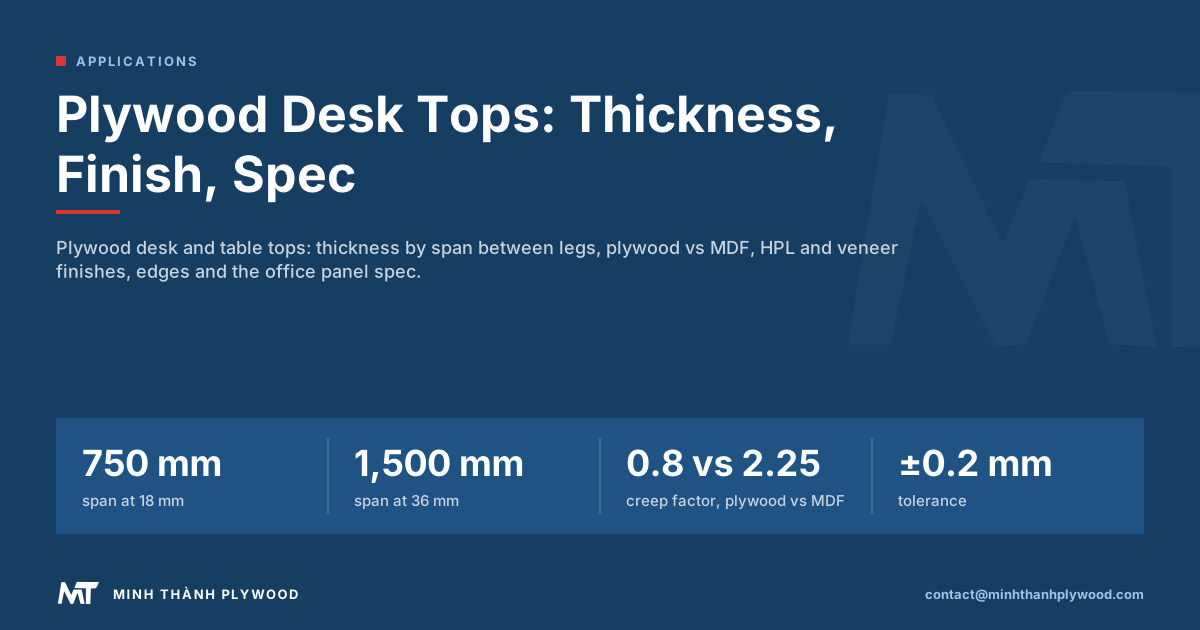
A plywood desk top should be 25–36 mm thick when it spans more than about a metre between legs, or 18 mm on a frame with rails under it. Plywood is strong enough for any desk, stiffer for its weight than MDF and holds screws in its edges. Minh Thanh Plywood supplies sanded, UV-ready furniture panels to desk and contract furniture makers.
What plywood is best for a desk?
The best plywood for a desk is sanded furniture plywood with a closed hardwood core, UF glue at E0 emission and a face chosen for the finish: birch or engineered veneer for a wood look, poplar under laminate or paint. A dense Eucalyptus core suits tops that span far between legs.
| Desk type | Plywood | Thickness | Surface |
|---|---|---|---|
| Home office desk on a frame | Furniture plywood, birch or EV face | 18–25 mm | Lacquer or hardwax oil |
| Office workstation | Furniture plywood, poplar face | 18–25 mm | HPL or melamine on the factory line |
| Desk without rails between legs | Furniture plywood, Eucalyptus core | 30–36 mm | HPL, veneer or lacquer |
| Gaming desk | Furniture plywood | 25–36 mm | HPL for wear |
| Dining or meeting table | Furniture plywood | 25–36 mm | Sealed lacquer or HPL |
| Coffee and side table | Furniture plywood | 18–25 mm | Veneer, lacquer or paint |
A plywood desk works because its cross-laminated veneers make a stiff, light panel that holds the screws of legs, frames and cable trays in its faces and edges. A plywood desk top also shows a clean layered edge when that is the look you want.
How thick should plywood be for a desk?
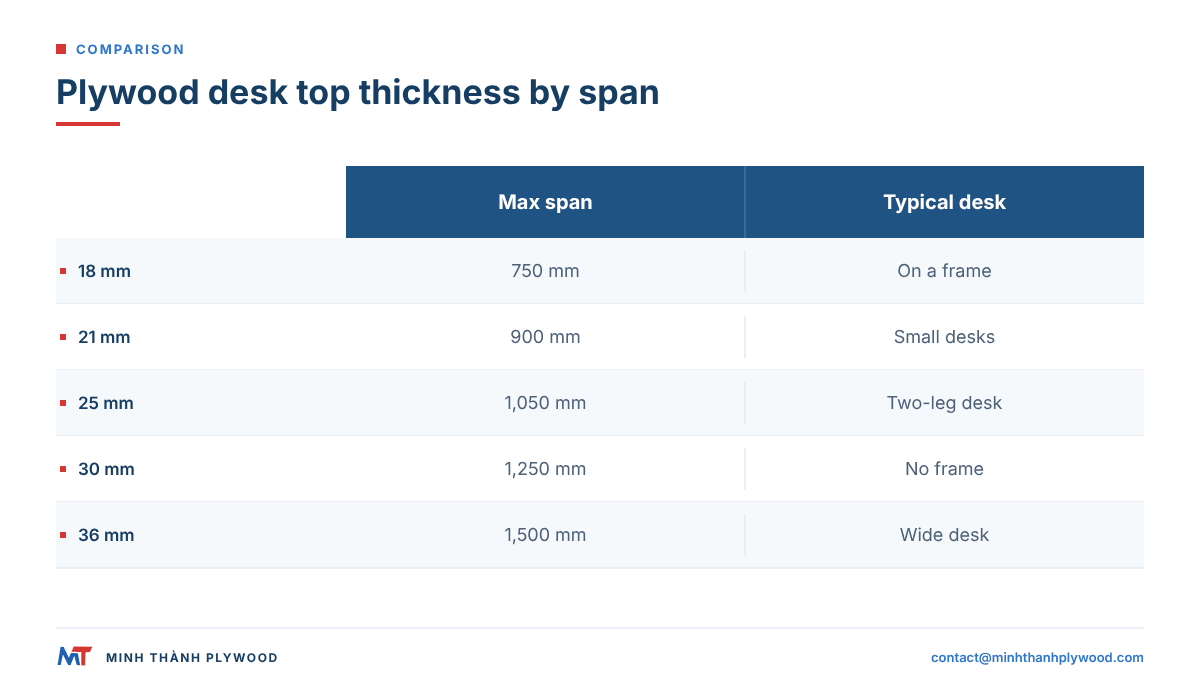
Plywood for a desk should be 18 mm when a frame or apron rails support the top, and 25–36 mm when the top spans between legs on its own. The span between supports, not the overall desk width, decides the thickness.
| Plywood desk top thickness | Max span between supports, 700 mm deep top | Typical desk |
|---|---|---|
| 18 mm | 750 mm | Top on a frame or rails |
| 21 mm | 900 mm | Small desks, side tables |
| 25 mm | 1,050 mm | Home office desk between two legs |
| 30 mm | 1,250 mm | Long desk without frame |
| 36 mm (two 18 mm layers glued) | 1,500 mm | Wide desk or meeting table |
How we calculated it: a 700 mm deep top resting on two supports carries 40 kg per metre of length for monitors, books and arms, plus its own weight at 650 kg/m³.
Deflection = 5 × w × L⁴ ÷ (384 × E × I) with a conservative bending modulus of 5,000 N/mm², multiplied by 1.8 for long-term creep (the kdef of 0.8 that Eurocode 5 gives for plywood indoors), and limited to span ÷ 300. Spans are rounded down to 50 mm. A desk of 1600 mm width with legs at the ends has a span close to its width, so it needs a 36 mm top or rails under an 18–25 mm top.
Is plywood strong enough for a desk?
Yes: plywood is strong enough for any desk, from a study desk to a long office bench, when the thickness matches the span. Its veneers cross at right angles, so a plywood top resists splitting at screws, stays flat across its width and carries point loads such as a monitor arm clamp.
What makes plywood strong in a desk:
- Stiffness for weight. An 18 mm Styrax-core sheet of 1220 × 2440 mm weighs about 26.8 kg; a desk top stays light enough to ship flat and lift into place.
- Screw holding. Leg plates, frames and drawer runners screw into face veneers that do not crumble.
- Clamp loads. Monitor-arm and desk-lamp clamps press on the edge; a closed core does not crush.
- Long-term creep. Eurocode 5 gives plywood a creep factor of 0.8 indoors, against 2.25 for MDF and particleboard, so a plywood top keeps its shape under monitors for years.
Plywood desk top vs MDF, particleboard and solid wood
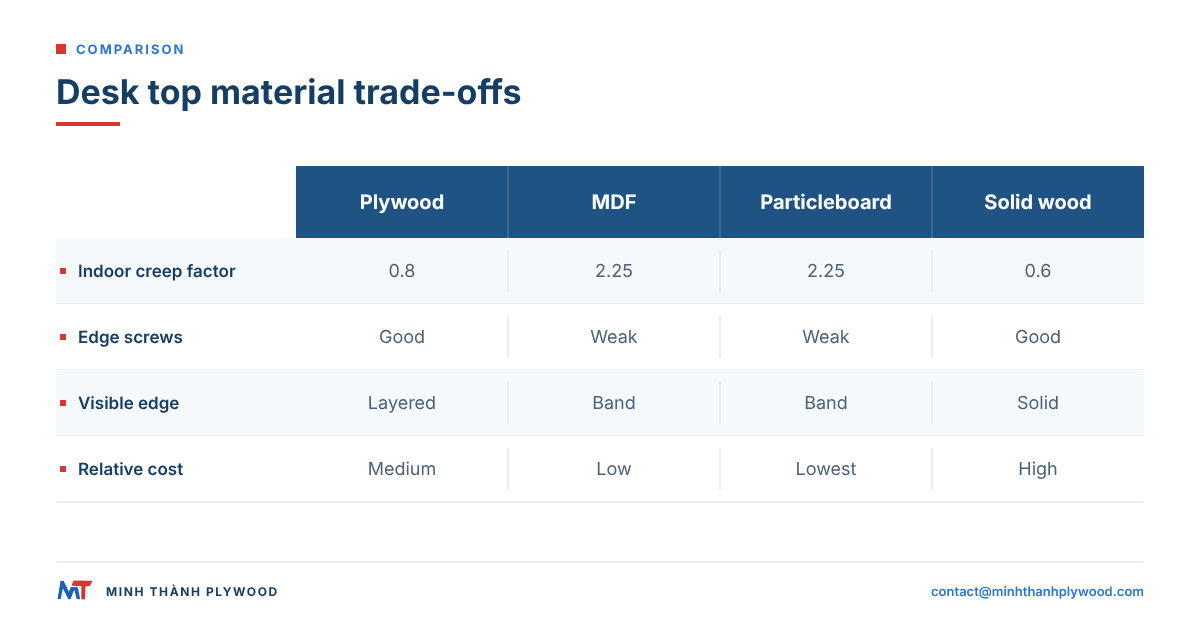
Plywood is the strongest and lightest choice for a desk top that spans between legs; MDF gives the smoothest paint surface; particleboard is the cheapest under laminate; solid wood is the natural-timber look. The table compares them for desks.
| Metric | Plywood | MDF | Particleboard | Solid wood |
|---|---|---|---|---|
| Long-term creep (kdef indoors, Eurocode 5) | 0.8 | 2.25 | 2.25 | 0.6 |
| Weight for the same stiffness | Low | High | High | Low to medium |
| Screw holding in edges | Good | Weak | Weak | Good |
| Clamp and point loads | Good | Edge crushes | Edge crushes | Good |
| Movement with humidity | Very low | Low, swells if wet | Swells if wet | Shrinks and swells |
| Visible edge | Layered, can be lacquered | Must be banded | Must be banded | Solid |
| Cost | Medium | Low | Lowest | High |
Verdict by use. Plywood for desks without a full frame, gaming and standing desks, and any top with a clamp-on monitor arm. MDF for painted tops on a full frame. Particleboard for budget laminated office desks on steel frames. Solid wood for executive and dining tops where the timber is the design.
Plywood desktop surfaces: HPL, melamine, veneer or lacquer
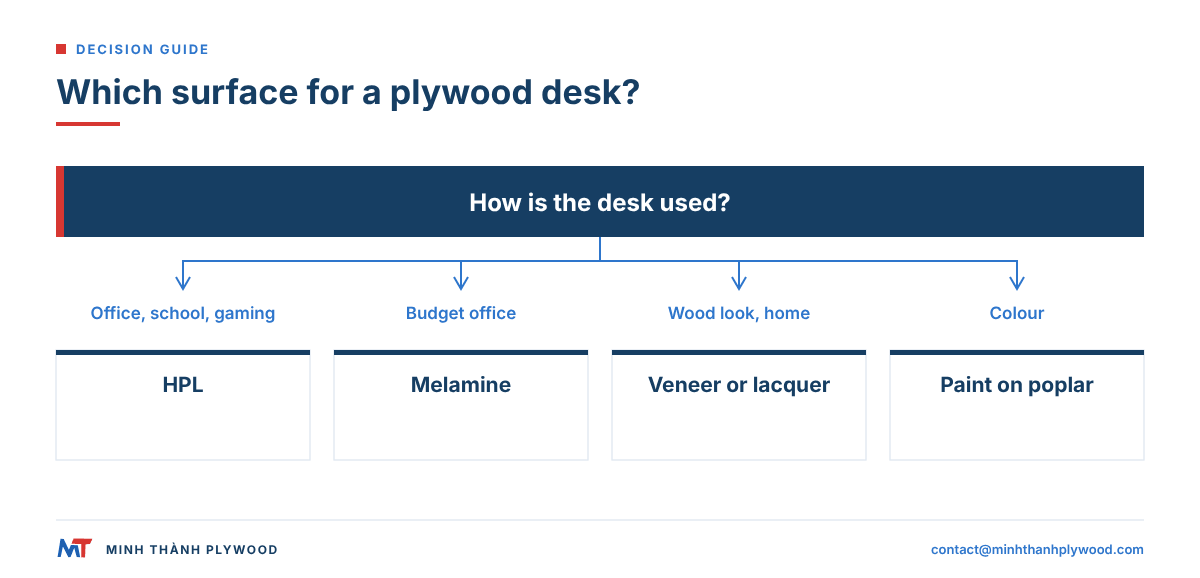
On a plywood desktop, choose HPL for the hardest-wearing surface, melamine for budget office furniture, a wood veneer or lacquered birch face for a natural look, and paint on poplar for colour. Each needs a flat, sanded panel under it.
| Surface | Wear | Look | Best desk |
|---|---|---|---|
| HPL (high-pressure laminate) | Very high, scratch and heat resistant | Solid colours, wood and stone designs | Office, school, gaming |
| Melamine paper | Medium | Solid colours, wood designs | Budget office desks |
| Wood veneer (oak, walnut) | Medium, refinishable | Real timber | Executive and home desks |
| Lacquered birch or EV face | Medium | Pale wood with layered edges | Scandinavian-style desks |
| Paint on poplar face | Medium | Any colour | Children’s and home desks |
The guide laminated plywood: melamine, HPL, PVC and pre-laminated boards compares the laminate options in detail. Minh Thanh sands and polishes both faces of furniture panels and leaves them UV-ready, so a desk factory can run its own UV lacquer line or laminate press without extra sanding.
How to finish plywood for a desk
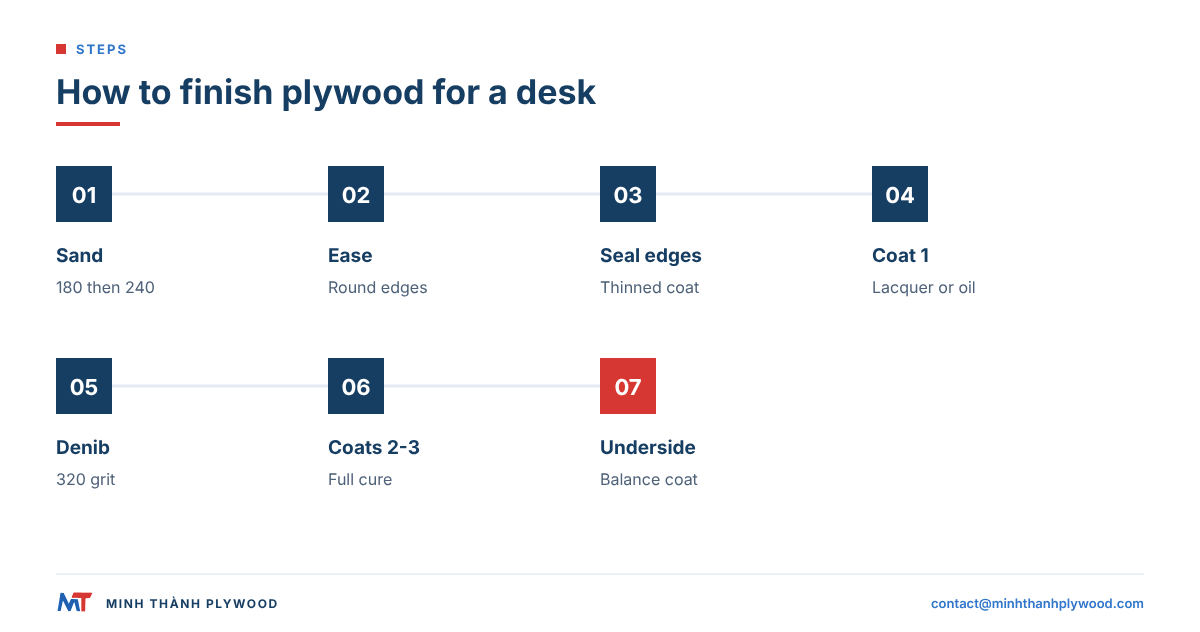
Finish a plywood desk by sanding the face smooth, sealing the edges, and building two or three coats of a hard-wearing clear coat, or by bonding HPL to the top. The steps below give a durable lacquered top.
- Sand the face with 180 grit, then 240 grit, along the grain.
- Ease the edges with a small round-over so the finish does not chip.
- Seal the edges with a first coat thinned slightly; end grain on ply edges soaks up more finish.
- Apply the first coat of water-based polyurethane, hardwax oil or a two-component lacquer.
- Denib with 320 grit when dry.
- Apply two more coats, letting each cure as the maker states.
- Finish the underside with at least one coat, so both faces take up moisture evenly and the top stays flat.
For HPL, bond the laminate with contact adhesive or in a press, and put a balancing laminate or veneer on the underside of tops that are not fixed to a frame.
Edge options for plywood table tops
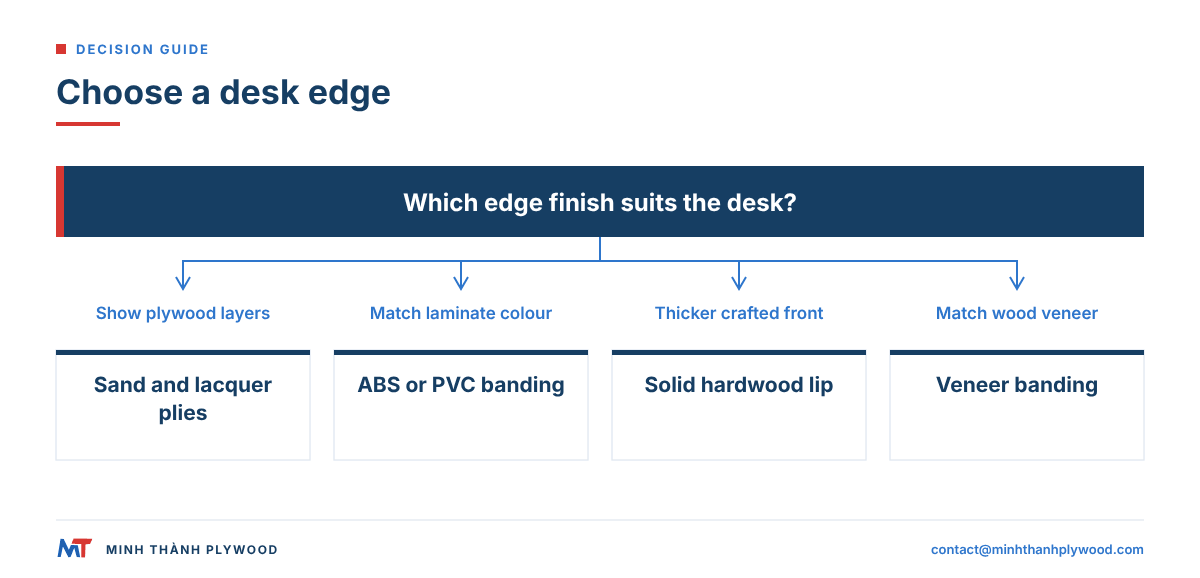
Plywood table tops take four edge treatments: lacquered visible plies, veneer or ABS banding, a solid hardwood lip, or an HPL top with a matching edge. Choose by the look and by how hard the edge is used.
| Edge | Look | Durability | Notes |
|---|---|---|---|
| Visible plies, sanded and lacquered | Layered stripes | Good | Needs a closed, even core |
| Veneer banding | Matches the face | Medium | Iron-on or edge-bander |
| ABS or PVC banding | Matches laminate colour | High | Standard on office desks |
| Solid hardwood lip | Crafted, thicker front | Very high | Also stiffens the top |
| Bevelled HPL edge | Thin, modern | High | Dark core line shows |
A visible-ply edge only looks good on a panel with straight, gap-free plies. Minh Thanh stitches core layers both horizontally and vertically and presses furniture panels twice, so the edge of a desk top shows even layers.
Marine plywood table tops: when you need them
You need marine or exterior-bond plywood for a table top only when the table lives outdoors or gets wet often: garden tables, boat tables, café terraces. Indoors, furniture plywood with UF glue at E0 emission is the right panel, and a sealed finish handles spills.
| Table | Bond | Finish |
|---|---|---|
| Home or office desk | UF glue at E0 emission | Lacquer, oil or HPL |
| Kitchen or dining table | UF at E0, or MR / melamine-fortified for humid homes | Water-resistant lacquer or HPL |
| Covered terrace or café | MR or phenolic WBP | Exterior lacquer, sealed edges |
| Open garden or deck | Phenolic WBP | Exterior finish renewed regularly |
Buyers in island markets such as Malta often ask for a marine plywood table top because of sea air. Sea air raises humidity; it does not soak the panel. A phenolic WBP bond with sealed edges covers covered outdoor use, and a true marine panel is only needed where the table is wet for long periods. True marine plywood is made to BS 1088:2018, which specifies standard and lightweight classes made from untreated tropical hardwood veneers.
Plywood for office and contract furniture: the panel spec
Office and contract furniture makers need plywood that is flat, calibrated to a tight thickness, low in emission and consistent from one container to the next, because their lines laminate, band and drill thousands of identical parts. The panel spec below is what a desk factory writes.
| Specification | Office desk panel |
|---|---|
| Thickness | 18, 21 or 25 mm |
| Thickness tolerance | ±0.2–0.3 mm on sanded furniture panels, down to ±0.2 mm |
| Length and width tolerance | ±2 mm |
| Core | White Styrax (light) or Eucalyptus (stiff), stitched both ways |
| Pressing | Twice: core calibrated, then faces |
| Glue and emission | UF glue at E0 emission |
| Moisture | 8–12% at dispatch |
| Faces | Sanded, polished, UV-ready; poplar or EV under laminate |
| Formats | 1220 × 2440 or 1250 × 2500 mm, or cut to size |
Emission proof. Office tenders in Europe and the US ask for formaldehyde evidence. Minh Thanh holds CARB P2 / TSCA Title VI certification (ICTT mill no. 23024), and six third-party ASTM D6007 chamber tests between April 2025 and June 2026, on 9, 15 and 18 mm panels, averaged 0.014–0.032 ppm against the 0.05 ppm limit. Testing to the buyer’s method, such as EN 717-1, is arranged through SGS on request.
Desk standards such as EN 527 for office work tables test the finished desk, frame and top together, so the furniture maker designs the frame and the mill supplies a consistent panel.
Plywood dining, coffee and study tables
Dining and meeting tables need 25–36 mm plywood tops with a wipeable finish; coffee and side tables work at 18–25 mm; study desks for children work at 18 mm on a frame. The rule is the same as for desks: the span between legs sets the thickness.
- Dining table. 25–36 mm, sealed lacquer or HPL, edges sealed against spills, legs or a frame near each end.
- Meeting table. 36 mm, or 25 mm on a steel frame, with a cable port cut before finishing.
- Coffee table. 18–25 mm, often with a lower shelf that ties the legs together.
- Study desk. 18 mm on a frame with drawers or a modesty panel, painted poplar or lacquered birch.
- Plywood table with visible edges. Glue two 18 mm layers into a 36 mm top for a thick, layered edge.
Furniture shops in markets such as Singapore sell plywood dining, coffee and study tables made this way: a sanded veneer face, a lacquered layered edge and a steel or timber base.
Plywood desk designs: from a DIY gaming desk to a factory workstation
A plywood desk can be as simple as a 25–36 mm top on two drawer cabinets or a steel frame, the classic DIY gaming desk, or a factory-made workstation with a laminated 18–25 mm top on a steel frame. The plywood choices are the same; the frame decides the thickness.
- Top on two cabinets. 25 mm top, span between the cabinets kept under about a metre.
- Top on a steel sit-stand frame. 18–25 mm, because the frame supports the top along its length.
- Corner desk. Two tops joined at the corner over a leg or cabinet, 25 mm.
- Wall-mounted desk. 25 mm on steel brackets, with a back rail into the wall.
- Factory workstation. 18–25 mm laminated top, ABS edges, pre-drilled for the frame and cable tray.
Gaming desk buyers, from Denmark to the US, choose plywood for monitor-arm clamps and the layered edge look; an HPL top resists mouse wear better than a lacquered face.
What this means for your order
A desk-top plywood order should name the thickness and tolerance, core, glue and emission, face for the chosen surface, format or cutting plan, and moisture. Desk factories usually combine top panels with thin back and drawer panels in one container.
Desk top panels: 25 mm ±0.2 mm, Eucalyptus core stitched both ways, pressed twice, UF glue at E0 emission, poplar A/B faces sanded and UV-ready for HPL, 1250 × 2500 mm, 8–12% moisture, one 40HC with 18 mm and thin plywood mixed by agreement.
Minh Thanh ships on FOB Hai Phong, CFR or CIF terms; production takes 15–45 days after the deposit, and free samples are available. Send your desk drawings to contact@minhthanhplywood.com, or message Lisa on WhatsApp at +84 988 586 601.
Buyer questions, answered
How thick should plywood be for a desk?
18 mm on a frame with rails under the top, 25 mm for a top spanning about a metre between legs, and 30–36 mm for 1250–1500 mm between legs without a frame. Two 18 mm sheets glued together make a 36 mm top.
Is plywood strong enough for a desk?
Yes. Plywood is stiffer for its weight than MDF or particleboard, holds screws in its edges and does not crumble at fixings, so 18–36 mm plywood carries monitors, books and people leaning on it.
What type of plywood is best for a desk?
Sanded furniture plywood with a closed hardwood core and UF glue at E0 emission: birch or engineered veneer for a visible wood top, poplar under laminate or paint. Choose a dense Eucalyptus core for long spans.
How do you finish plywood for a desk?
Sand to 180–240 grit, seal the edges, then apply two or three coats of a hard-wearing lacquer, hardwax oil or water-based polyurethane, or bond an HPL sheet for the toughest surface.
Is plywood or MDF better for a desk top?
Plywood for tops that span between legs or carry monitors, because MDF creeps under long-term load and holds screws poorly in its edges. MDF suits short, painted tops on a full frame.
Is HPL or veneer better on a plywood desk?
HPL is better for hard use: offices, schools and gaming desks. Wood veneer or a lacquered birch face is better where the top must look like wood and is used with some care.
Do I need marine plywood for a table top?
Only for tables that live outdoors or get wet often. Indoors, furniture plywood with UF glue at E0 emission is the right panel; outdoors, use a phenolic WBP bond with a sealed finish.
What plywood do office furniture makers use?
Sanded furniture plywood with tight thickness tolerance, flat faces, UF glue at E0 emission and documented emission proof, usually 18–25 mm, laminated or veneered on the factory line.
How do you stop a plywood desk from sagging?
Shorten the span between legs, add a steel frame or timber apron rails under the top, glue a second layer to double the thickness, or add a back modesty panel fixed to the top.
Can you make a gaming desk from plywood?
Yes. A 25–36 mm plywood top on a steel frame or two cabinets carries monitors and arms; finish it with HPL or a hard lacquer and band the edges.
Is plywood good for a dining table top?
Yes, at 25–36 mm with a sealed, wipeable finish. A dining top needs a water-resistant lacquer or HPL and edges sealed against spills.