
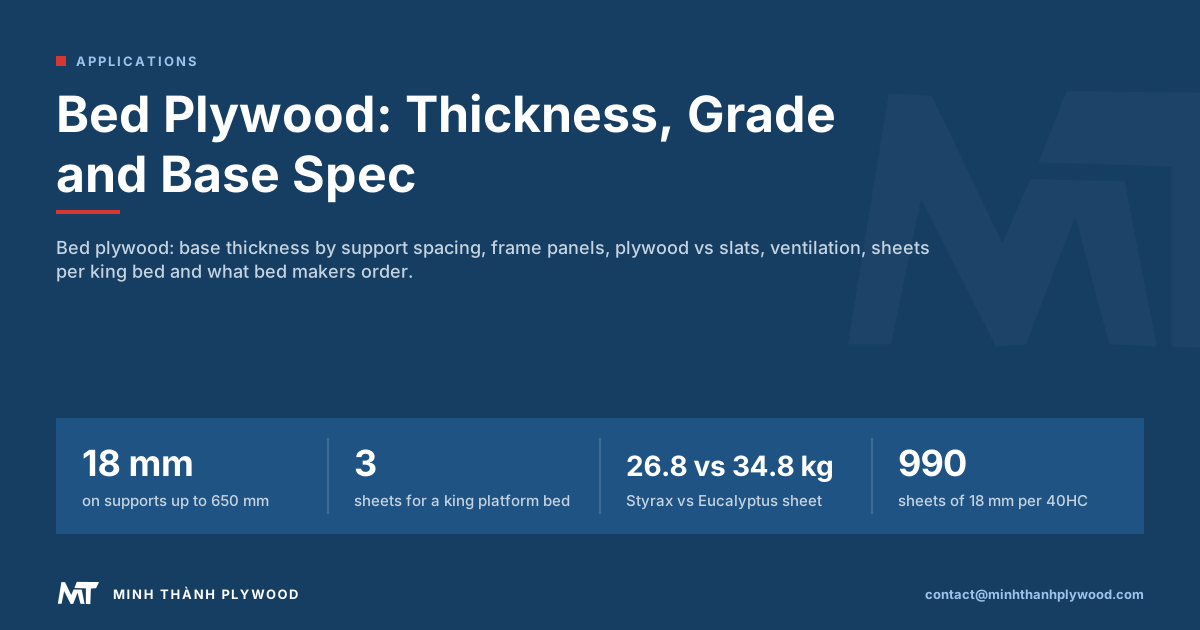
Bed plywood is 18 mm for frame panels, headboards and solid platform bases on supports up to 650 mm apart, 12–15 mm for bases on closer battens, and 9 mm for a bunkie board over slats. Choose a closed core, UF glue at E0 emission for bedrooms and a face to match the finish. Minh Thanh Plywood supplies these panels to furniture and bed makers, mainly in Europe.
What is the best bed plywood?
The best bed plywood is 18 mm furniture plywood with a closed hardwood core, UF glue at E0 emission and a face matched to the finish: poplar under upholstery, birch or engineered veneer for visible frames. Base boards can be thinner when the supports are closer.
| Bed part | Thickness | Plywood | Why |
|---|---|---|---|
| Side rails and end boards | 18 mm | Furniture plywood, closed core | Holds screws, bolts and hinges |
| Headboard | 18 mm | Birch, EV or poplar face | Flat, takes veneer, paint or upholstery |
| Solid platform base | 18 mm on supports up to 650 mm apart | Furniture plywood, ventilated | Firm, quiet support |
| Base on close battens | 12–15 mm | Furniture plywood | Lighter, same stiffness on shorter spans |
| Bunkie board over slats | 9 mm | Plywood, often fabric-covered | Flat layer for the mattress |
| Storage box and lift lid | 18 mm | Furniture plywood | Carries the lift mechanism |
| Drawer bottoms | 4–6 mm | Thin 5-ply (3–5 mm) plywood | Light and flat |
Bed plywood beats particleboard for frames because its cross-laminated veneers hold screws in the edges and do not crumble at bolt holes. It beats solid wood for wide panels because it stays flat and does not shrink across the width.
Bed plywood price and supply in Saudi Arabia and the Gulf
In Saudi Arabia, Alzaben lists its RILICO China plywood range at SAR 34.50 to 132.25 per sheet, VAT included, across product variants (read on 3 November 2026). Confirm the selected thickness, dimensions and construction before comparing a retail sheet with a mill quotation.
As a raw FOB example only, not a sheet price: an 18 mm sheet is 0.0536 m³, so at US$350/m³ (Minh Thanh’s furniture/interior starting reference, October 2026) the conversion gives about US$18.75, or SAR 70 at the pegged rate of 3.75 riyals to the dollar. Freight, import duty and VAT come on top, and the final price depends on face, core, glue and quantity.
What a Gulf bed maker checks before ordering:
| Point | Gulf practice |
|---|---|
| Bed sizes | Single 90 × 200 cm, king 180 × 200 cm, large king 200 × 200 cm; buy by centimetres, because stores label 160 × 200 cm and 180 × 200 cm differently |
| Sheets per bed | 3 sheets of 18 mm for a 180 × 200 cm base, rails, ends and spine (see the cutting table below); 4 sheets for a 200 × 200 cm bed with headboard |
| Bond for coastal homes | MR (melamine-fortified) for humid Jeddah, Dammam and Gulf-coast bedrooms; ask the mill whether a termite-protected glue line can be added to the order |
| Duty | The GCC common tariff is at least 5% on the CIF value. The exact rate follows the 12-digit tariff line in the ZATCA tariff search |
| VAT | Standard rate of 15%, where applicable (ZATCA) |
| Conformity | Importer to confirm the applicable product registration and product/shipment certificates through SABER for Saudi market entry |
| Terms | CFR Jeddah or Dammam on request, quoted from FOB Hai Phong |
For Saudi buyers the useful step is a quotation on CFR terms for one 40HC of 18 mm, 12–15 mm and 4–6 mm panels, with the SABER product record prepared before booking. The sibling guide Plywood price in Saudi Arabia walks through the landed-cost lines.
What thickness of plywood for a bed base?
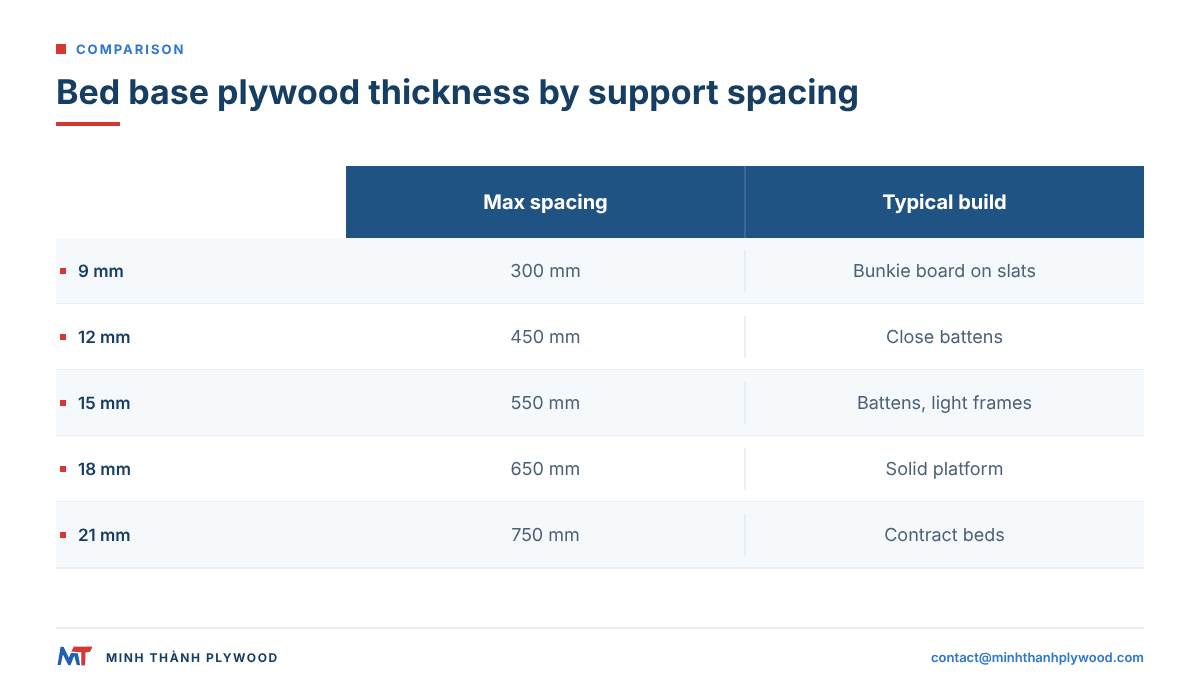
Plywood for a bed base should be 18 mm when it spans up to 650 mm between supports, 15 mm up to 550 mm and 12 mm up to 450 mm. A 9 mm board only works as a bunkie board laid over slats about 300 mm apart or closer.
| Base plywood thickness | Maximum support spacing | Typical build |
|---|---|---|
| 9 mm | 300 mm | Bunkie board over slats |
| 12 mm | 450 mm | Base on closely spaced battens |
| 15 mm | 550 mm | Base on battens, light frames |
| 18 mm | 650 mm | Solid platform, storage bed lid |
| 21 mm | 750 mm | Heavy-duty and contract beds |
How the spacing was calculated: a 1 m wide strip of base under 2.0 kN/m², about two adults and a mattress concentrated on part of the bed, with deflection held to span ÷ 300, using a conservative plywood bending modulus of 5,000 N/mm² and the formula deflection = 5 × w × L⁴ ÷ (384 × E × I). Spans are rounded down to 50 mm. A king bed of 1800 mm width with a centre spine has 900 mm between supports, so it needs cross battens under an 18 mm base.
Plywood board under a mattress: when and how
Use a plywood board under a mattress when slats are too far apart, when the mattress maker asks for a solid base, or when an old base sags. It must let the mattress breathe: a sleeper gives off moisture every night, and a sealed board traps it under the mattress.
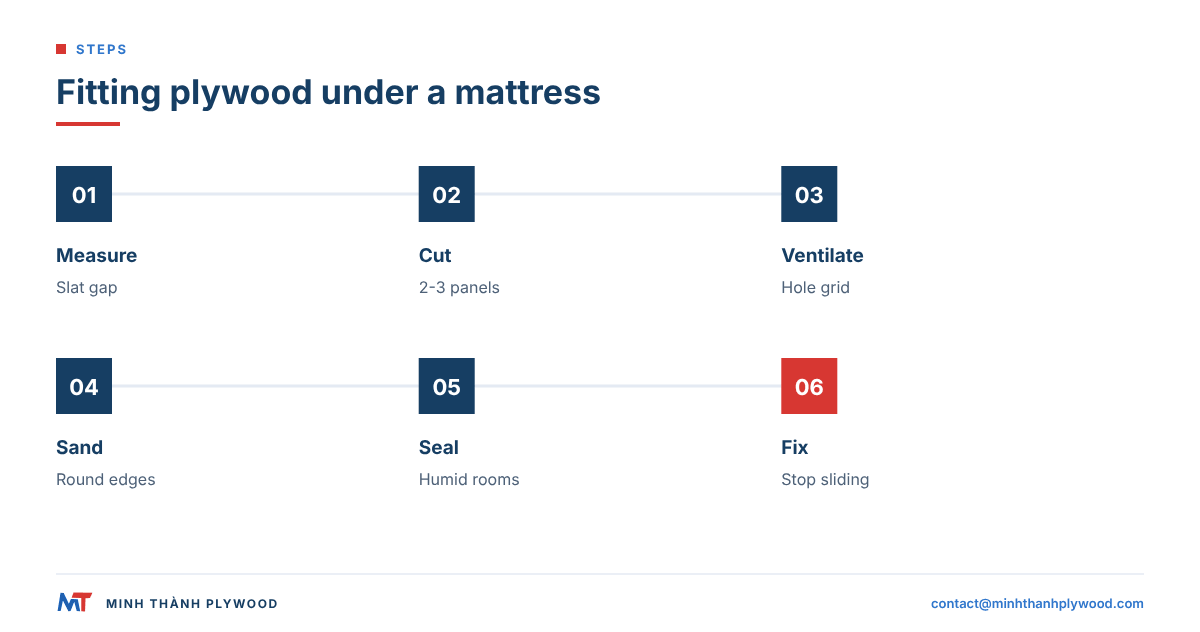
How to fit plywood under a mattress:
- Measure the slat gap. Over gaps of about 300 mm or less, 9 mm plywood is enough; over wider gaps use 12–18 mm by the base table.
- Cut in two or three panels so the board fits through doors and lifts out for cleaning.
- Ventilate. Drill a regular grid of holes through each panel, or leave small gaps between panels.
- Round and sand the edges so they do not cut the mattress cover.
- Seal the faces with a clear coat if the room is humid.
- Fix against sliding with a few screws into the slats or a frame lip.
A plywood bunkie board is the same idea made as a product: a 9 mm sheet, often covered in fabric, that turns a slatted or bunk frame into a flat platform.
Plywood vs slats vs LVL slats for a bed base
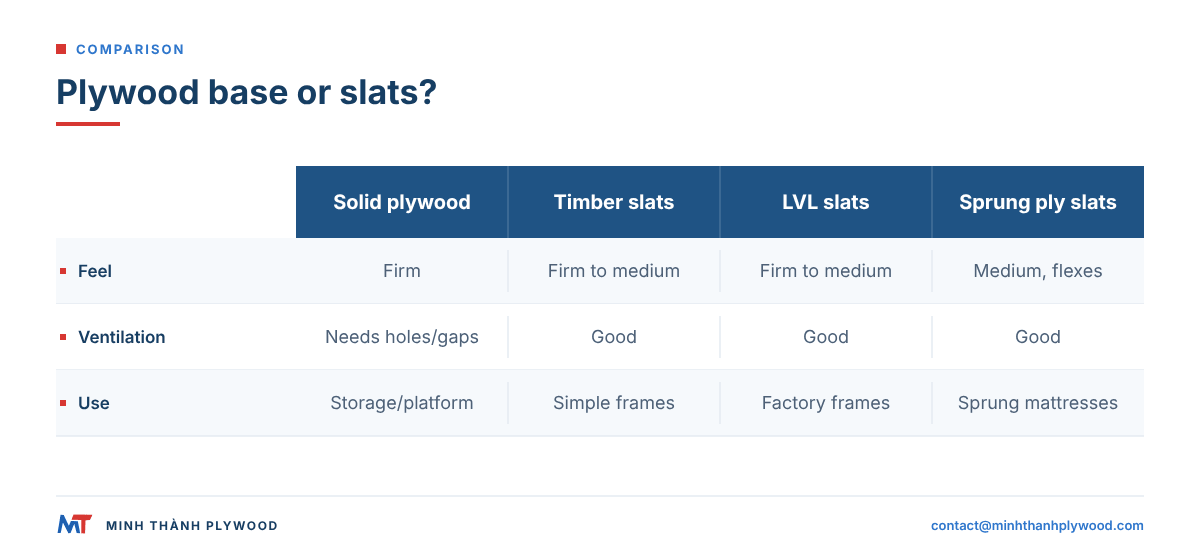
Slats ventilate best and give a little flex; a solid plywood base is firmest and quietest; LVL slats are the straight, consistent version of timber slats. Choose by the mattress and by the bed design.
| Point | Solid plywood base | Timber slats | LVL slats | Sprung plywood slats |
|---|---|---|---|---|
| Feel | Firm | Firm to medium | Firm to medium | Medium, flexes |
| Ventilation | Needs holes or gaps | Good | Good | Good |
| Straightness over time | Flat | Can bow or twist | Stays straight | Holds its curve |
| Noise | Quiet | Can creak at fixings | Quiet when fixed well | Quiet in holders |
| Best for | Storage beds, platform beds | Simple frames | Mass-produced frames | Sprung and latex mattresses |
| Factory supply | Full sheets or cut to size | Sawn timber | Ripped from billets | Moulded veneer slats |
Laminated veneer lumber slats are ripped from LVL billets, so every slat has the same stiffness and stays straight; see our guide to LVL beams and members for how the material is made. Sprung slats, the curved ones in clip holders, are a separate moulded-veneer product.
Which plywood grade and glue for a bed frame?
For a bed frame indoors, choose furniture plywood with UF glue at E0 emission; use a melamine-fortified (MR) bond in humid climates and phenolic WBP only where the bed meets real damp. Glue and emission are separate specifications: UF, MR and WBP name the bond, E0 names the formaldehyde emission class.
| Room and climate | Bond | Emission | Note |
|---|---|---|---|
| Heated or air-conditioned bedroom | UF | E0 | Standard for furniture |
| Humid bedroom, coastal or tropical | MR / melamine-fortified | E0 or E1 as ordered | Resists humidity swings |
| Damp basement or holiday cabin | Phenolic WBP | As ordered | Also for outdoor-adjacent furniture |
India grades plywood MR, BWR and BWP under IS 303 and IS 710; BWP is for wet use and more than a bedroom needs. People sleep in a closed bedroom for hours. Low emission matters more here than in most furniture. Minh Thanh furniture panels meet the emission requirements European and US furniture buyers ask for, with CARB P2 / TSCA Title VI certification (ICTT mill no. 23024) as the accepted proof, and third-party testing to the buyer’s method, for example EN 717-1, is arranged through SGS on request. The US limit for hardwood plywood with a veneer core is 0.05 ppm under EPA formaldehyde emission standards.
How many plywood sheets do you need for a bed?
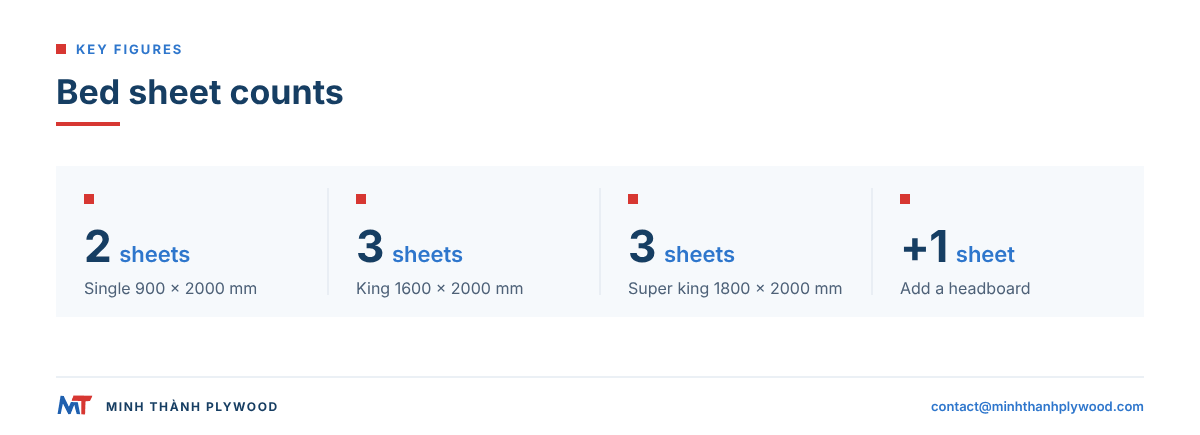
A platform bed of 1600 × 2000 mm or 1800 × 2000 mm takes three 1220 × 2440 mm sheets of 18 mm plywood: two for the base and the side rails, one for the end boards and centre spine. A headboard adds one sheet, and drawers or a lift-up storage box add one or two more.
| Bed | Sheets of 18 mm, 1220 × 2440 mm | What they give |
|---|---|---|
| Single, 900 × 2000 mm | 2 | Base in one piece, rails, ends |
| Double, 1400 × 2000 mm | 3 | Base in two halves, rails, ends, spine |
| King, 1600 × 2000 mm | 3 | Base in two 800 mm halves, rails, ends, spine |
| Super king, 1800 × 2000 mm | 3 | Base in two 900 mm halves, rails, ends, spine |
| Add a headboard | +1 | Panel up to 1220 mm tall |
| Add a storage box with lid | +1 to 2 | Box sides, lid, battens |
How a king bed cuts: each of the first two sheets gives one 800 × 2000 mm base half, and its 420 mm offcut strip gives a 300 mm side rail. The third sheet is ripped into 300 mm strips for the two end boards, the centre spine and spare battens. For a king bed in India, 1830 × 1980 mm, the plan is the same three sheets, with the base split into two 915 mm halves.
Plywood bed frame: how factories build it
A plywood bed frame is a box of 18 mm panels: two side rails, a head end and a foot end joined with bolts, cam fittings or dowels, a centre spine on legs, and battens or slats carrying the base. Bed factories cut these parts on panel saws or CNC routers from full sheets or cut-to-size panels.
The parts and what each needs from the panel:
- Side rails carry the base along the length, so they need a straight, closed core and good edge-screw holding.
- End boards and headboard need flat faces for veneer, paint, laminate or upholstery.
- Centre spine carries the middle of the base; a double-thickness 36 mm spine, two 18 mm layers glued, resists sag on super king beds.
- Battens at the spacing in the base table, fixed into the rails.
- Corner joints with bed bolts or knock-down fittings, so the bed ships flat.
A flat-pack bed frame ships as panels in a carton, so panel weight decides the freight. An 18 mm Styrax-core sheet of 1220 × 2440 mm weighs about 26.8 kg against about 34.8 kg on a Eucalyptus core, so the Styrax-core plywood is about a quarter lighter at the same dimensions.
Plyboard for bed: what the trade name means
Plyboard for a bed is an ambiguous description: sellers may use it for plywood, blockboard or another panel (terminology comparison). Confirm that the product is cross-laminated plywood before applying the thickness and support-spacing guidance here. Ask the seller for the build behind the name.
- Core species and whether the core is closed.
- Glue type: MR, BWR or BWP in Indian terms; UF, MR or phenolic WBP in export terms.
- Thickness and tolerance for frame panels and base.
- Face grade for the finish you plan.
Blockboard, with a core of solid timber strips, is a different panel; it is used for long doors and shelves, while plywood suits bed frames and bases.
Plywood for storage and hydraulic beds
Storage and hydraulic beds need 18 mm plywood for the box, frame and lift lid, because the gas-strut and hinge screws pull on the panel every time the bed opens. Thin 5-ply plywood makes the box floor and drawer bottoms.
| Storage bed part | Plywood |
|---|---|
| Box sides and ends | 18 mm furniture plywood, closed core |
| Lift lid (the base) | 15–18 mm on battens, ventilated |
| Mechanism mounting zone | 18 mm, screws into solid core veneers |
| Box floor | 4–6 mm thin plywood on battens |
| Drawer sides and fronts | 12–18 mm with veneer or laminate |
| Drawer bottoms | 4–6 mm thin plywood |
Minh Thanh thin plywood of 3–5 mm is always 5-ply, so box floors and drawer bottoms stay flat. Where the storage box sits against an outside wall in a humid house, specify an MR bond for the box floor.
Plywood vs solid wood beds: which lasts longer?
Plywood beds last as long as solid wood beds when the plywood has a closed core and the right glue, and they stay flatter, because cross-laminated veneers do not shrink and swell across the width. Solid wood is chosen for its look on visible posts and rails.
| Point | Plywood bed | Solid wood bed |
|---|---|---|
| Stability across the width | Stays flat | Shrinks and swells with the seasons |
| Splitting at screws and bolts | Resists splitting | Can split near ends |
| Wide panels and headboards | One piece, any width up to the sheet | Glued boards |
| Look | Veneer, paint, laminate or upholstery | Natural timber |
| Weight | Light on Styrax core | Heavier for hardwoods |
| Price per bed | Lower for the same size | Higher |
The best of both is common in factories: solid wood or LVL for visible posts and legs, plywood for the panels and base.
How plywood quality decides the life of a bed
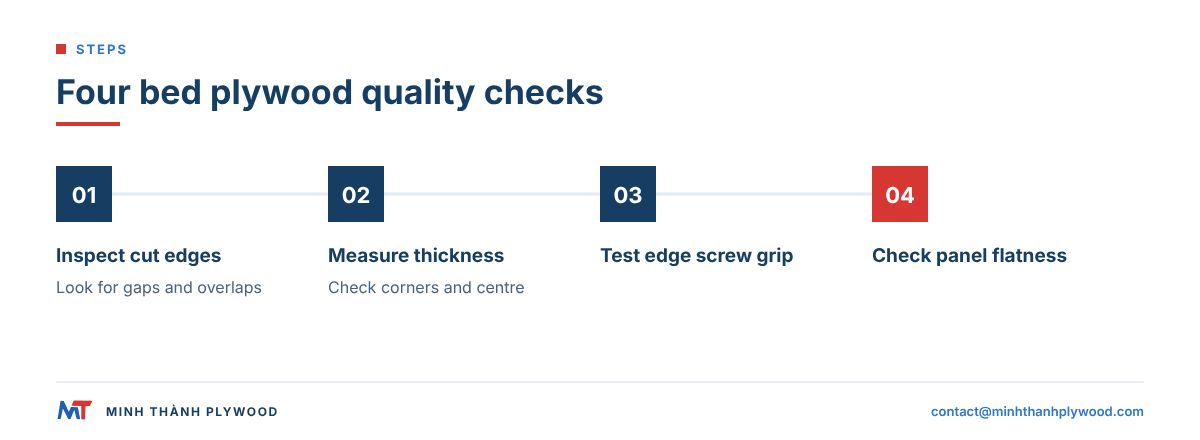
Plywood quality decides whether a bed stays tight and quiet. Core gaps lose screw grip and creak, uneven thickness opens joints, and a weak bond can delaminate in a humid bedroom. Four checks on the sample tell you which panel you are buying.
- Look along the edges of a cut sheet: core veneers should be closed, without gaps or overlaps.
- Measure thickness at the corners and the centre with a caliper.
- Drive a screw into the edge and pull it: a closed core holds, a gapped core lets go.
- Check flatness by laying the sheet on a flat table.
Minh Thanh stitches core layers both horizontally and vertically, presses furniture panels twice, core first and then the faces, and sands to a thickness tolerance of ±0.2–0.3 mm, down to ±0.2 mm. Panels leave the factory at 8–12% moisture, so they do not shrink after assembly in a dry bedroom.
Bed plywood for manufacturers: what a factory order looks like
Bed manufacturers order plywood by the container. They mix two or three thicknesses for frames, bases and drawer bottoms, cut to size where parts repeat. One 40HC carries about 990 sheets of 18 mm on Styrax core, so a factory can plan a month of bed frames on one booking.
- Mixed loads. 18 mm frame panels, 12–15 mm base boards and thin drawer-bottom plywood in one 40HC, by agreement.
- Cut to size. One panel cut into 4, 6 or 8 pieces, so base halves and rails arrive ready for edging.
- Faces. Poplar A/B for upholstered frames; birch D+/D or engineered veneer for visible ones; both faces sanded and UV-ready for a factory’s own lacquer line.
- Documents. For European buyers we supply the EUDR dossier with origin records and geolocation files. The EU due-diligence framework is set by Regulation (EU) 2023/1115.
- Loading evidence. Every shipment is photographed and filmed before loading, and the buyer gets the photos and video.
Bed makers in the Gulf receive containers in 15–25 days at sea from Hai Phong, and in Northern Europe in 30–40 days.
What to write on a bed plywood order
A bed plywood order states each part’s thickness, core, glue and emission, face grade, size or cutting list, moisture and packing. One line per thickness keeps the quotation and the inspection simple.
Bed frame panels: 18 mm ±0.2 mm, Styrax core stitched both ways, pressed twice, UF glue at E0 emission, poplar A/B faces sanded, 1220 × 2440 mm, 8–12% moisture. Bed base: 15 mm, same build, cut to size, one panel into 4 pieces. Drawer bottoms: 4 mm thin plywood, 5-ply, same glue.
Minh Thanh’s minimum order is one 40HC, production takes 15–45 days after the 30% deposit, with the balance against the scanned bill of lading, and free samples are available. Send your bed drawings to contact@minhthanhplywood.com.
Buyer questions, answered
What thickness of plywood is ideal for a bed frame?
18 mm for side rails, end boards, headboards and solid bases on supports up to about 650 mm apart. Use 15 mm for bases on battens 550 mm apart and 12 mm on battens 450 mm apart.
Which plywood is best for a bed?
Furniture plywood with a closed hardwood core, UF glue at E0 emission and a face that suits the finish: poplar under upholstery, birch or engineered veneer where the frame shows. In humid rooms or for storage beds against outside walls, choose a melamine-fortified (MR) bond.
How many plywood sheets do I need for a bed?
A king or queen platform bed of 1600–1800 mm by 2000 mm takes two 1220 × 2440 mm sheets for the base and side rails and a third for the end boards and centre spine. Add one or two sheets for a headboard, drawers or a storage lid.
Can plywood go under a mattress?
Yes. A plywood board under a mattress stops slats from cutting into it and spreads the load, but it needs ventilation: drill a grid of holes or leave gaps between panels so moisture from the sleeper can escape.
What is a bunkie board?
A bunkie board is a thin, usually fabric-covered board, often 9 mm plywood, laid on top of slats or a bunk frame to give the mattress a flat, firm support without a box spring.
Is plywood or slats better for a bed base?
Slats ventilate better and flex a little, which many sprung and foam mattresses are designed for. A solid plywood base is firmer and quieter and suits storage beds; it needs ventilation holes.
Can plywood beds be as strong as solid wood beds?
Yes. Cross-laminated plywood resists splitting at screws and stays flat in large panels, so plywood frames and bases match or beat solid wood in strength for their weight, and they do not shrink across the width.
How does plywood quality affect the lifespan of a bed?
A gapped core loses screw grip and creaks, uneven thickness makes joints open, and a weak bond can delaminate in humid rooms. A closed, calibrated core with the right glue keeps the joints tight for years.
What is plyboard for a bed?
Plyboard is an ambiguous trade name that may mean plywood, blockboard or another panel. For a bed, confirm that the seller is supplying cross-laminated plywood, then specify core species, glue type, thickness and face grade.
Is marine plywood needed for a bed frame?
No. A bedroom is a dry interior. Furniture plywood with UF glue at E0 emission is the standard; an MR or phenolic WBP bond is only needed in damp rooms or tropical coastal homes without air conditioning.
How much does bed plywood cost in Saudi Arabia?
Alzaben lists its RILICO China range at SAR 34.50 to 132.25 per sheet, VAT included, across product variants (3 November 2026). Check the selected thickness and dimensions before comparing prices. A raw FOB volume calculation for an 18 mm sheet gives about US$18.75 at Minh Thanh's furniture/interior starting reference of US$350/m³ (October 2026); import duty, VAT and freight come on top.
What plywood is used for storage and hydraulic beds?
18 mm plywood for the box, lid and frame, so the hinge and lift-mechanism screws hold, with a 15 or 18 mm lid on battens. Thin 5-ply plywood suits drawer bottoms and box bases.
Do bed makers in the UAE and Europe buy plywood direct from Vietnam?
Yes. Bed and furniture makers buy full containers direct from Vietnamese mills; Minh Thanh's minimum is one 40HC with mixed thicknesses by agreement, at 15–25 days at sea from Hai Phong to the Middle East.