
LVL, PSL and LSL are the three main types of structural composite lumber. LVL bonds whole veneer sheets with the grain running one way, parallel strand lumber (PSL) bonds long veneer strips, and LSL bonds short wood strands. LVL and PSL are the stiffest and suit beams and headers; LSL is the most economical for rim boards, studs and short headers. Minh Thanh Plywood makes LVL in Vietnam.
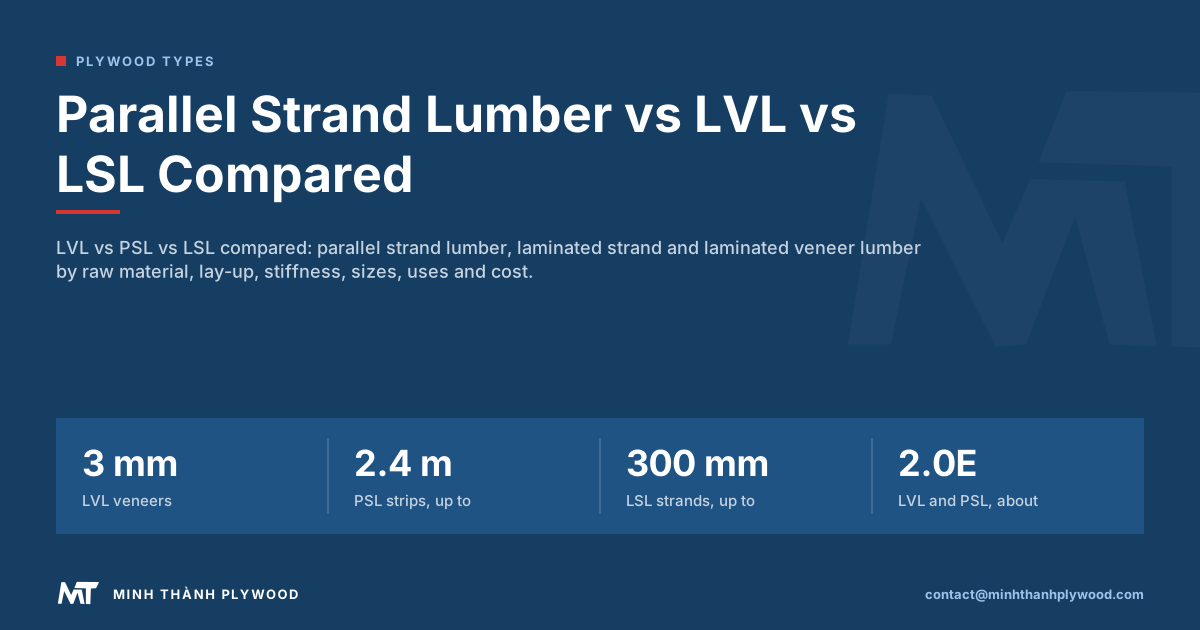
What is parallel strand lumber, where did it come from and who uses it?
Parallel strand lumber (PSL) is a structural composite lumber made from long, narrow veneer strips, glued with waterproof adhesive and pressed so that every strip runs along the length of the member. It is the engineered alternative to a large sawn or glulam beam or column.
- History. PSL is described by the BC wood promotion site naturally:wood as invented in British Columbia (naturally:wood, PSL). Weyerhaeuser sells it as Parallam (Weyerhaeuser Parallam PSL). A separate strand-based process, Scrimber, was developed in Australia by CSIRO and written up in 1985 and 1986 (Wikipedia: Parallel-strand lumber).
- Where it is used. PSL carries heavy loads in exposed structure: 13 m PSL columns support the glass roof of the UBC Forest Sciences Centre atrium, PSL roof beams span the Vancouver Aquarium Pacific Canada Pavilion, and PSL sits beside glulam and CLT in the five-storey Trinity Western University Jacobson Hall.
- Code and test proof. In North America PSL is evaluated to ASTM D5456. It is listed in evaluation reports such as ICC-ES ESR-1387, which also covers Microllam LVL and TimberStrand LSL. The USDA Forest Products Laboratory Wood Handbook chapter on engineered wood products describes the family.
- UK and Europe. There is no harmonised European standard for PSL, so a PSL beam is sold on a European Technical Assessment with CE or UKCA marking; LVL is covered by EN 14374. UK buyers use PSL for exposed posts and beams, and as a glulam alternative where a single solid section is wanted.
Typical design values for a 2.2E Parallam PSL beam, 12 in depth basis, are bending 2,900 psi, shear 290 psi, compression perpendicular to grain 625 psi and a modulus of elasticity of 2.2 million psi (about 15,170 MPa). Treat them as typical only: design from the maker’s evaluation report for the product on site.
LVL vs PSL vs LSL: the short answer
LVL, PSL and LSL differ in what they are made from: veneer sheets, veneer strips or wood strands. That decides stiffness, sizes and cost. PSL and LVL are the stiffest for beams and columns; LSL is the economical choice for rim boards, studs and short headers.
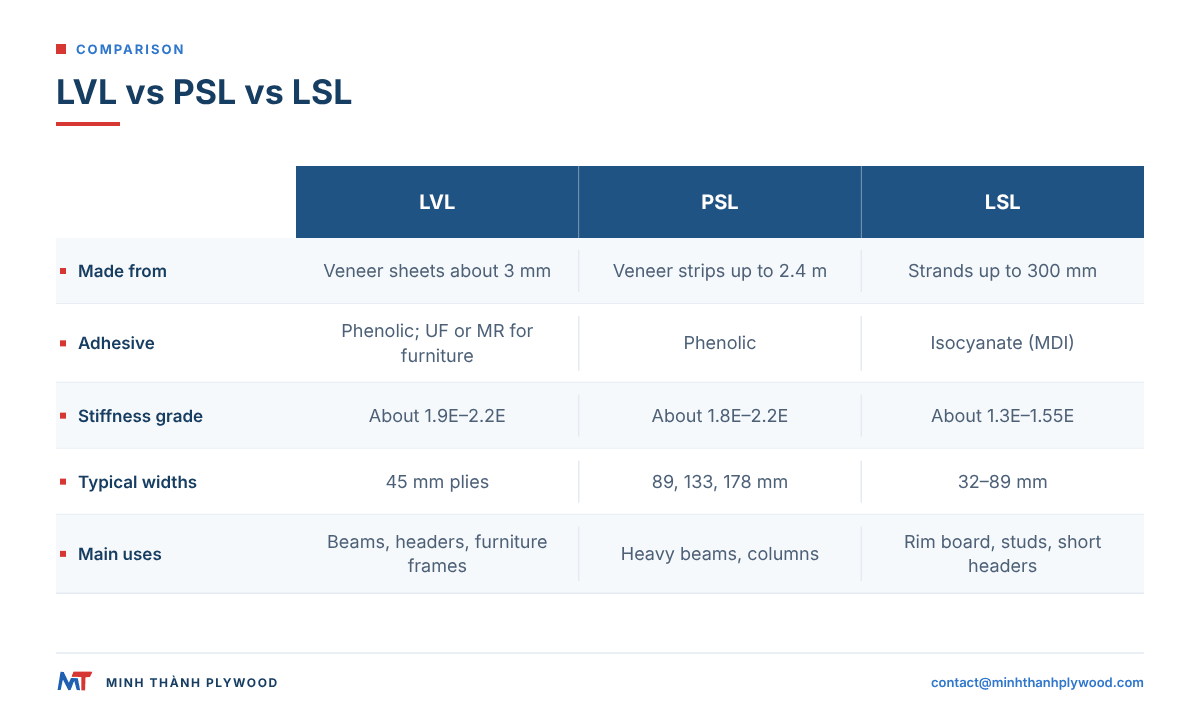
| LVL (laminated veneer lumber) | PSL (parallel strand lumber) | LSL (laminated strand lumber) | |
|---|---|---|---|
| Raw material | Whole veneer sheets, about 3 mm thick | Veneer strips up to about 2.4 m long | Wood strands up to about 300 mm long |
| Typical species | Douglas fir, southern pine, spruce, poplar; in Vietnam Acacia and Eucalyptus | Douglas fir, southern pine, western hemlock, yellow poplar | Aspen, yellow poplar |
| Lay-up | Veneers glued with the grain mainly one way | Strips aligned along the length | Strands aligned along the length |
| Adhesive | Phenolic (structural); UF or MR for furniture LVL | Phenolic, cured in the press | Isocyanate (MDI) |
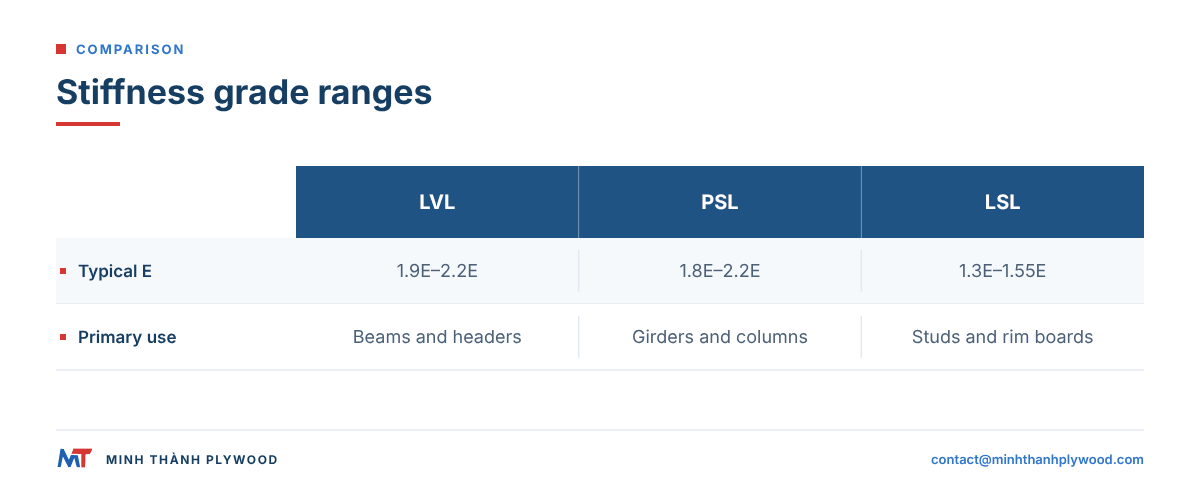
| Typical stiffness grade | About 1.9E–2.2E | About 1.8E–2.2E | About 1.3E–1.55E |
| Typical widths | 45 mm plies, built up for wider beams | 89, 133 and 178 mm single pieces | 32–89 mm |
| Main uses | Beams, headers, rafters, flanges, furniture frames | Heavy beams, girders, columns, posts | Rim board, studs, short headers, sills |
| Best-known trade names | Microllam | Parallam | TimberStrand |
| Look | Veneer edges in fine lines | Visible strand texture | Flaked strand surface |
Stiffness grades are shown as “E” in million psi of modulus of elasticity, the way US makers publish them. In North America all three are evaluated under code-referenced ASTM specifications, mainly ASTM D5456, or proprietary evaluation methods, as APA – The Engineered Wood Association describes.
What is structural composite lumber?
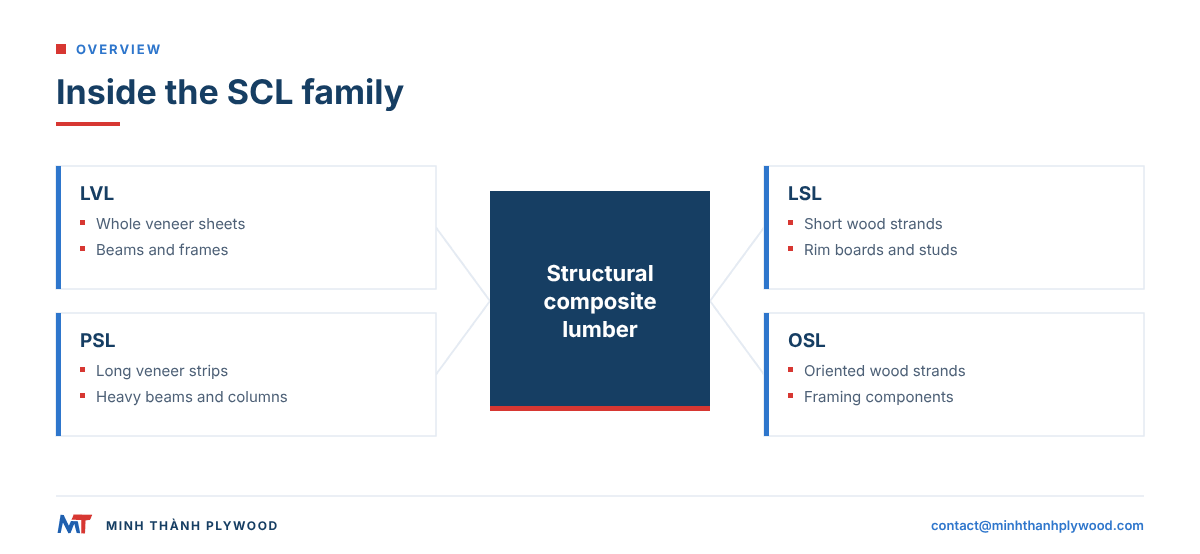
Structural composite lumber (SCL) is engineered wood made by bonding veneers, veneer strips or wood strands with their grain aligned along the length of the member. The family includes LVL, PSL, LSL and oriented strand lumber (OSL).
SCL exists for one reason: sawn timber is limited by the tree. Long, straight, knot-free beams need large old logs, and even then the strength varies from piece to piece. Cutting the log into thin veneers or strands spreads knots and grain defects through many layers, so the finished member is stronger on average and far more predictable.
Three properties follow from that:
- Consistent strength. Design values are published per grade, not guessed per piece.
- Long, straight members. Billets are pressed long and cut to length, limited by transport more than by the tree.
- Better use of the log. Smaller, fast-growing logs make structural members that once needed old-growth timber.
Glulam and cross-laminated timber (CLT) are engineered wood too, but they are built from sawn boards, so they sit outside the SCL family. See glulam beams and cross-laminated timber for those.
What is laminated veneer lumber (LVL)?
Laminated veneer lumber is made by gluing thin rotary-peeled veneers, about 3 mm each, with the grain running mainly along the length of the member. It is pressed into billets, then sawn into beams, headers, flanges and strips.
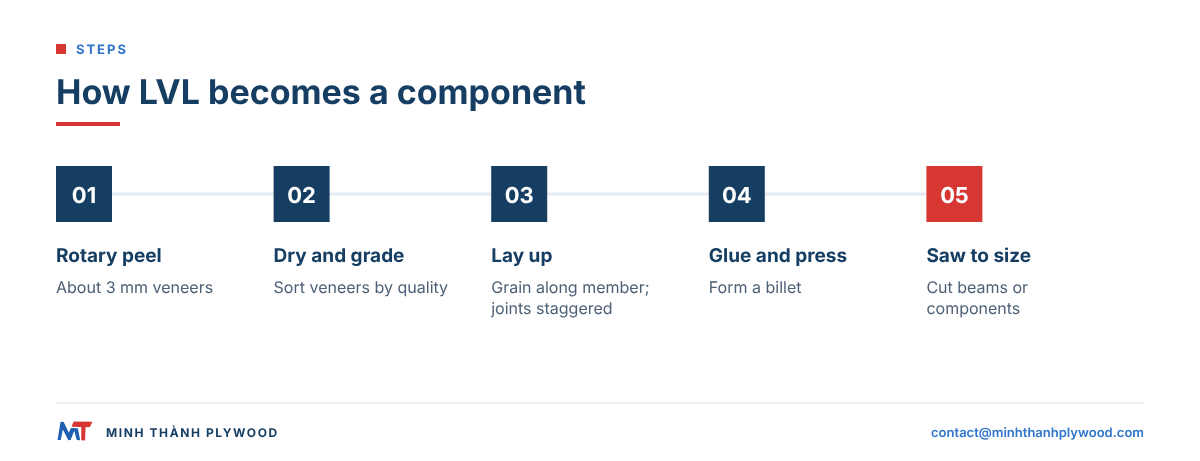
How LVL is made, step by step:
- Peel logs into veneer sheets on a rotary lathe.
- Dry and grade the veneers, often by ultrasonic stiffness grading for structural LVL.
- Lay up the sheets with the grain one way and staggered end joints; some products add a few cross plies for width stability.
- Glue and press the lay-up into a continuous or batch billet under heat.
- Saw the billet into members of the ordered depth and length.
LVL differs from plywood in one point only: plywood alternates the grain at right angles in every layer, LVL keeps it one way. That makes LVL strong along a beam and plywood stable across a panel. Minh Thanh’s laminated veneer lumber uses Acacia or Eucalyptus plantation veneers, about 580 kg/m³ for Acacia and 650–750 kg/m³ for Eucalyptus, dried to 8–12 % moisture.
What is parallel strand lumber (PSL)?
Parallel strand lumber is made from long, narrow strips clipped from veneer sheets, up to about 2.4 m long, coated with phenolic adhesive, aligned along the length and pressed into large billets for structural beams and columns. The best-known PSL is sold as Parallam.
The process explains its strengths:
- Strips, not sheets. Clipping veneer into strips removes the worst defects and lets the mill use veneer that would be rejected for LVL.
- Large sections in one piece. PSL is pressed in widths of 89, 133 and 178 mm, so a heavy beam or column needs no built-up plies.
- High stiffness. Typical grades sit around 1.8E for columns and 2.0E–2.2E for beams.
- Distinctive look. The strands show on every face, so PSL is often left exposed in posts and beams.
PSL lumber costs more than LVL per cubic metre. It earns that where one large, stiff, uniform member is simpler than three plies of LVL bolted together, or where the look of the beam matters.
What is laminated strand lumber (LSL)?
Laminated strand lumber is made from short wood strands, up to about 300 mm long, cut from fast-growing species such as aspen and yellow poplar, coated with an isocyanate (MDI) adhesive, aligned along the length and pressed into thick billets. The best-known LSL is sold as TimberStrand.
LSL lumber is the economy member of the family:
- Smaller logs. Strands come from small-diameter, fast-growing trees that make neither veneer nor sawn beams.
- Straight and stable. LSL studs and plates stay straight, which helps on tall walls and around windows.
- Good fastener holding. Dense strand mats hold nails and screws well near edges, useful in rim boards.
- Lower stiffness. Typical grades sit around 1.3E–1.55E, below LVL and PSL.
LSL is chosen for rim boards, tall-wall studs, sills, short headers and window and door framing, where straightness matters more than maximum span.
LSL vs LVL: which should you use?
Use LVL where the member must span and carry load; use LSL where straightness, fastener holding and cost matter more than span. LVL is stiffer, LSL is more economical.
| Question | LVL | LSL |
|---|---|---|
| Long-span beams and headers | Yes, first choice | Short spans only |
| Rim board around a floor | Used | First choice |
| Tall-wall studs | Rare | First choice |
| Stiffness grade | About 1.9E–2.2E | About 1.3E–1.55E |
| Nail and screw holding near edges | Good | Very good |
| Cost per m³ | Middle | Lowest of the three |
| Furniture and joinery parts | Yes (furniture-grade LVL) | Rarely |
On a typical house frame both appear: LVL for the beams and headers, LSL for the rim board and the tall walls. The choice is the engineer’s, from the design values of the product on site.
Parallel strand lumber vs LVL: when does PSL win?
Parallel strand lumber beats LVL where one large, solid section is needed: heavy girders, long beams carrying point loads, and columns. LVL beats PSL on cost and on availability in thin members.
Where PSL wins:
- Columns and posts. A single 178 mm square PSL post replaces built-up LVL.
- Wide beams. A 178 mm wide PSL beam carries large loads without bolting plies together.
- Exposed structure. The strand texture is a finish in its own right.
Where LVL wins:
- Cost. LVL usually costs less per cubic metre than PSL.
- Thin members. 45 mm LVL plies suit headers, rafters, I-joist flanges and furniture frames.
- Billets and panels. LVL can be supplied as billets for machining into components.
A short rule: LVL vs PSL is a question of section size. Thin and long goes LVL; wide and heavy goes PSL.
How do LVL, PSL and LSL compare on strength and stiffness?
LVL and PSL are close in stiffness, around 2.0E for common beam grades; LSL is lower at around 1.3E–1.55E. All three are more consistent than sawn timber of the same species, which is why their design values are higher.
Three points help when reading the numbers:
- “E” is stiffness, the modulus of elasticity in million psi. A 2.0E member deflects less under load than a 1.55E member of the same size.
- Bending strength follows the grade, and each maker publishes it per product in an evaluation report.
- Values are not interchangeable between brands, even at the same E. The engineer designs to the report of the product that will be installed.
For furniture-grade LVL, strength is not specified as a design value but by the component: the section, the span of a rail or frame, the screw positions. Our LVL for frames and rails is specified on the component drawing, and the buyer tests the free sample on the actual joint and load.
What sizes are LVL, PSL and LSL made in?
Sizes follow the product. Structural LVL comes mainly as 45 mm plies in beam depths, PSL as single pieces 89, 133 and 178 mm wide, and LSL as 32–89 mm members. All three are pressed as long billets and cut to the ordered length.
| Product | Typical widths | Typical supply |
|---|---|---|
| Structural LVL | 45 mm plies, joined for 89 and 133 mm beams | Beams, headers, rafters by depth and length |
| PSL | 89, 133 and 178 mm | Beams and square or rectangular columns |
| LSL | 32–89 mm | Rim board, studs, headers |
| Minh Thanh LVL | Billets 1220 × 2440 or 1250 × 2500 mm | Cut to the component drawing |
Minh Thanh supplies LVL as billets in the two formats, cut to your sections and lengths: thickness × width × length from the approved drawing, grain along the member, marked on the cutting plan.
What are LVL, PSL and LSL used for?
LVL is used for beams, headers, rafters, I-joist flanges, scaffold planks and, in furniture-grade LVL, frames, rails and door components. PSL is used for heavy beams, girders and columns. LSL is used for rim boards, studs, sills and short headers.
| Use | Best choice | Why |
|---|---|---|
| Floor and roof beams | LVL or PSL | High stiffness, long lengths |
| Window and door headers | LVL; LSL for short spans | Stiff, straight, sized to the opening |
| Columns and posts | PSL | Large single sections |
| Rim board | LSL | Fastener holding, straight |
| Tall-wall studs | LSL | Stays straight |
| I-joist flanges | LVL | Strong, thin members |
| Sofa and bed frames, rails | Furniture-grade LVL | Consistent, machinable, no knots |
| Door stiles and frame components | Furniture-grade LVL | Stable, straight core for facings |
| Packing skids and runners | LVL | Strong per cross-section, cut to length |
Minh Thanh Plywood makes its LVL for the last three rows: furniture frames, door components and packaging members.
Will LVL, PSL or LSL rot or warp?
None of the three warps much if kept dry, because their layers or strands balance each other; all three can rot if left wet, because they are wood. Keep them covered on site, off the ground and dry before closing in.
Practical rules:
- Store flat on bearers, under cover and off concrete; leave the wrap on.
- Seal cut ends on members that may see moisture during building.
- Use treated or exterior-rated products where the member will be exposed; the bond alone does not stop decay.
- Check moisture before finishing furniture parts; our LVL ships at 8–12 % moisture content.
LSL can swell at the edges if soaked; LVL and PSL are more stable in short wetting. None should stay wet for long.
How do LVL, PSL and LSL compare with glulam and solid timber?
Glulam is built from sawn boards about 35–45 mm thick, not veneers or strands, and suits large exposed beams and curves. Solid sawn timber is the cheapest but the least predictable. LVL, PSL and LSL sit between them: consistent strength in compact sections.
| LVL | PSL | LSL | Glulam | Solid timber | |
|---|---|---|---|---|---|
| Built from | Veneers | Veneer strips | Strands | Sawn laminations | One piece |
| Strength consistency | High | High | High | High | Variable |
| Large exposed beams | Possible | Yes | No | First choice | Limited |
| Curved members | No | No | No | Yes | No |
| Furniture parts | Yes | Rare | Rare | Rare | Yes |
For the detailed comparisons, see LVL vs glulam and LVL vs solid timber.
Which should you choose? A decision by use
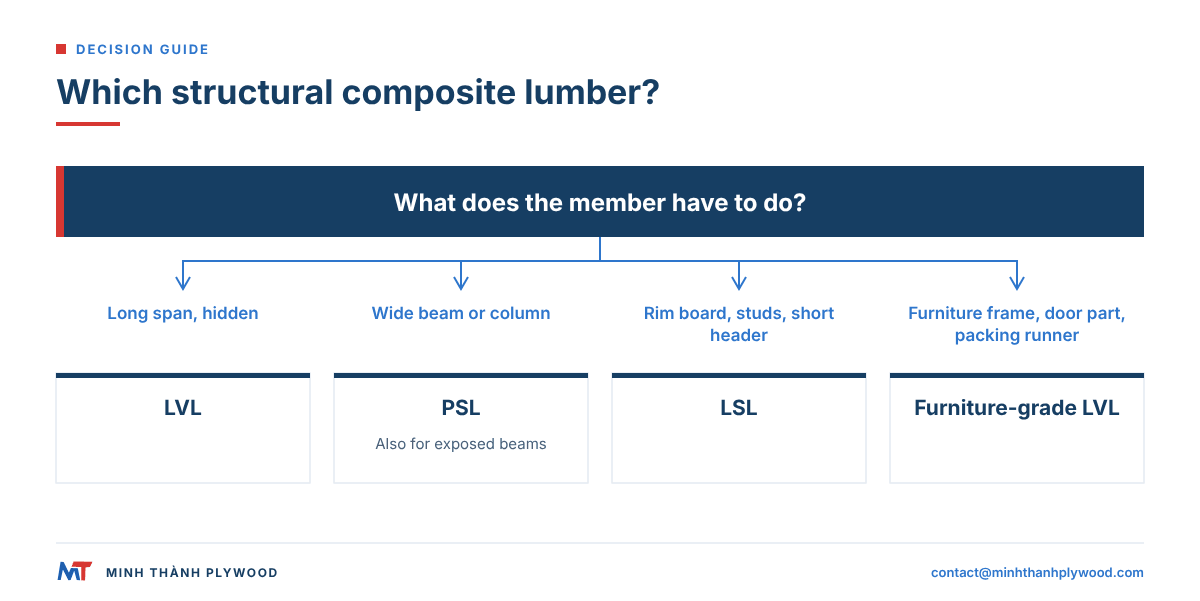
Start with the member, not the product: span, load, section size and whether it shows. The answer then follows.
- Long span or heavy load, member hidden: LVL.
- Very wide beam or a column: PSL.
- Exposed beam with an engineered look: PSL, or glulam for large spans.
- Rim board, studs or short headers: LSL.
- Furniture frames, door components, packaging runners: furniture-grade LVL from veneers.
How do you order LVL from Minh Thanh Plywood?
Send the component drawing and six lines, and we quote the LVL build. Minh Thanh Plywood makes LVL from Acacia or Eucalyptus plantation veneers; it does not make PSL or LSL.
- Application: furniture frame, door component or packaging member.
- Species: Acacia (about 580 kg/m³) or Eucalyptus (650–750 kg/m³).
- Glue and emission: UF glue at E0 emission for interiors, E1 as an option, MR / melamine-fortified or phenolic WBP for damp or exposed parts.
- Section and length: thickness × width × length, grain along the member.
- Surfaces: visible faces and machining allowance.
- Quantity and packing: pieces per section and length, total m³, destination port.
Orders start at one 40HC with mixed specifications by agreement; production takes 15–45 days after the 30% deposit, and we ship FOB Hai Phong, CFR or CIF. We supply the EUDR compliance dossier (origin records and geolocation files) with orders. The factory’s chamber test results for UF glue at E0 emission are on the formaldehyde emission page. Free samples come with the quotation: write to contact@minhthanhplywood.com.
Buyer questions, answered
What is parallel strand lumber (PSL)?
Parallel strand lumber is structural composite lumber made from long, narrow strips of wood veneer, laid parallel to the length and bonded with a waterproof adhesive under heat and pressure. It is used for heavy beams, headers and columns.
What is the difference between LSL and LVL?
LVL is made from whole veneer sheets glued with the grain one way; LSL is made from short wood strands glued and pressed into a billet. LVL is stiffer and stronger in bending; LSL is more economical and holds fasteners well in rim boards, studs and short headers.
Is PSL stronger than LVL?
They are close. Typical published grades sit around 2.0E for both, with PSL also offered in larger single-piece widths for heavy beams and columns. The engineer chooses by the evaluated design values of the actual product.
Is LVL stronger than solid timber?
For the same section, LVL gives higher and more consistent strength along its length, because the veneers spread natural defects such as knots through many thin layers. That is why LVL beams can span further than sawn timber of the same size.
What is the difference between LVL and glulam?
LVL is made from thin veneers about 3 mm thick, glued with the grain parallel; glulam is made from sawn timber laminations, typically about 35–45 mm thick, glued face to face. Glulam is chosen for large exposed beams and curved members; LVL for compact, high-strength members.
Will LVL rot or warp?
LVL is as straight as it is made and stays straight if kept dry, because the veneers balance each other. It is wood, so it rots if left wet; exterior use needs a weather-resistant bond, preservative treatment where specified, and protection of cut ends.
Is structural composite lumber the same as glulam?
No. Structural composite lumber covers LVL, PSL, LSL and oriented strand lumber, all made from veneers or strands. Glulam is made from sawn lumber boards, so it is a separate engineered wood product.
Which is cheapest: LVL, PSL or LSL?
LSL is usually the most economical per cubic metre, because it uses smaller, lower-grade logs. LVL sits in the middle, and PSL is usually the most expensive, paid for where its large sections and appearance are needed.
Can PSL be used exposed?
Yes. PSL shows a distinctive strand texture and is often left exposed in posts and beams. LVL is usually covered, though it can be sanded and finished for visible furniture and joinery parts.
Does Minh Thanh Plywood make PSL or LSL?
No. Minh Thanh Plywood makes LVL from Acacia or Eucalyptus plantation veneers for furniture frames, door components and packaging members, in 1220 × 2440 and 1250 × 2500 mm billet formats.