
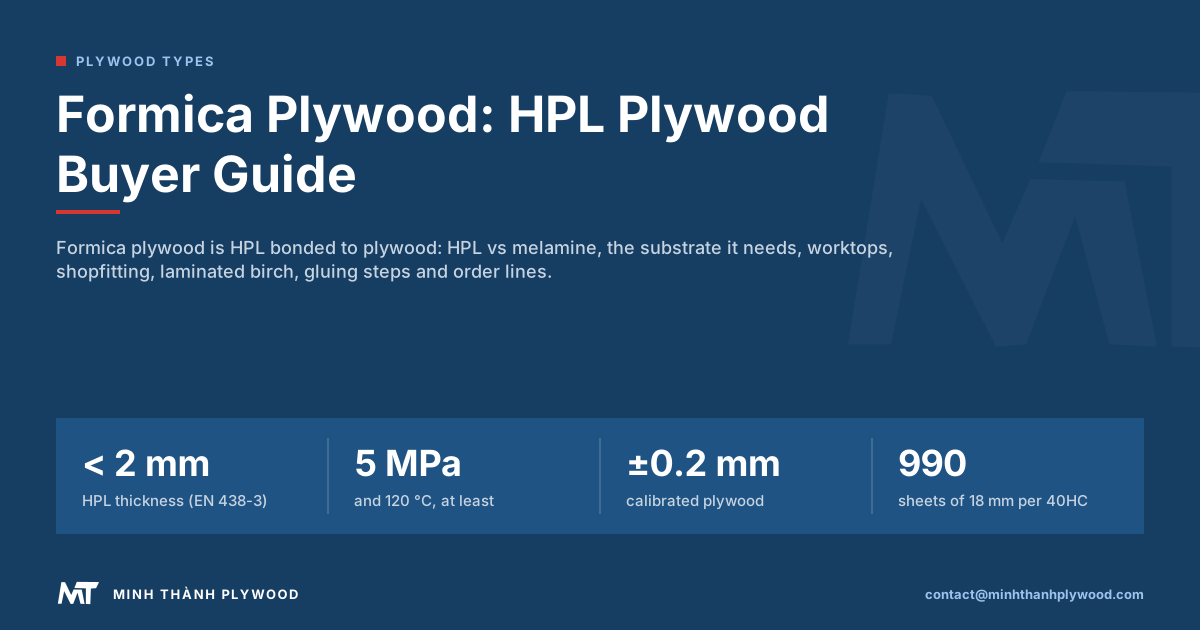
Formica plywood is plywood with a sheet of high-pressure laminate (HPL) bonded to its face; Formica is the best-known brand of HPL, so the name stuck to the whole product. The laminate gives a hard, hard-wearing surface for worktops, counters and shop furniture, and the plywood underneath gives strength, light weight and screw holding. Minh Thanh Plywood makes the calibrated furniture plywood such a laminate needs.
What is HPL plywood (formica faced plywood)?
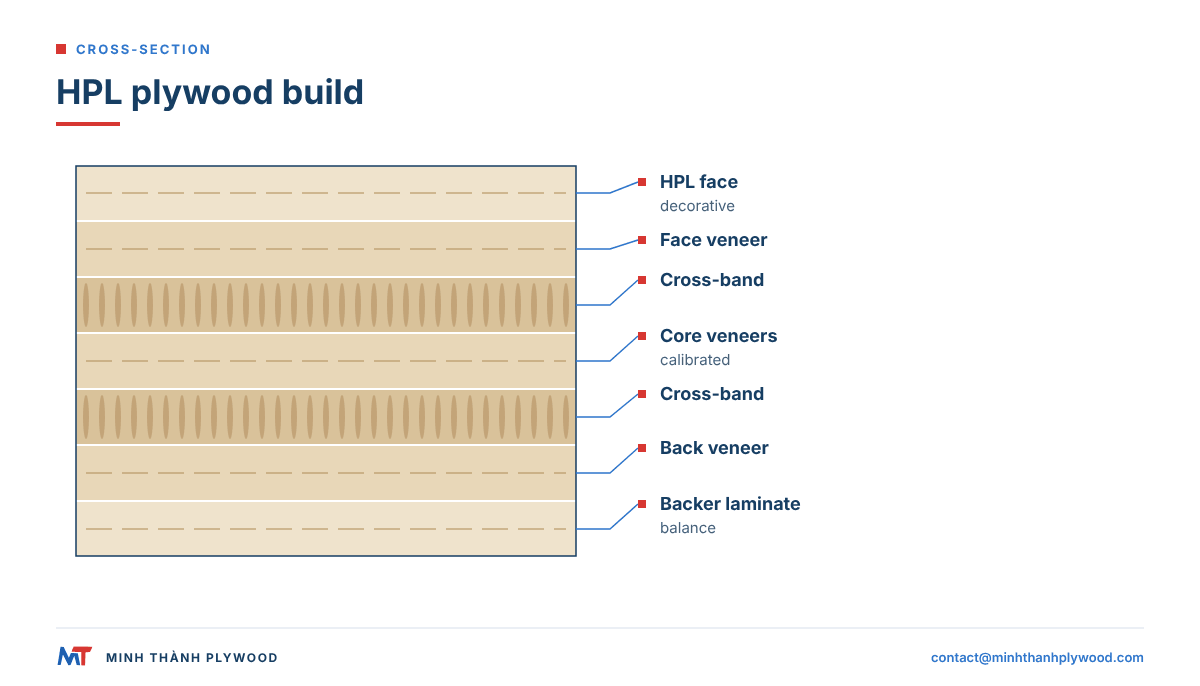
Formica plywood is a plywood panel with a high-pressure decorative laminate (HPL) glued to its face, and usually a balancing laminate on its back. The laminate is a separate sheet, made in a laminate press long before it meets the plywood, then bonded on with glue in a press or by hand.
The name comes from Formica, the best-known HPL brand. In the UK and many other English-speaking markets, “formica” became the everyday word for any plastic laminate, so formica plywood, formica faced plywood, formica laminated plywood, HPL plywood and high pressure laminate plywood all mean the same product. A plywood formica worktop is the most common example.
What the buyer gets is two materials working together: the laminate’s hard, wear-resistant, cleanable face and the plywood’s strength, light weight and screw holding. The plywood under the laminate decides whether the finished panel stays flat.
What is HPL, and how is it made?
HPL is a sheet of paper layers saturated with thermosetting resins and pressed together at high pressure and temperature until the resins cure into one hard laminate. A typical build, from the top:
- Overlay: a clear melamine-impregnated paper that carries wear resistance (used on high-wear grades).
- Décor paper: the colour or print, impregnated with melamine resin.
- Core papers: several layers of kraft paper impregnated with phenolic resin, which give the sheet its body.
The European standard EN 438 defines high-pressure laminates and their test methods: EN 438-3 covers decorative laminates under 2 mm thick made for bonding to a substrate such as plywood, and EN 438-4 covers compact laminates 2 mm and thicker that stand on their own. EN 438-1 defines “high pressure” as at least 5 MPa together with a temperature of at least 120 °C. In North America the standard is NEMA LD 3.
Grades differ by use: horizontal grades for worktops, vertical grades for walls and cabinet sides, post-forming grades thin and flexible enough to bend round a rounded worktop edge, and flame-retardant grades for public interiors.
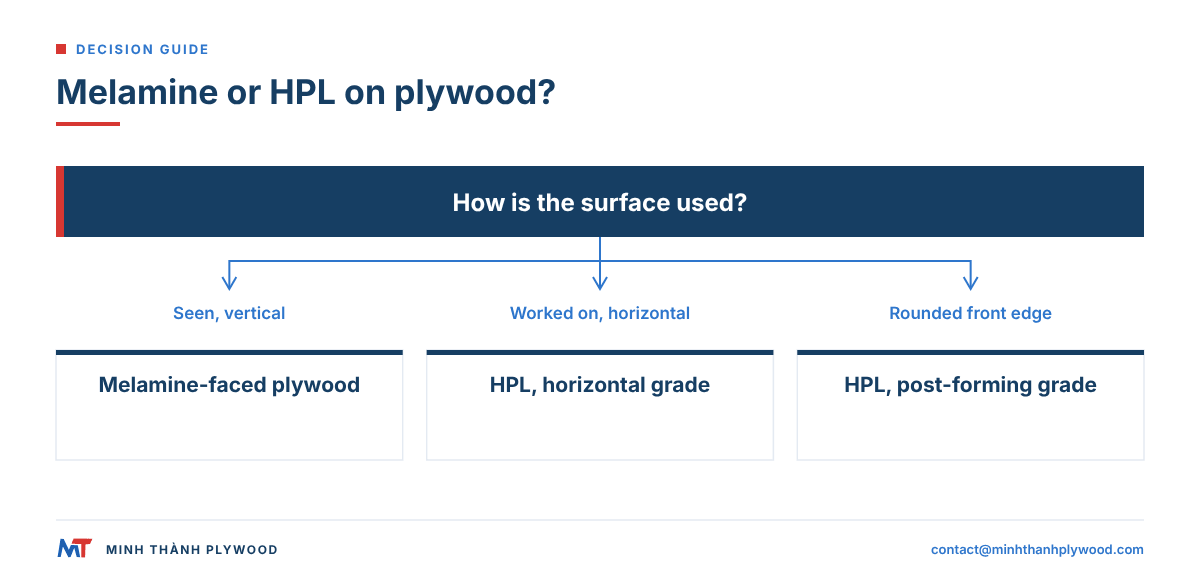
HPL vs melamine on plywood: which should you choose?
HPL and melamine both put a resin face on plywood, but they are made and used differently. Melamine paper is cured straight onto the plywood at low pressure; HPL is a thicker laminate made at high pressure and glued on. One row per property:
| Property | Melamine-faced plywood | HPL (formica) plywood |
|---|---|---|
| How the face goes on | Impregnated paper cured directly onto the panel | Separate laminate sheet glued on |
| Face thickness | One paper layer, a fraction of a millimetre | Under 2 mm sheet (EN 438-3) |
| Impact resistance | Low: a sharp knock can crack it | High: absorbs knocks |
| Wear and scratch | Good for vertical surfaces | Best: horizontal grades for worktops |
| Heat resistance | Moderate | Higher, resists hot cups and short contact |
| Rounded edges | Not possible: edge banding only | Post-forming grades wrap round edges |
| Cost | Lower | Higher |
| Best for | Cabinet carcasses, wardrobes, shelves, doors | Worktops, counters, shop and lab furniture, high-traffic walls |
The rule of thumb: melamine for vertical surfaces that are seen, HPL for horizontal surfaces that are used. Kitchens often combine the two, melamine carcasses and an HPL worktop. Melamine faces are specified in our melamine plywood guide.
What plywood substrate does HPL need?
HPL needs a substrate that is flat, calibrated, dry and stable, because the laminate copies every step in the surface and pulls on the panel as it moves with humidity. Five requirements:
- Calibrated thickness. An even, sanded panel so the press applies even pressure and the glue line stays uniform. Minh Thanh’s sanded furniture panels hold ±0.2–0.3 mm, down to ±0.2 mm.
- Flat, defect-free face. No open splits, overlaps or core gaps under the face: our core layers are stitched both horizontally and vertically, and furniture-grade panels are pressed twice as standard.
- Stable moisture. Veneers and finished panels at 8–12% moisture content, the normal range for furniture plywood, so the panel does not shrink or swell under the laminate after bonding.
- Clean, sanded surface. Sanded and polished faces, free of dust and oil, so the glue wets the wood.
- Sound bond inside. UF glue at E0 emission for dry interiors; melamine-fortified MR or phenolic WBP where water is near.
The bonding-quality requirements are in EN 314-2, and BS EN 636:2012+A1:2015 covers plywood for use in dry, humid or exterior conditions.
The face veneer under HPL is hidden, so its appearance grade matters less than its soundness. A panel with a lower appearance grade face but a perfectly flat, calibrated surface makes better HPL plywood than a premium face on an uneven core.
Why does HPL plywood need a balanced back?
HPL plywood needs a balanced back because the laminate and the wood react differently to humidity. When the room dries, the laminate shrinks and pulls the panel into a bow towards the face; when it is damp, the wood swells against a laminate that hardly moves. A matching sheet on the back pulls the other way and keeps the panel flat.
The options for the back:
- Same HPL on both faces: cabinet doors, partitions and any panel seen from both sides.
- Backer laminate: a cheaper, undecorated HPL of similar thickness for worktops and counters fixed to a frame.
- Melamine balancing paper: only for light, small parts; it does not balance a full HPL face on a large panel.
Plywood itself helps: its cross-laminated veneers resist movement better than particleboard or MDF, so a plywood core warps less under an HPL face. A symmetric plywood build, the same number of veneers either side of the centre, completes the balance.
Which plywood core is best under formica?
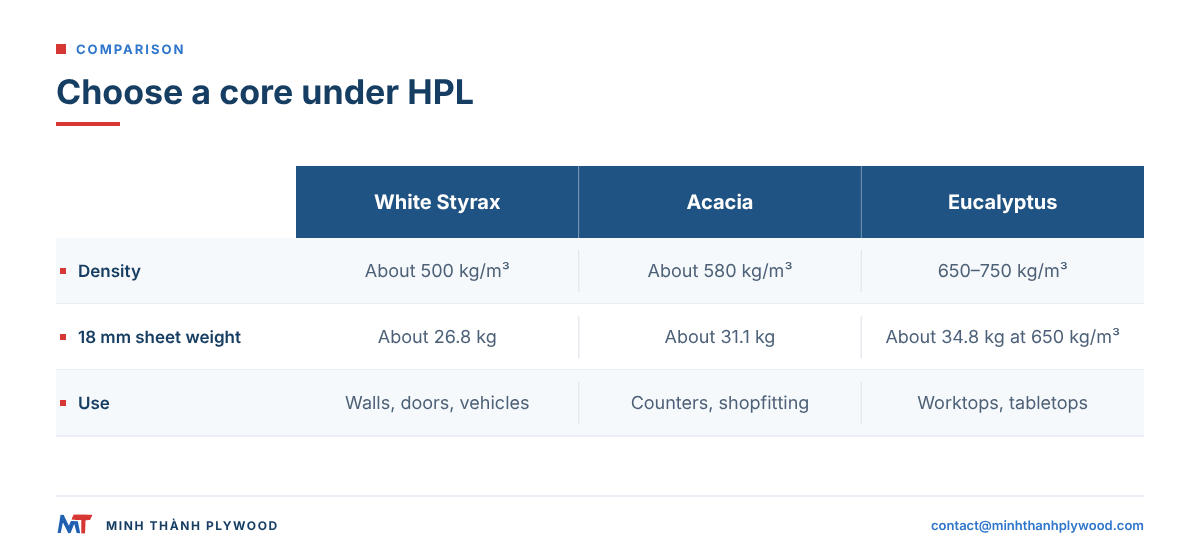
The core decides how heavy the panel is, how well it resists dents under the laminate and how firmly it holds screws. Minh Thanh’s furniture panels use white Styrax or Eucalyptus cores as standard, with Acacia and Pine on order.
| Core | Density | 18 mm sheet, 1220 × 2440 mm | Best under HPL for |
|---|---|---|---|
| White Styrax | about 500 kg/m³ | about 26.8 kg | Wall panels, doors, cabinet sides, van and caravan furniture |
| Acacia | about 580 kg/m³ | about 31.1 kg | Counters and shopfitting, general furniture |
| Eucalyptus | 650–750 kg/m³ | about 34.8 kg at 650 kg/m³ | Worktops, tabletops, heavily used counters |
A denser core resists denting: when a heavy object hits an HPL worktop, the laminate survives but a soft core underneath can dent and the dent shows through. Eucalyptus is therefore the choice for worktops and counters; Styrax is the choice where weight matters, such as wall linings, doors and vehicle interiors. The core options are on our Eucalyptus plywood page.
How do you build a plywood formica worktop?
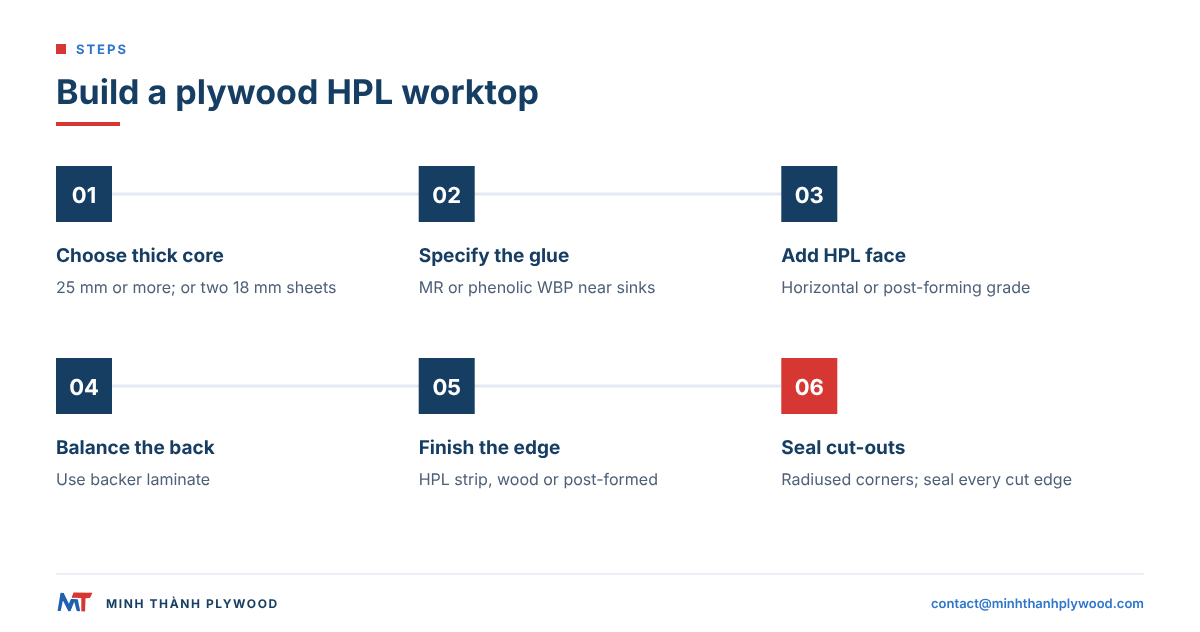
A plywood formica worktop is built from a thick plywood core, a horizontal-grade HPL face, a backer and a finished edge. The usual build:
- Core thickness: 25 mm or more, or two 18 mm plywood sheets bonded together for a 36 mm look.
- Glue in the plywood: melamine-fortified MR, or phenolic WBP around sinks and in humid kitchens.
- Face: horizontal-grade HPL, or a post-forming grade where the front edge is rounded.
- Back: a backer laminate.
- Edge: an HPL strip, a solid wood lipping or a post-formed edge; on plywood, the multi-ply edge can also be left visible and lacquered.
- Cut-outs: sink and hob cut-outs with radiused corners, and every cut edge sealed.
Plywood worktops are lighter than particleboard ones of the same thickness and hold fixings for brackets and undermount sinks better. Their weak point is water at the cut edges, which is why the sealing step is never skipped. For the cabinets under the worktop, see plywood for kitchen cabinets.
Where is HPL plywood used in shopfitting and interiors?
HPL plywood is used wherever a surface takes daily wear and must stay clean. The main uses:
- Shopfitting: counters, checkouts, display units, shelving and fitting-room panels.
- Offices and schools: desks, tables, reception counters and lockers.
- Hotels and restaurants: bar tops, table tops, wall cladding and service counters.
- Healthcare and labs: cabinets and work surfaces with chemical-resistant HPL grades.
- Vehicles: van, caravan, boat and train interiors, where a light plywood core saves weight.
- Wall panelling and doors: corridors, lift lobbies and doors that are touched and cleaned constantly.
Public interiors may require a fire classification for the whole panel, not just the laminate. In that case the specification names the fire class and the test standard for the finished panel, and both the laminate and the plywood are chosen to meet it.
What is laminated birch plywood?
Laminated birch plywood is birch plywood with an HPL face, used in Nordic-style furniture, kitchens and children’s furniture where the colourful laminate face and the pale multi-ply edge are both part of the design. The edge is left visible and lacquered instead of being banded.
That look depends on the core. An all-birch panel gives an even, dense birch edge. A birch-faced panel on a pale white Styrax core gives a light, even edge as well, at a lower weight; Minh Thanh’s birch plywood has imported birch faces on white Styrax or Eucalyptus cores, in face grades quoted as pairs such as D+/D or D/E.
Under HPL the birch face is hidden, so the face grade can be chosen for soundness rather than look. Where the edge shows, approve a cut sample of the edge as well as the face. The builds are on our birch plywood page.
How do you apply formica to plywood?
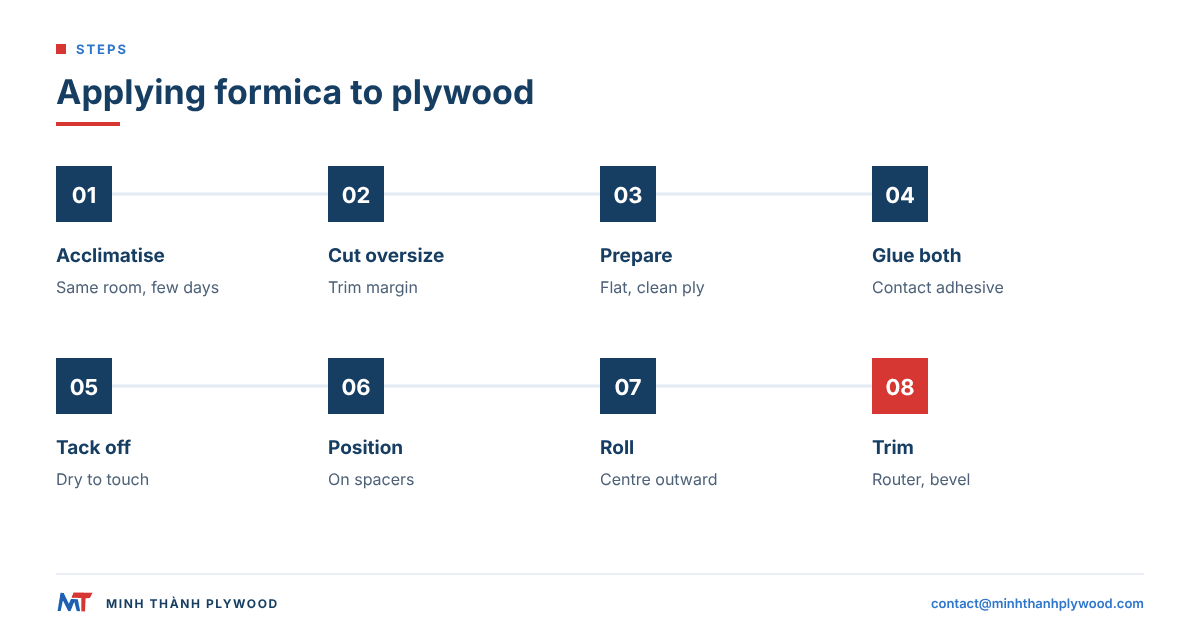
Formica is applied to plywood with contact adhesive for hand and site work, or with PVAc or urea glue in a press in a factory. The hand method, step by step:
- Acclimatise. Keep the laminate and the plywood in the same room for a few days so both reach the same moisture.
- Cut the laminate oversize. Leave a few millimetres beyond every edge of the plywood for trimming.
- Prepare the plywood. Check it is flat and sanded; remove dust with a clean cloth.
- Apply contact adhesive to both surfaces. Roll or spray an even coat on the back of the laminate and on the plywood face.
- Let it tack off. Wait until the adhesive is dry to a light touch, as the adhesive maker specifies.
- Position with spacers. Lay dowels or strips across the plywood, place the laminate on them, line it up, then pull the spacers out one by one from the centre outward.
- Roll it down. Press the laminate with a J-roller or laminate roller from the centre to the edges to drive out air.
- Trim the edges. Rout flush with a laminate trimming bit, then bevel lightly and file.
- Balance the back. Apply a backer laminate to the underside the same way, unless the panel is fixed to a sealed frame.
Contact adhesive bonds on contact, so the laminate cannot be slid once it touches. In factory lamination, PVAc or urea glue is spread on the plywood and the laminate is pressed on in a cold or heated press, which gives a more even glue line on large runs.
How do you install formica on plywood without bubbles or lifting?
Bubbles and lifting edges come from three causes: a dusty or uneven surface, adhesive that was not fully tacked off, and too little pressure. Prevent them on every panel:
- Use calibrated plywood. Thickness differences across the sheet leave areas the roller cannot press.
- Apply adhesive evenly. Thin or missed areas show as bubbles later.
- Roll hard, from the centre out. Air trapped in the middle of a large sheet cannot escape at the edges.
- Keep heat away for the cure time. A worktop next to an oven or in sun cures unevenly.
- Seal edges and cut-outs. Water entering at an edge swells the plywood and lifts the laminate from below.
On large orders, a pressed glue line made in a factory gives more uniform results than contact adhesive by hand. A test panel from the first pack, glued with the adhesive and method of the production line, settles the method before the order runs.
Is HPL plywood the same as film-faced plywood for formwork?
No. HPL plywood carries a decorative laminate for furniture, worktops and interiors; film-faced plywood carries a smooth phenolic film for pouring concrete. They look alike from a distance because both have a resin face, but the face, the glue and the job differ.
Film-faced plywood is built for formwork: a dark phenolic film on both faces, a water-resistant bond and sealed edges, so the panel can be cast against, cleaned and reused. Concrete contractors buying forming plywood need that product, not HPL. Minh Thanh’s film-faced build is described on its own film-faced plywood page.
What should go on a formica plywood quotation?
A formica plywood sheet order is complete when the plywood and the laminate are written as separate lines. Use this list:
- Use: worktop, counter, wall panel, door, vehicle interior.
- Plywood core: white Styrax, Eucalyptus, or Acacia or Pine on order.
- Glue and emission: UF glue at E0 emission, MR or phenolic WBP; emission class on its own line.
- Thickness, tolerance and size: for example 25 mm, ±0.2 mm, 1220 × 2440 or 1250 × 2500 mm, or custom sizes such as 1220 × 2500 and 1220 × 2280 mm.
- Laminate: grade (horizontal, vertical, post-forming, flame-retardant), décor, texture, back sheet.
- Packing and quantity: sheets per thickness, pack marks, destination port.
Send the list to contact@minhthanhplywood.com or on WhatsApp +84 988 586 601 (Lisa); replies come within hours, and samples are free. The minimum order is one 40HC with mixed specifications by agreement, production takes 15–45 days after the 30% deposit, and panels ship FOB Hai Phong, CFR or CIF.
Where can UK buyers source formica plywood, and what sizes and thicknesses apply?
UK buyers source formica plywood in two ways: finished panels laminated to order by a UK merchant, or plywood bought from a mill by the container and laminated in the buyer’s own workshop. The first is quick for a few sheets; the second suits fabricators and shopfitters who already run a laminating press.
| Point | UK laminating merchant (October 2026) | Container from Minh Thanh |
|---|---|---|
| Sheet sizes | 2440 × 1220 mm and 3050 × 1525 mm | 1220 × 2440 and 1250 × 2500 mm, custom sizes such as 1220 × 2500 mm, or cut-to-size into 4, 6 or 8 pieces |
| Panel thickness | 4–50 mm laminated panels | 3–40 mm plywood |
| Minimum order | About 5 sheets | One 40HC, mixed specifications by agreement |
| Lead time | 10–15 working days for in-stock laminates | 15–45 days after the 30% deposit, plus sea freight |
| Laminate | Formica ranges, chosen from the merchant’s stock | Your own HPL supplier and décor, applied locally |
Thickness adds up. A 0.7 mm laminate adds about 0.7 mm per face, so a panel laminated on both faces gains about 1.4 mm on the core thickness (SPP gives 1.4 mm). An 18 mm core laminated both sides is therefore about 19.4 mm; order the core thickness your joinery needs after lamination, and hold the core to ±0.2–0.3 mm so the finished panel stays even.
“Birch-look” formica plywood is a real product line, not a marketing phrase. Formica’s Birchply decors include F6372 White Washed Birchply, F8910 Raw Birchply, F8552 Black Birchply, F9229 Dark Sky Birchply and F8911 Green Slate Birchply, which are made to be used with a visible plywood edge. FENIX is the premium matt, anti-fingerprint alternative to HPL for the same worktop and cabinet jobs. A plywood core with a clean, pale edge, such as white Styrax or birch-faced Styrax, suits these decors.
For plywood bought from a mill, the checks are the same as for any import: the core species and glue, the thickness tolerance, the moisture content and the emission evidence. Minh Thanh’s furniture panels are certified to CARB P2 / TSCA Title VI (ICTT mill no. 23024); six ASTM D6007 chamber tests between April 2025 and June 2026 averaged 0.014–0.032 ppm. The limit for hardwood plywood is 0.05 ppm under 40 CFR 770.10. Third-party testing to the buyer’s own method is arranged through SGS on request.
A 40HC holds about 990 sheets of 18 mm, 1220 × 2440 mm plywood on a Styrax core, 18 packs of 55 sheets. The builds are on our furniture plywood page.
Buyer questions, answered
What is HPL plywood?
HPL plywood is plywood with a high-pressure decorative laminate sheet glued to one or both faces. The laminate is made separately under high heat and pressure, then bonded to the plywood.
Is Formica plywood the same as HPL plywood?
Yes. Formica is a brand of high-pressure laminate, and in the UK and many other markets formica has become the everyday word for any laminate. Formica plywood and HPL plywood describe the same build.
What is the difference between HPL and melamine plywood?
Melamine paper is pressed straight onto the plywood at low pressure; HPL is a thicker, separately made laminate glued on afterwards. HPL resists impact, wear and heat better, and costs more.
What thickness of plywood is best for a formica worktop?
Most plywood worktops use 25 mm or more, or two 18 mm sheets bonded together, with a moisture-resistant MR or phenolic WBP glue near sinks and a balancing laminate underneath.
What glue do you use to stick formica to plywood?
Contact adhesive for hand work and on site; PVAc or urea glue in a cold or hot press for factory lamination. All need a clean, flat, dry plywood surface.
Do you need a backer on formica plywood?
Yes, for any free-standing panel. A balancing laminate on the back stops the panel bowing towards the face when humidity changes; fixed worktops on a sealed frame can use a cheaper backer grade.
Can you put formica on plywood with a router edge?
Yes. The laminate is cut slightly oversize, bonded, then trimmed flush with a router and a laminate trimming bit, and the edge lightly bevelled.
Is HPL plywood waterproof?
The HPL face is water-resistant, but water can enter at edges, joints and screw holes. For wet areas, use plywood with a phenolic WBP or MR bond and seal every edge.
Is HPL plywood the same as film-faced plywood?
No. Film-faced plywood carries a phenolic film for concrete formwork; HPL plywood carries a decorative laminate for furniture, worktops and interiors.
What face veneer should be under HPL?
A sound, smooth, sanded face, because the laminate hides its look. A lower appearance grade is fine under HPL; what matters is flatness, no open defects and a calibrated thickness.
Which HPL standard applies?
EN 438 in Europe, with EN 438-3 for laminates under 2 mm thick bonded to a substrate; NEMA LD 3 is the North American standard.