
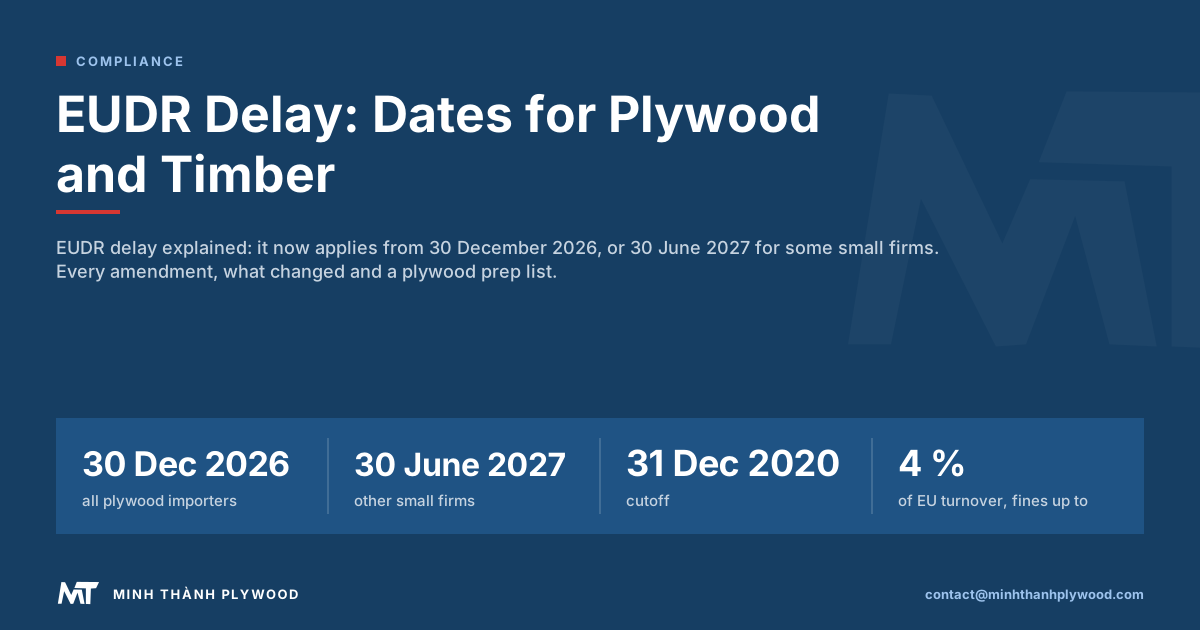
The EUDR was delayed twice and now applies from 30 December 2026 to large and medium operators and to every plywood importer already covered by the EU Timber Regulation, whatever its size. Other micro and small operators follow on 30 June 2027. No further delay has been adopted as of 20 October 2026. Minh Thanh Plywood supplies the EUDR compliance dossier with every order.
Is the EUDR delayed? The dates that apply now
Yes, the EUDR was delayed twice, and its obligations now apply from 30 December 2026. That date covers large and medium operators and every micro or small operator handling products already listed under the EU Timber Regulation (EUTR), which includes plywood. Other micro and small operators established by 31 December 2024 follow on 30 June 2027.
| Who | Original date (2023/1115) | After first delay (2024/3234) | Current date (2025/2650) |
|---|---|---|---|
| Large and medium operators and traders | 30 December 2024 | 30 December 2025 | 30 December 2026 |
| Micro and small operators, products under the EUTR (plywood, sawn wood, most timber) | 30 December 2024 | 30 December 2025 | 30 December 2026 |
| Other micro and small operators | 30 June 2025 | 30 June 2026 | 30 June 2027 |
| Products newly added by Delegated Regulation 2026/2102 | Not in scope | Not in scope | 30 December 2027 |
| EUTR transition for timber produced before 29 June 2023 | 31 December 2027 | Moved with the delay | 31 December 2029 |
The current dates are in Article 38 of Regulation (EU) 2023/1115 as replaced by Regulation (EU) 2025/2650, and the Commission repeated them on 13 July 2026 (European Commission). As of 20 October 2026 no further postponement has been published in the Official Journal.
For a plywood importer the short version is one date: 30 December 2026. The later June 2027 date does not reach plywood, because plywood is in the EUTR annex.
That answers the most searched EUDR delay question, “is the EUDR regulation delayed to 2026?”: yes, to 30 December 2026, and for plywood that is the only date that matters. Shipments released into free circulation in the EU from that day need a due diligence statement, even if they were bought or loaded earlier.
What is the EUDR and when does it take effect?
The EUDR, Regulation (EU) 2023/1115 on deforestation-free products, is the EU law that bans seven commodities and their products from the EU market unless they are deforestation-free, legally produced and covered by a due diligence statement. It entered into force on 29 June 2023 and takes effect for operators on 30 December 2026.
The seven commodities are cattle, cocoa, coffee, oil palm, rubber, soya and wood (Regulation (EU) 2023/1115, Article 1). Annex I lists the products made from them by customs code; plywood sits under ex 4412, together with veneered panels and similar laminated wood.
Article 3 sets three conditions. A product may be placed on the EU market, made available or exported only if:
- it is deforestation-free: made from wood harvested from forest without deforestation or forest degradation after 31 December 2020;
- it was produced legally under the laws of the country of production;
- it is covered by a due diligence statement (DDS) filed by the operator in the EU information system.
The delays changed when these conditions start to bite. They did not change the conditions, the 31 December 2020 cutoff or the list of commodities. A panel placed on the market in January 2027 must therefore contain wood harvested without deforestation or forest degradation after 31 December 2020: for plantation wood, plots that were already plantation on that date and were not converted from natural forest after it. For a plantation grown on the same land through several rotations, the plot history proves it.
EUDR timeline: every date from proposal to application
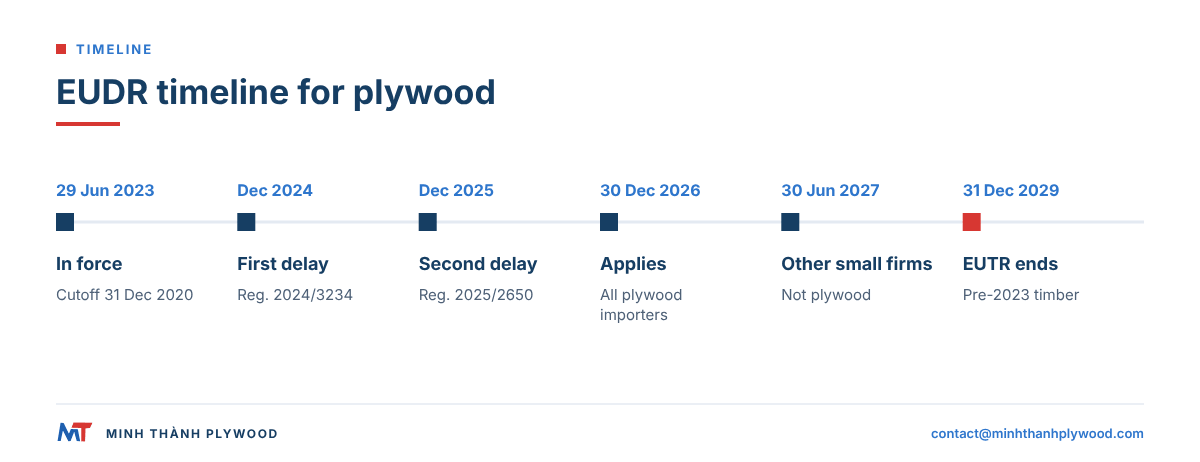
The EUDR timeline runs from the Commission proposal in November 2021 to full application for all operators in 2027, with two delays and a scope update between. The table lists every date a plywood buyer needs, each from the Official Journal or the Commission.
| Date | Event | What it means for plywood |
|---|---|---|
| 17 November 2021 | Commission proposes the regulation | Plywood and other wood products named from the start |
| 31 May 2023 | Regulation (EU) 2023/1115 signed | Final text, cutoff 31 December 2020 |
| 29 June 2023 | Entry into force | Wood produced from this date counts; older stock follows EUTR transition rules |
| 30 December 2024 | Original application date | Replaced by the first delay |
| 23 December 2024 | Regulation (EU) 2024/3234 published | First 12-month delay |
| May 2025 | Implementing Regulation (EU) 2025/1093 | Country risk list; Vietnam low risk |
| 19 December 2025 | Regulation (EU) 2025/2650 signed | Second 12-month delay plus simplifications |
| 30 April 2026 | Deadline for the Commission’s simplification review | Report on burden for small operators |
| 13 July 2026 | Commission announces Delegated Regulation (EU) 2026/2102 | Product scope updated; plywood stays as ex 4412 |
| 30 December 2026 | Application for large and medium operators and all EUTR-product operators | Plywood importers of every size |
| 30 June 2027 | Application for other micro and small operators | Not plywood |
| 30 December 2027 | Newly added products come into scope | Soluble coffee, some palm derivatives and others |
| 31 December 2029 | End of EUTR transition for timber produced before 29 June 2023 | Old stock placed on the market after 30 December 2026 |
| 30 June 2030 | General review of the regulation | Possible wider scope |
The entry into force on 29 June 2023 still matters. The EUDR does not apply to wood produced before that day; that wood stays under the EUTR until the end of the transition.
Why was the EUDR delayed twice?
The EUDR was delayed twice because operators, third countries, member states and the EU information system were not ready to run due diligence for millions of shipments by the original date. Both delays were 12 months and both were adopted days before the date they replaced.
The first delay, in December 2024, answered warnings from trading partners and EU industry that guidance, the country risk list and the information system came too late for a December 2024 start. The second, in December 2025, followed concerns about the capacity of the information system to handle the expected volume of statements and a push to simplify duties for smaller firms.
Regulation 2025/2650 gives its own reason in recital 15: the postponement was needed “to allow third countries, Member States, operators and traders to be fully prepared”. It also added a simplification review, due by 30 April 2026, to look at the burden on micro and small operators before the new date.
Neither delay weakened the substance. The cutoff, the geolocation duty and the deforestation-free test are the same as in 2023. The extra time is preparation time, and supply chains that used it are the ones ready for December 2026.
| Delay | Adopted | Length | What else changed | Main reason given |
|---|---|---|---|---|
| First, Regulation (EU) 2024/3234 | December 2024 | 12 months | Nothing of substance; “no-risk” category dropped | Partners, operators and member states not ready |
| Second, Regulation (EU) 2025/2650 | December 2025 | 12 months | Downstream and trader duties cut, simplified declaration, review clause, longer EUTR transition | Readiness of all parties and of the information system |
Read together, the two delays show a pattern: each moved the date and kept the core rules. The second also lightened the load on businesses after the first operator, which is where plywood buyers in the EU furniture trade sit.
What changed with the first delay, Regulation (EU) 2024/3234?
Regulation (EU) 2024/3234 moved every EUDR application date back by 12 months and changed nothing else of substance. Large and medium operators moved from 30 December 2024 to 30 December 2025; micro and small operators from 30 June 2025 to 30 June 2026. The repeal of the EUTR and its transition dates moved with them.
The European Parliament had voted to add a “no-risk” country category, which would have removed most duties for some origins. That amendment did not survive negotiations with the Council, so the final text was a pure delay (Regulation (EU) 2024/3234).
The extra year was used for three pieces of groundwork:
- the country benchmarking, adopted as Implementing Regulation (EU) 2025/1093, which classed most countries, Vietnam included, as low risk;
- guidance and FAQs from the Commission on scope, roles and geolocation;
- the information system, where operators register and file statements.
For plywood buyers, the low-risk listing of Vietnam was the most practical change of that year: it opened the simplified due diligence route described below.
What changed with Regulation (EU) 2025/2650?
Regulation (EU) 2025/2650 delayed the EUDR by another 12 months and also changed who files what. It is the amendment that reshaped duties along the supply chain, so it matters more for planning than the first delay did. These are the changes a plywood buyer should know.
| Change in 2025/2650 | Before | After |
|---|---|---|
| Main application date (Article 38(2)) | 30 December 2025 | 30 December 2026 |
| Micro and small operators (Article 38(3)) | 30 June 2026 | 30 June 2027, if established by 31 December 2024, except EUTR-annex products |
| Downstream operators (new Article 2(15b), Article 5) | Filed their own statements | No statement; the first downstream operator collects and keeps the reference numbers |
| Micro and small primary operators (new Article 4a) | Full due diligence | One-time simplified declaration and a declaration identifier |
| Geolocation for micro and small primary operators | Coordinates only | Postal address of the plots or of the producing establishment allowed (Article 4a(5)) |
| EUTR transition (Article 37(2)) | Shorter | Until 31 December 2029 for timber produced before 29 June 2023 |
| Simplification review | None | Commission report by 30 April 2026 |
The downstream change helps EU furniture and joinery firms that buy plywood already covered by a statement. They no longer file a second statement for the cabinet or door made from it. The importer of the plywood stays the operator and still files.
The simplified declaration is a route for micro and small primary operators, such as small farmers and forest owners. It is not a general exemption for small importers, and plywood importers of any size still carry the full operator duty from 30 December 2026.
EUDR delay latest news: what is the latest update on the EUDR?
The EUDR delay latest news for plywood is that there is no new delay: the latest update is the product scope change of July 2026: Commission Delegated Regulation (EU) 2026/2102 rewrote parts of Annex I and kept plywood in scope. The application dates did not change, and the Commission confirmed them in the same announcement on 13 July 2026.
For plywood, the delegated act made three points clear:
- the customs line now reads “ex 4412 plywood, veneered panels and similar laminated wood (not including used products and second-hand products)” (Delegated Regulation (EU) 2026/2102);
- samples and products used for analysis, examination and testing are outside the scope;
- single-use packing material and containers used only to support, protect or carry another product, and presented with it, are outside the scope, so plywood crate panels around a machine fall outside, while plywood sold as a product does not.
Products newly added by the delegated act, such as soluble coffee and some palm oil derivatives, come into scope on 30 December 2027. That later date is for the new products only; it does not extend to plywood.
The other 2026 milestone was the simplification review due by 30 April 2026 under the 2025 amendment. As of 20 October 2026 it has not led to a new delay in the Official Journal, so 30 December 2026 is the date to plan for.
Which date applies to you: large, medium, micro and small operators
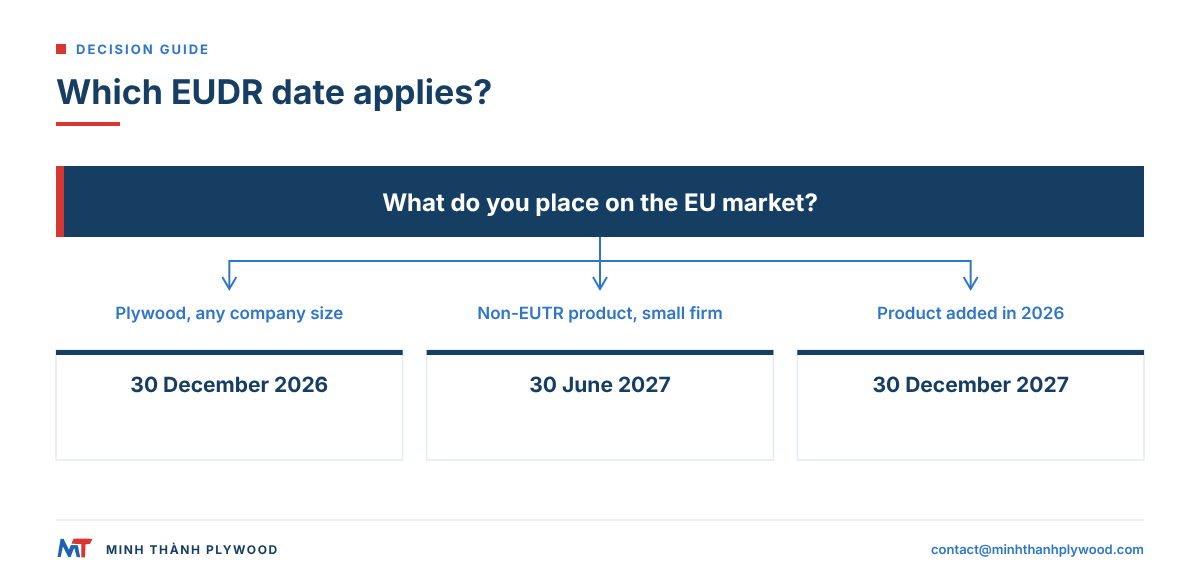
The date that applies to you depends on your company size and on whether your product is listed in the EUTR annex. For plywood the second question settles it: plywood is listed, so every plywood operator starts on 30 December 2026, whatever its size.
| Your business | Product | Your application date |
|---|---|---|
| Large or medium importer | Plywood (ex 4412) | 30 December 2026 |
| Micro or small importer, established by 31 December 2024 | Plywood (ex 4412) | 30 December 2026, because plywood is an EUTR-annex product |
| Micro or small importer, established by 31 December 2024 | Product not in the EUTR annex, for example cocoa | 30 June 2027 |
| EU furniture maker using plywood already covered by a statement | Furniture made from it | Downstream operator from 30 December 2026: no statement, keep reference numbers |
| Distributor reselling plywood inside the EU | Plywood | Trader duties from 30 December 2026 |
Company size follows the EU accounting directive, Directive 2013/34/EU, which sorts businesses by balance sheet, turnover and headcount; the 2025 amendment added that legal form does not matter. For plywood the size test changes the paperwork route, not the date. Most plywood importers who supplied the EU under the EUTR will recognise their duties: the EUDR builds on them.
Is plywood covered by the EUDR?
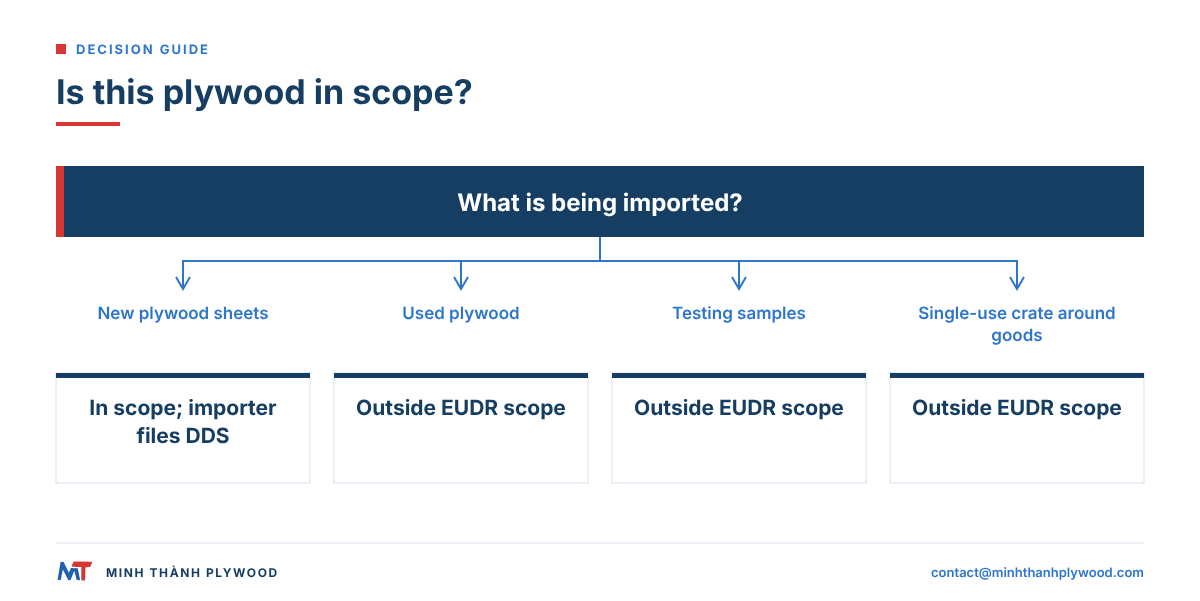
Yes, plywood is covered by the EUDR as ex 4412 in Annex I, and every wood layer counts: face, back and core veneers. The importer must trace each species in the panel to the plots where it was grown. A poplar-faced panel with a Eucalyptus core has two species and two sets of plots.
Some plywood falls outside the regulation:
- used and second-hand plywood, excluded by the 2026 scope update;
- single-use plywood packing used only to carry or protect another product and presented with it, such as crate panels around machinery;
- samples sent for testing or analysis.
Plywood sold as a product, cut-to-size panels and plywood made into finished goods remain in scope. Furniture made in the EU from plywood already covered by a statement falls under the downstream rules, without a second statement.
| Plywood item | In EUDR scope? | Who files |
|---|---|---|
| Full sheets imported for sale or production | Yes | Importer (operator) |
| Cut-to-size panels imported for furniture parts | Yes | Importer (operator) |
| Furniture imported ready-made with plywood parts | Yes, if its customs code is in Annex I | Importer of the furniture |
| Furniture made in the EU from plywood with a statement | Yes, as a downstream product | No new statement; reference numbers kept |
| Single-use crate panels around imported machinery | No | Nobody |
| Used or second-hand plywood | No | Nobody |
| Samples for testing | No | Nobody |
Film-faced, thin, LVL and exterior panels follow the same rule as furniture plywood: if the product is placed on the market under a listed code, the wood in it needs origin data.
What does EUDR compliance require from plywood importers?
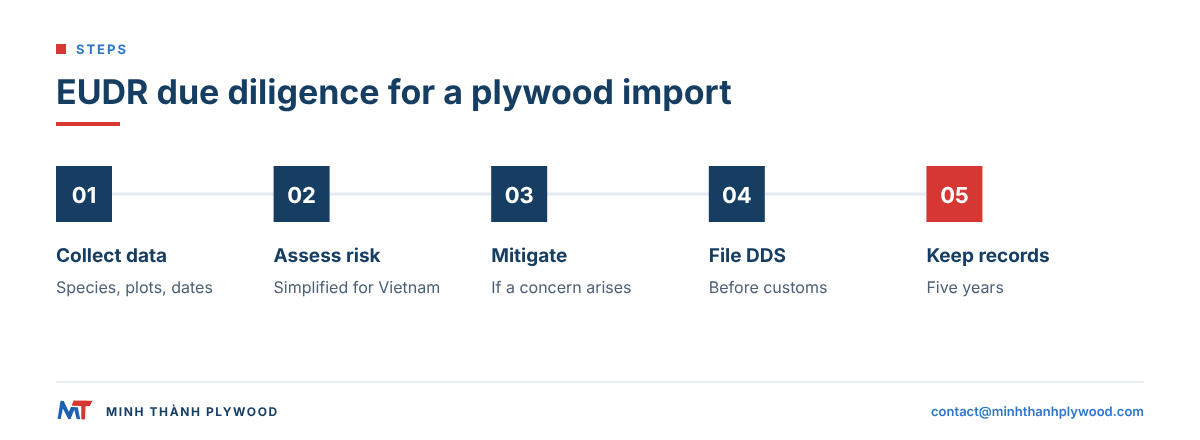
EUDR compliance requires a plywood importer to collect origin information, assess the risk that the wood is not deforestation-free or legal, reduce any risk found, and file a due diligence statement before customs clearance. These steps are Articles 8 to 11 and Article 4 of the regulation.
- Collect the information (Article 9). Product description and trade name, wood species by common and full scientific name, quantity, country of production, the geolocation of every plot and the date or time range of harvest, and the supplier and buyer.
- Assess the risk (Article 10). Use the country risk level, the presence of forests, the supplier’s record and any concerns raised; document the assessment.
- Mitigate the risk (Article 11). Where risk is not negligible, ask for more evidence, audits or independent checks until it is.
- File the due diligence statement (Article 4). In the EU information system, before the customs declaration; quote the DDS reference number on the declaration.
- Keep records for five years and review the due diligence system at least once a year.
Geolocation has a fixed format: latitude and longitude with at least six decimal digits, and a polygon for any plot over four hectares (Article 2(28)). One DDS can cover several shipments within the declared quantity and scope (Commission due diligence guidance).
There is no official “EUDR certificate”. The importer’s own statement is the compliance document; supplier files and certification schemes feed into it.
A good dossier for one plywood line looks like this in practice: a product sheet naming “18 mm plywood, poplar face A/B, Eucalyptus core, UF glue at E0” with species Populus spp. and Eucalyptus spp. written in full; the quantity in cubic metres and sheets matching the invoice; one GeoJSON file per supplier with a point or polygon for each plot; and a harvest period for each plot. The importer reads it, runs the risk check and files.
Two errors stop most first statements. The species list leaves out the face or back veneer, or the geolocation file uses a single point for a large plantation. Both are cheap to fix in October and expensive to fix at the port in January.
Vietnam’s low-risk status and simplified due diligence
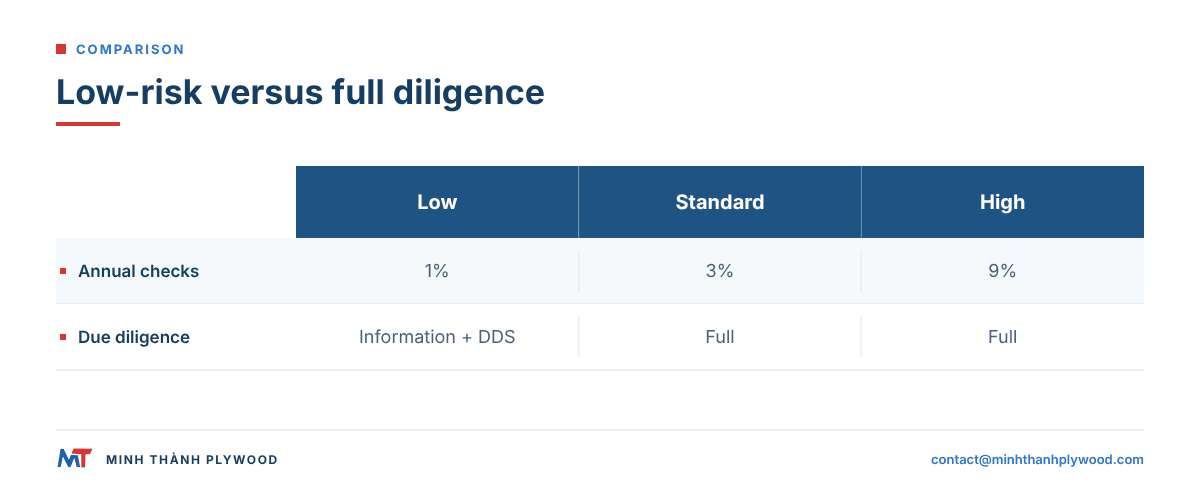
Vietnam is listed as a low-risk country under Commission Implementing Regulation (EU) 2025/1093, which lets importers use simplified due diligence when every commodity in the product comes from low-risk countries (Implementing Regulation (EU) 2025/1093). Belarus, North Korea, Myanmar and Russia are high risk; countries not listed are standard risk.
Simplified due diligence under Article 13 removes the risk assessment and mitigation steps, not the information step. The importer still collects species, quantities and plot geolocations, still files the statement and still acts on any substantiated concern that comes to light.
| Country risk | Steps required | Minimum annual checks on operators (Article 16) |
|---|---|---|
| Low (Vietnam) | Information collection and statement; risk assessment only if a concern arises | 1% of operators |
| Standard | Full due diligence | 3% of operators |
| High | Full due diligence | 9% of operators |
For a Vietnamese plywood panel this matters in one detail: if the face veneer is imported from another country, that country’s risk level counts too. A panel with a Vietnamese core and a face from a standard-risk country needs full due diligence for the face.
Why is Vietnam well-positioned for EUDR compliance?
Vietnam is well-positioned for EUDR compliance because its plywood cores come mainly from planted forest, the country is listed as low risk, and a national timber legality system already traces wood from harvest to mill. The remaining work is plot-level geolocation for small plantation owners, which mills now collect as part of each purchase.
Plantation wood. Vietnamese plywood cores are mostly fast-growing plantation species: Eucalyptus, Acacia and Styrax, grown in rotations on land that has been in forestry use for years. Wood harvested from a plantation that was already a plantation on 31 December 2020 meets the deforestation-free test, as long as the plot data prove it.
Low risk. The 2025 country benchmarking placed Vietnam in the low-risk group, which opens simplified due diligence and a 1% minimum check rate on operators.
A legality system already in place. The EU and Vietnam signed a Voluntary Partnership Agreement (VPA) under the FLEGT programme on 19 October 2018, in force from 1 June 2019 (EU and Vietnam joint release, 2019). Vietnam’s Timber Legality Assurance System (VNTLAS) under Decree 102/2020/ND-CP classifies businesses and requires harvest and transport records. These records feed the legality part of an EUDR file.
What still needs care. Many plantations belong to households with small plots, often below four hectares. Each plot needs its own coordinates and harvest period, so mills that buy from many growers keep a plot register and match each log purchase to it. Veneers bought from other regions or countries need the same data from their seller.
At Minh Thanh the core wood comes from plantations around Ha Hoa in Phu Tho province, the area where the factory sits. Short supply lines from local plots make the geolocation files simpler to build and check.
What penalties apply for EUDR non-compliance?
Penalties for EUDR non-compliance are set by each member state, within minimums fixed in Article 25. For a company, the maximum fine must be at least 4 % of its total annual EU-wide turnover in the previous financial year, and it must rise for repeated breaches. Authorities also confiscate products and the revenue made from them.
| Penalty under Article 25 | What it means for a plywood importer |
|---|---|
| Fines with a maximum of at least 4 % of annual EU turnover | Fines scale with the size of the business and the value of the goods |
| Confiscation of the products | Plywood in stock or in transit can be taken |
| Confiscation of revenues from the transaction | Profits from sold panels can be recovered |
| Exclusion from public procurement and public funding for up to 12 months | Lost tenders for contractors and public suppliers |
| Temporary ban on placing products on the market | Trade in the commodity stopped for a period |
Competent authorities also order corrective action under Article 24, such as withdrawing products, and the Commission publishes a list of final judgments against companies for EUDR infringements (Article 25(3)). For most importers the reputational cost of a published breach outweighs the fine.
Operators, downstream operators and traders: who files what?
The operator who first places the plywood on the EU market files the due diligence statement; the businesses after it collect and pass on the reference number. Since the 2025 amendment, downstream operators and traders no longer file their own statements for products already covered. This table shows who does what in a typical plywood chain.
| Role | Example in the plywood chain | Duty from 30 December 2026 |
|---|---|---|
| Operator | The EU importer clearing Vietnamese plywood through customs | Full due diligence and the statement before the customs declaration |
| Downstream operator | An EU furniture factory making cabinets from that plywood | No statement; the first downstream operator collects and keeps the DDS reference numbers for five years; non-SMEs register |
| Trader | A distributor reselling the plywood unchanged | Keep supplier and customer records and pass on the reference numbers |
| Supplier outside the EU | The Vietnamese mill | No legal duty under the EUDR; supplies the origin data the operator needs |
The supplier outside the EU has no legal duty, but its data decide whether the importer can file. A mill that cannot produce plot geolocations for every species in the panel cannot sell to the EU after the application date.
Take one container of 18 mm poplar-faced plywood with a Eucalyptus core, shipped from Hai Phong to Antwerp. The Belgian importer files one statement covering both species, with the geolocation files from the mill, and quotes the reference number on the customs declaration. A German kitchen maker buys half the panels: as the first downstream operator it receives and keeps that reference number. The kitchens it sells carry no new statement. A Dutch distributor buys the other half and resells it unchanged: it records who supplied it and whom it sold to, and passes the reference number on.
How does EUDR interact with REACH formaldehyde limits and other EU rules?
The EUDR covers where the wood came from; other EU rules cover what is in the panel and its packaging. Plywood importers face three EU deadlines in the same year, and a full supplier check in 2026 covers them together.
| Rule | What it covers | Date | Plywood detail |
|---|---|---|---|
| EUDR, Regulation (EU) 2023/1115 | Deforestation-free, legal origin, due diligence | 30 December 2026 | Every species and plot in the panel |
| REACH entry 77, Regulation (EU) 2023/1464 | Formaldehyde released by articles | 6 August 2026 | 0.062 mg/m³ for furniture and wood-based articles, Appendix 14 chamber |
| PPWR, Regulation (EU) 2025/40 | Packaging and packaging waste | 12 August 2026 | Heavy metals in packaging, 100 mg/kg limit |
| EN 13986 and CE marking | Construction panels | In force | Declaration of Performance for structural uses |
The REACH formaldehyde limit applies to the article placed on the market, so a furniture maker using plywood answers for the finished piece (Regulation (EU) 2023/1464). Furniture plywood made for the European market meets the emission requirements European buyers ask for; at Minh Thanh, CARB P2 / TSCA Title VI certification and six chamber tests are the evidence, and SGS runs the EU method on request.
On packaging, our packing materials passed an SGS test in September 2026 under Regulation (EU) 2025/40: lead, cadmium, mercury and hexavalent chromium were not detected in the cardboard, plywood and pallet blocks, strapping band or wrapping film tested, against the 100 mg/kg limit.
What happens to the EUTR while the EUDR is delayed?
The EU Timber Regulation keeps applying until the EUDR takes over on 30 December 2026. Plywood importers who place panels on the market before then still need an EUTR due diligence system, and the EUTR prohibition on illegally harvested timber still applies. The delay moved the EUTR repeal date with it.
After 30 December 2026 the EUTR continues in one narrow case: timber and timber products produced before 29 June 2023 and placed on the market from 30 December 2026 stay under the EUTR until 31 December 2029 (Article 37(2) as amended by 2025/2650). Old stock is the main example. An importer holding panels made from logs harvested before 29 June 2023 keeps its EUTR records for those panels and its EUDR process for new production, side by side, until the end of 2029.
Until the switch, an EUTR due diligence system for plywood still needs three parts: access to information on species, country of harvest, quantity, supplier and compliance with harvest laws; a risk assessment of illegal harvest; and risk mitigation where risk is not negligible. Most of that information reappears in the EUDR file, so a well-run EUTR system is a head start.
Our guide EUTR vs EUDR compares the two regimes line by line, including how FLEGT licences fit.
What should plywood importers prepare before enforcement?
Plywood importers should use the remaining time to test their EUDR process on real shipments before 30 December 2026. The work is mostly data: mapping species, collecting geolocation files, setting up the information system account and agreeing document formats with each supplier. The steps below follow the order that saves rework.
- List your products and species. For each plywood line, write every species in face, back and core, and the country of each.
- Map your suppliers. Identify which mills press the panels and which supply veneers to them; ask each for plot-level origin data.
- Collect sample dossiers now. Ask for the full dossier on a current shipment and check it against Article 9: species with scientific names, quantity, country, geolocation, harvest dates.
- Check the geolocation files. Open the GeoJSON files, check six decimal digits and polygons for plots over four hectares, and plot them on a map.
- Register in the information system. Create your operator account and test the statement form with a sample shipment.
- Decide simplified or full due diligence per product, based on the country risk of every species in it.
- Write the due diligence system down. Procedures, responsibilities, record keeping for five years, and an annual review.
- Agree contract clauses. Put the dossier, its format and its timing into purchase contracts for shipments arriving after 30 December 2026.
- Brief your customs broker. The DDS reference number must be on the customs declaration.
- Run a dry run. File a test statement for a shipment loading in November or December 2026 and time each step.
A realistic plan for the last months before the date looks like this:
| When | Importer task | Supplier task |
|---|---|---|
| October 2026 | Species and supplier map; account in the information system | Sample dossier for a current shipment |
| November 2026 | Test statement on a sample shipment; contract clauses agreed | Dossier with every invoice for shipments arriving after 30 December |
| December 2026 | Broker briefed; procedures signed off | Plot register updated for new log purchases |
| January 2027 onward | Statement before each customs declaration; records kept five years | Dossier with every shipment; changes reported |
Shipments loading in Vietnam in November and December 2026 will arrive in Europe after the application date: Northern Europe is 30–40 days at sea from Hai Phong, the Mediterranean 25–35. They need full EUDR files even though they are bought before the date.
Check the face veneer first. Most Vietnamese mills can document their plantation cores; the imported face veneer, often bought through several companies in China, is where dossiers stop. Ask for the face lot’s plot geolocation before the order, not after loading (face veneer and the EUDR).
Documentation checklist for an EUDR plywood shipment
An EUDR-ready plywood shipment carries the normal trade documents plus an origin dossier the importer can turn into a statement. The table lists what to receive from the supplier and what the importer adds.
| Document | From | What to check |
|---|---|---|
| Commercial invoice and packing list | Supplier | Product description, HS 4412 line, quantity in m³ and sheets |
| Bill of lading and certificate of origin | Supplier and carrier | Origin, consignee, container and seal |
| Species list per product line | Supplier | Common and scientific names for face, back and core |
| Geolocation files | Supplier | GeoJSON, six decimal digits, polygons over four hectares |
| Harvest dates or time range | Supplier | Covers the wood in this shipment |
| Legality evidence | Supplier | Harvest permits, land-use rights, transport records |
| Supporting certificates | Supplier | FSC or others where held; support, not proof |
| Due diligence statement and reference number | Importer | Filed before the customs declaration |
| Risk assessment record | Importer | Simplified or full, kept for five years |
Minh Thanh supplies the EUDR compliance dossier, origin records and geolocation files, with orders. FSC is available* where buyers need it. Our EUDR traceability page shows how the dossier is built.
*Supplied directly or through qualified partner mills.
Check the dossier against the invoice before the ship arrives, not after. The species and quantities in the dossier must match the commercial invoice and packing list line by line, and each product line must point to its own geolocation files. When a container carries several specifications, for example 18 mm poplar-faced panels and 12 mm Eucalyptus-faced panels, each line has its own species set.
A short internal checklist, signed off by the person who files the statement, keeps the same errors from repeating on the next shipment. Allow time for one round of questions to the supplier: in the first months after the application date, most delays will come from small mismatches between these files, not from missing data.
The biggest mistakes buyers make with delayed deadlines
The biggest mistake buyers make with a delayed deadline is treating it as a reason to wait. Every delay so far came days before the old date; a buyer who stopped preparing would have had a week to catch up. The others are close behind.
- Assuming a third delay. Plan for 30 December 2026 until the Official Journal says otherwise.
- Reading the June 2027 date as theirs. Small plywood importers do not get it; plywood is an EUTR-annex product.
- Collecting core data only. Faces and backs are wood too; an imported face veneer needs its own origin data.
- Accepting a certificate instead of data. FSC or a “deforestation-free” letter helps the risk assessment; it does not replace plot geolocations.
- Forgetting goods in transit. The date is the date of placing on the market, usually customs release, not the loading date.
- Leaving contracts silent. Without a clause, the dossier arrives late or in the wrong format.
- Filing per container without planning. One statement can cover several shipments within a declared quantity; plan statements by product line and period, not by container alone.
- Ignoring cut-to-size and mixed loads. Each product line in a mixed container needs its species and plots; cut panels keep the origin of the sheet they came from.
What this means for your order
For plywood from Minh Thanh, EUDR readiness is part of the order. Our panels use plantation-grown Vietnamese cores, Styrax and Eucalyptus as standard, Acacia and Pine on order, and we supply the EUDR compliance dossier with origin records and geolocation files with every EU shipment. Vietnam’s low-risk listing lets most of our panels use simplified due diligence.
Order terms are unchanged: MOQ one 40HC with mixed specifications by agreement, production 15–45 days after the 30% deposit, balance 70% against the scanned B/L or irrevocable L/C at sight, FOB Hai Phong, CFR or CIF. Every shipment is photographed and filmed before loading, and you receive the photos and video.
We keep the dossier format stable from order to order, so the statement you file for the first container is a template for the next. If your compliance team uses its own data template, send it with the enquiry and the dossier follows it. Ask for a sample dossier with your next quotation and test it in your own system before December. See our furniture plywood range, the EUDR traceability dossier, our list of plywood import documents and more compliance guides.
Buyer questions, answered
Is the EUDR delayed to 2026?
Yes. Regulation (EU) 2025/2650 moved the main application date to 30 December 2026. Micro and small operators established by 31 December 2024 get 30 June 2027, except for products already under the EU Timber Regulation, such as plywood.
What is the latest update on the EUDR?
The 30 December 2026 date stands. In July 2026 the Commission updated the product scope with Delegated Regulation (EU) 2026/2102, which keeps plywood in scope, excludes used and second-hand products, and gives newly added products until 30 December 2027.
Will the EUDR be delayed again?
No further delay has been adopted as of 20 October 2026. Any change would need a new regulation published in the Official Journal before 30 December 2026; until then, plan for that date.
When does the EUDR apply to plywood importers?
From 30 December 2026, for importers of every size. Plywood is listed in the EU Timber Regulation annex, so the later 30 June 2027 date for micro and small operators does not apply to it.
What is the EUDR?
Regulation (EU) 2023/1115 bans placing wood, cattle, cocoa, coffee, palm oil, rubber and soya products on the EU market unless they are deforestation-free since 31 December 2020, legally produced and covered by a due diligence statement.
Did the EUDR cutoff date change with the delay?
No. The cutoff stays 31 December 2020. Wood in a product placed on the market after the application date must come from land not deforested, and for wood not degraded, after that date.
What penalties apply for EUDR non-compliance?
Member states set penalties, which must include fines with a maximum of at least 4 % of the company's annual EU turnover, confiscation of products and revenues, and exclusion from public procurement for up to 12 months.
Is Vietnam high risk under the EUDR?
No. Commission Implementing Regulation (EU) 2025/1093 lists Vietnam as a low-risk country. Importers can apply simplified due diligence when every commodity in the product comes from low-risk countries.
Does the EUTR still apply during the EUDR delay?
Yes. The EU Timber Regulation applies until the EUDR applies on 30 December 2026, and it keeps applying until 31 December 2029 to timber produced before 29 June 2023 and placed on the market from that date.
Do EU furniture makers need to file a due diligence statement?
Not if they make products from plywood already covered by a due diligence statement. Under the 2025 amendment they are downstream operators: the first one collects and keeps the statement reference numbers, and non-SMEs register in the information system.
Is there an EUDR certificate for plywood?
No. The EUDR has no official certificate. The importer files a due diligence statement based on origin data; FSC or other certificates can support the risk assessment but do not replace it.
What does Minh Thanh provide for EUDR?
We supply the EUDR compliance dossier with orders: origin records and geolocation files for the wood in the panels. Importers use it for their due diligence statement in the EU information system.
What is Regulation (EU) 2025/2650?
It is the second EUDR amendment, signed on 19 December 2025. It delayed application by 12 months to 30 December 2026, removed statements for downstream operators and traders, and added a simplified declaration for micro and small primary operators.
Does the EUDR apply to plywood loaded before 30 December 2026 but cleared after?
Yes. What counts is when the plywood is placed on the EU market, normally at release for free circulation. A container loaded in November 2026 and cleared in January 2027 needs a due diligence statement.
Can one due diligence statement cover several plywood shipments?
Yes. The Commission's guidance allows one statement to cover several batches or shipments placed on the market over time, within the quantity and scope declared and with due diligence done for all of them.