
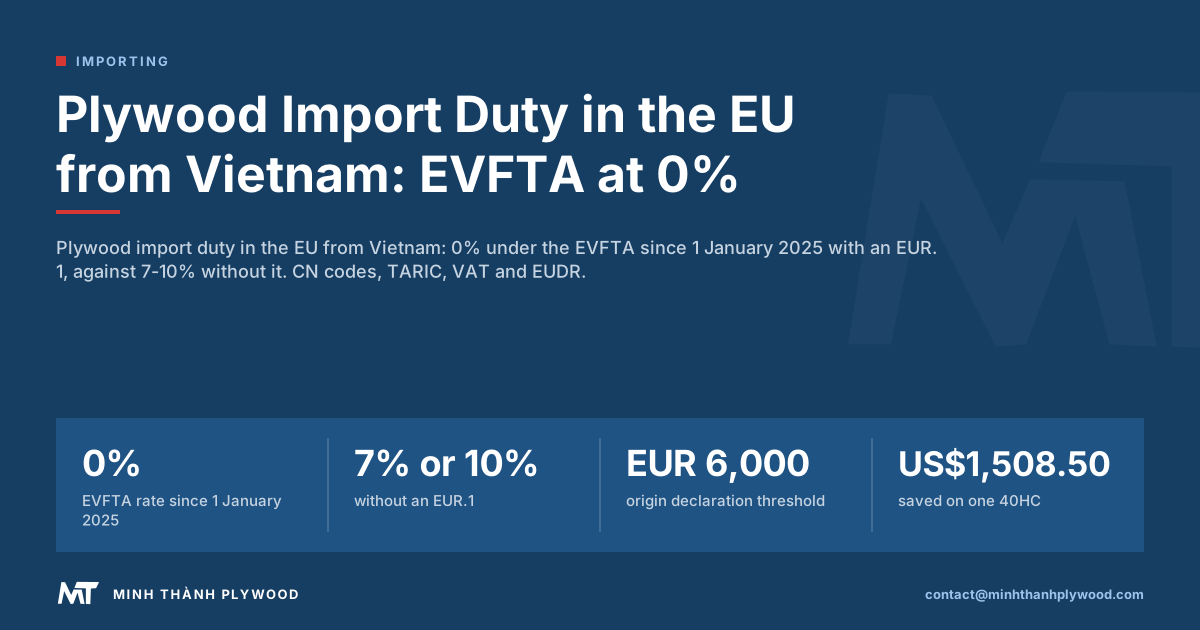
Plywood of heading 4412 from Vietnam enters the EU at 0% customs duty under the EU-Vietnam Free Trade Agreement (EVFTA), in force on every plywood line in TARIC since 1 January 2025, when the shipment carries a valid EUR.1. Without that origin proof the standard rate is 7% or 10%. Minh Thanh Plywood ships EU orders with the EUR.1 in the document set.
What is the plywood import duty in the EU from Vietnam in 2026?
The EU import duty on plywood from Vietnam is 0% in 2026, provided the shipment carries a valid EVFTA proof of origin. That rate sits in TARIC, the EU’s integrated tariff, for every plywood line of heading 4412 with Vietnam as origin, in force since 1 January 2025.
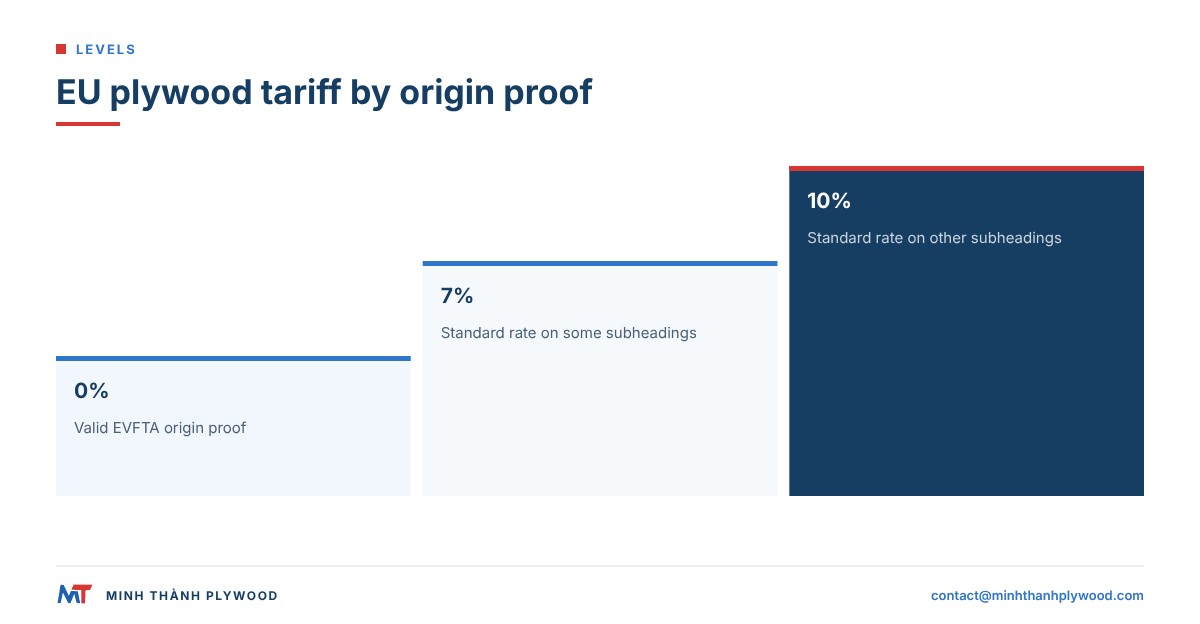
Without the proof of origin, the same panels pay the standard third-country rate, which for plywood is 7% or 10%. On a 40-foot container of furniture plywood that difference runs into four figures in euros, which is why the EUR.1 belongs in the contract and not only in the shipping file.
| Situation | Customs duty | Legal basis |
|---|---|---|
| Vietnamese plywood with a valid EUR.1 (or origin declaration up to EUR 6,000) | 0% | EVFTA tariff preference, TARIC measure since 1 January 2025 |
| Vietnamese plywood without origin proof | 7% or 10% by subheading | Third-country duty, Combined Nomenclature |
| Plywood from Vietnam with Chinese origin under the origin rules | 7% plus anti-dumping duty where the product is in scope | Regulation (EU) 2025/2333 |
We checked each rate in this article in TARIC with origin “VN” and reference date 20 October 2026. The agreement itself was concluded by Council Decision (EU) 2020/753, the legal act TARIC quotes for the preference.
What is the EVFTA and when did it enter into force?
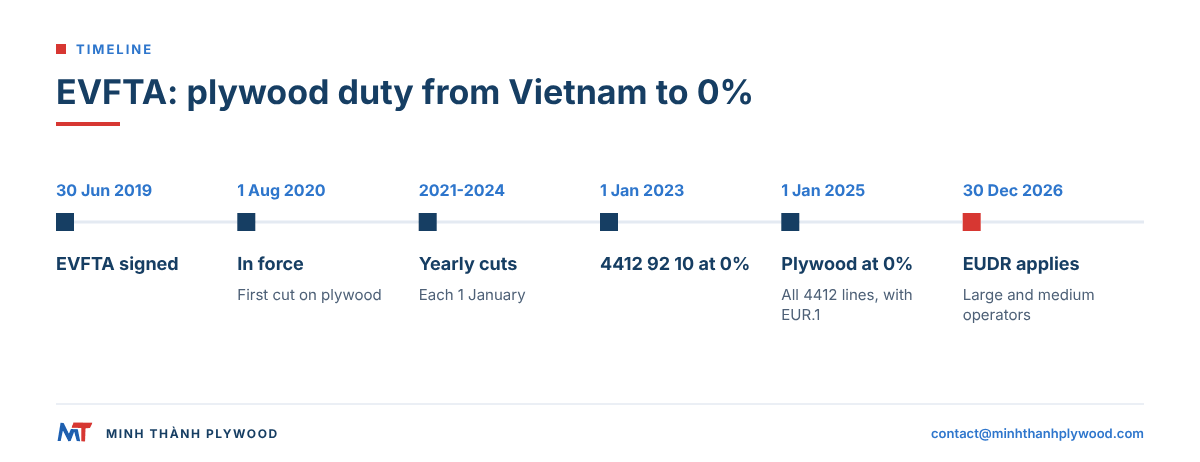
The EU-Vietnam Free Trade Agreement (EVFTA) is the trade agreement between the European Union and Vietnam. It was signed on 30 June 2019 and has applied since 1 August 2020, according to the European Commission page on the agreement.
For plywood, the agreement did not cut the duty to zero on day one. The EU scheduled heading 4412 for step-by-step reduction, with the EVFTA rate at 3.5% (6.5% on the tropical lines) at entry into force in August 2020, cuts following in 2022 to 2024. The last step took effect on 1 January 2025, and TARIC has shown 0% for Vietnamese plywood since that date.
The agreement covers far more than plywood. It removes duties on almost all goods traded between the two sides over its staging periods, opens public procurement and services, and adds chapters on labour and environmental standards that both sides committed to in the text. For a plywood importer only three parts matter: the EU tariff schedule, the origin protocol and the customs chapter that lets a proof of origin be checked after release.
Three practical consequences follow:
- The phase-in is finished. A buyer quoting a “reduced EVFTA rate” for plywood in 2026 is working from an old table; the rate is 0%.
- The preference is not automatic. Customs applies it only when the declaration carries a valid proof of origin.
- One rate covers the whole EU. The agreement binds the EU customs union, so the answer is the same in Hamburg, Antwerp, Genoa and Gdańsk.
The earlier choice between EVFTA and the EU’s Generalised Scheme of Preferences (GSP) ended on 31 December 2022, according to the same French guidance. From 2023, the EVFTA is the only preferential route for Vietnamese plywood into the EU.
Which CN codes does Vietnamese plywood fall under?
Vietnamese plywood falls under heading 4412 of the Combined Nomenclature (CN), “Plywood, veneered panels and similar laminated wood”. The subheading depends on the species of the outer plies, not on the core. A panel with a poplar face and a Styrax or Eucalyptus core is classified by its poplar face.
The table lists the subheadings that cover the panels a Vietnamese mill exports, with the standard rate from Regulation (EU) 2021/1832 and the EVFTA rate from TARIC.
| CN code | What it covers | Third-country duty | EVFTA rate from Vietnam (2026) |
|---|---|---|---|
| 4412 10 00 | Plywood of bamboo | 10% | 0% |
| 4412 31 10 | Outer ply of listed tropical species: okoumé, sapelli, meranti, mahogany and others | 10% | 0% |
| 4412 31 90 | Outer ply of other tropical wood, such as bintangor or gurjan faces | 7% | 0% |
| 4412 33 10 | At least one outer ply of birch | 7% | 0% |
| 4412 33 20 | No birch, at least one outer ply of poplar or aspen | 7% | 0% |
| 4412 33 30 | No birch or poplar, at least one outer ply of eucalyptus | 7% | 0% |
| 4412 33 90 | Other listed hardwood faces: beech, oak, maple, walnut, ash | 7% | 0% |
| 4412 34 00 | Outer ply of another non-coniferous wood | 7% | 0% |
| 4412 39 00 | Both outer plies coniferous, such as pine-faced plywood | 7% | 0% |
| 4412 41 to 4412 49 | Laminated veneered lumber (LVL) | 10% | 0% |
| 4412 52 00 | Blockboard with a non-coniferous outer ply | 10% | 0% |
Each plies-only subheading applies to “plywood consisting solely of sheets of wood, each ply not exceeding 6 mm thickness”. Standard furniture plywood in 3–40 mm meets that test, because every veneer in the panel is far thinner than 6 mm.
Engineered veneer (EV) faces need a word with your customs broker. EV is made from a plantation species and re-sliced, so the classification follows the species declared for the face sheet. We state face, core and glue on the invoice for each line, which gives the broker what it needs to pick the subheading.
What do the 10-digit TARIC codes add?
TARIC adds two digits to the 8-digit CN code. For plywood, those two digits split each subheading into “okoumé” and “other than okoumé”, and into coated and uncoated panels, mainly to run the anti-dumping measure on Chinese hardwood plywood and the statistics that go with it.
For example, birch-faced plywood other than okoumé falls under TARIC codes such as 4412 33 10 12, 4412 33 10 22 or 4412 33 10 82, depending on the face and coating. Poplar-faced plywood falls under 4412 33 20 10 or 4412 33 20 90.
For a Vietnamese shipment with an EUR.1, the extra digits do not change the duty: every one we checked shows the same 0% preference for Vietnam. They still matter for your declaration, because the code must match what is in the container. Our invoice lists face species, core species, thickness and whether the face is coated or film-faced, so the broker can declare to 10 digits without guessing.
How do you check the rate in TARIC yourself?
You can confirm the 0% rate for any plywood line in about two minutes in the EU’s own database. TARIC is public and needs no login.
- Open the TARIC consultation page of the European Commission.
- Enter the goods code, for example 4412332090 for poplar-faced plywood other than okoumé, or only 441233 to see every line under it.
- Enter the origin country code “VN” for Vietnam.
- Set the reference date to the date your goods will be declared.
- Read the measures listed for “Viet Nam (VN)”. The line “Tariff preference” shows the EVFTA rate (0% from 01-01-2025), with Council Decision D0753/20 as its legal reference.
- Read the “ERGA OMNES” block for the third-country duty (7.00% or 10.00%) and for any measure that applies to all origins, such as statistical surveillance.
- Open “Show conditions” on the preference line: it lists the origin proofs, including the EUR.1 (code N954).
The same page shows measures that have nothing to do with duty, such as CITES import controls on wood and export restrictions on old wooden articles. They do not apply to new plantation plywood, but they appear on the screen, so it helps to know they are there.
For a binding answer on a difficult panel, for example an EV face on a mixed core, the national customs authority issues a Binding Tariff Information decision on request. With it, the classification is fixed for every shipment of that panel.
How did the EVFTA rate come down to 0%?
The EU’s tariff schedule in the EVFTA lists each tariff line with a base rate and a staging category. For heading 4412 plywood, the staging spread the cut over annual steps from entry into force.
| Date | What happened |
|---|---|
| 30 June 2019 | EVFTA signed |
| 1 August 2020 | EVFTA enters into force; first cut on plywood lines |
| January 2022 to January 2024 | Yearly cuts on the plywood lines (e.g. 4412 33: 3.5% to 2.3% to 1.1%) |
| 31 December 2022 | End of the transition in which importers could still choose GSP |
| 1 January 2023 | Particle-board plywood lines such as 4412 92 10 reach 0% |
| 1 January 2025 | Plywood lines of heading 4412 reach 0% (TARIC tariff preference, Council Decision 2020/753) |
| 30 December 2026 | EUDR obligations apply to large and medium operators importing plywood |
The difference between lines is visible in TARIC: 4412 92 10, plywood containing a particle-board layer with a 6% base rate, shows the 0% preference from 1 January 2023, while the main plywood lines show it from 1 January 2025.
What this means in 2026: there is no “current stage” to look up for plywood. If a forwarder’s calculator still shows a percentage under EVFTA for 4412, it is using a schedule from before 2025.
Which proof of origin does the EU accept from Vietnam?
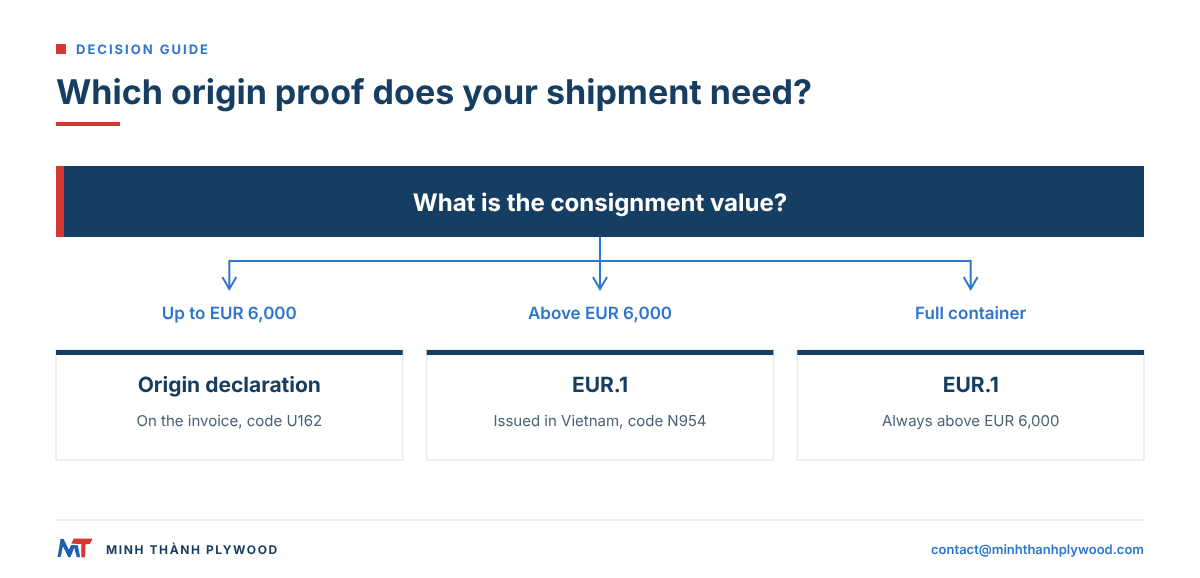
For plywood from Vietnam into the EU, the proof of origin is an EUR.1 movement certificate issued in Vietnam. Below EUR 6,000 per consignment, an origin declaration made out by the exporter on the invoice is enough.
The French customs guidance puts it in one line: for consignments above EUR 6,000, “la seule preuve d’origine possible à l’importation dans l’UE est l’EUR.1” (the only possible proof of origin for import into the EU is the EUR.1).
| Proof | When it applies | Code on the EU customs declaration |
|---|---|---|
| EUR.1 movement certificate, issued in Vietnam | Any value; required above EUR 6,000 | N954 |
| Origin declaration on the invoice by the exporter | Consignments up to EUR 6,000 in total value of originating products | U162 |
A full container of plywood is always above EUR 6,000. In practice, every plywood container from Vietnam to the EU needs an EUR.1.
In Vietnam, EUR.1 certificates for the EVFTA are issued by the Ministry of Industry and Trade through its regional offices. The exporter applies with the commercial invoice, the packing list, the bill of lading and the production records that show the origin. Minh Thanh applies for the EUR.1 for every EU order; it is part of our standard document set, listed on the trade terms page.
Why is there no REX statement for plywood from Vietnam?
Many importers ask for a “REX statement” on the invoice, because the EU’s Registered Exporter system (REX) is the standard for GSP imports and several other agreements. Under the EVFTA, REX works in one direction only.
EU exporters shipping to Vietnam need a REX number for consignments above EUR 6,000; the French guidance says so for that direction. Vietnamese exporters shipping to the EU use the EUR.1 above that threshold, as shown in the table above. An “approved exporter” number issued under another EU agreement cannot be used for Vietnam either.
So when a buyer’s template asks for REX wording on a Vietnamese plywood invoice, the right answer is the EUR.1 number and date in the invoice remarks. Write that into the purchase order once, and the question does not come back on every shipment.
What does an EUR.1 for plywood look like and what must it match?
The EUR.1 is a one-page certificate with numbered boxes. For a plywood container, customs reads it against the invoice and the declaration. These are the boxes that cause trouble when they do not match:
- Exporter (box 1): the legal name and address of the Vietnamese exporter, exactly as on the invoice.
- Consignee (box 3): the EU importer named on the invoice and the bill of lading.
- Countries (boxes 4 and 5): Vietnam as the country of origin, the EU as destination.
- Transport details (box 6): vessel and port of loading, Hai Phong for our shipments.
- Goods description (box 8): number of packs, a plain description (“plywood, poplar face, 18 mm”) and the HS code.
- Gross weight or other measure (box 9): the same weight or cubic metres as on the packing list.
- Invoice reference (box 10): the invoice number and date.
A mixed container is described line by line: one entry per specification, the same order as the packing list. If box 8 says “plywood” and the invoice lists four specifications in cubic metres, most offices accept it; if the weight in box 9 differs from the bill of lading, many do not.
We send a draft of the EUR.1 details with the draft invoice and packing list after loading. You or your broker approve them before the certificate is issued, so a typo is fixed in Vietnam rather than argued over at your port.
When does plywood count as made in Vietnam?
Plywood counts as Vietnamese for the EVFTA when it meets the product-specific rule for heading 4412 in the agreement’s origin protocol (Protocol 1 and its Annex II). For panels peeled, dried, laid up and pressed in Vietnam from Vietnamese plantation wood, origin is straightforward: the veneer and the panel are both made in Vietnam.
The question becomes real when a face veneer is imported. Birch and okoume faces are not grown in Vietnam, and many furniture panels use them on a Vietnamese core. Before applying for the EUR.1, the exporter’s origin file must show that the panel meets the Annex II rule with the imported faces included. That file is what the issuing office checks and what an EU verification request would ask for years later.
For Minh Thanh’s standard furniture panels, cores are white Styrax or Eucalyptus from Vietnamese plantations, and the panels are pressed twice as standard: the core board is pressed and calibrated, then face and back are pressed on. The production file for each order holds the species and source of every veneer layer, which is also the data the EUDR dossier uses.
The origin file is not a separate document a buyer receives with each container. It is the mill’s record behind the EUR.1: purchase records of logs and veneers, peeling and drying records, the press log of the order and the packing list that ties the finished packs to it. When an EU customs office asks the Vietnamese authority to verify an EUR.1, this is the file that answers.
Two red flags for an importer:
- A quotation for “Vietnamese” plywood far below the market with no production address, no factory photos and no loading video.
- A supplier who cannot say which species the core is or where it was grown.
EU customs and the European Anti-Fraud Office (OLAF) check origin claims on wood panels after release. If origin is refused, the importer pays the duty, and where Chinese origin is found on hardwood plywood, the anti-dumping duty as well.
How is the EU import duty on plywood calculated?
EU import duty is a percentage of the customs value, which is the price paid plus freight and insurance up to the point where the goods enter the EU. Import VAT is then charged on the customs value plus the duty and the costs to the first destination in the member state.
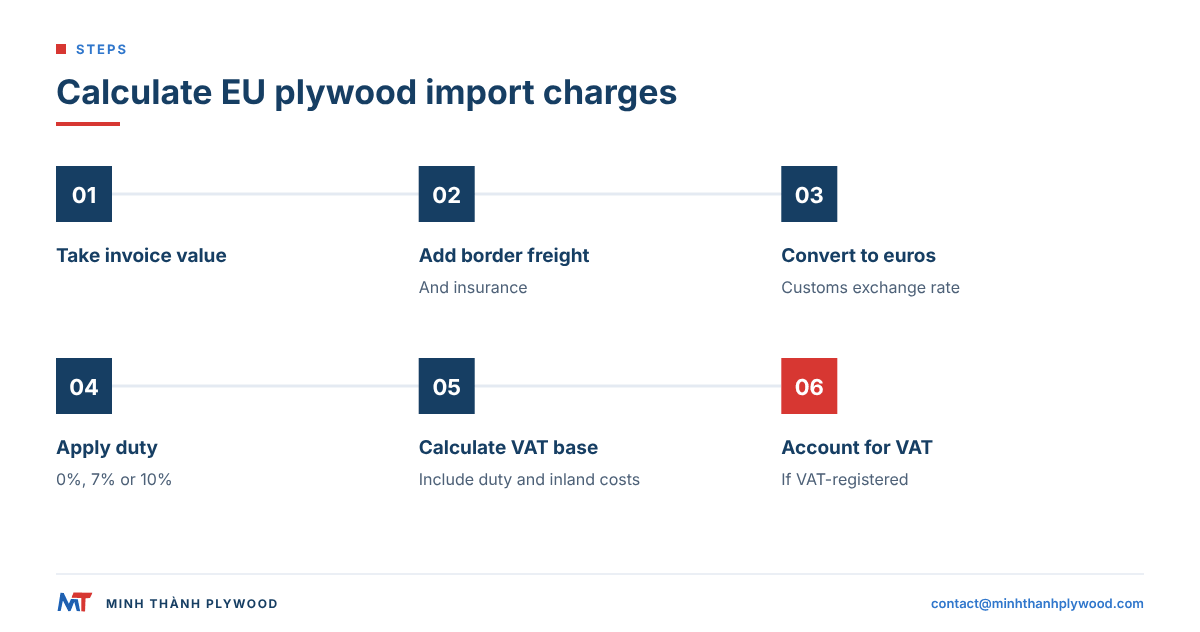
The steps, for a container shipped FOB Hai Phong:
- Start from the invoice value. The price on the commercial invoice, in the invoice currency.
- Add freight and insurance to the EU border. For a CIF invoice these are already in the price.
- Convert to euros at the customs exchange rate published for the month.
- Apply the duty rate. 0% with an EUR.1, 7% or 10% without.
- Add duty and inland costs to the VAT base. Multiply by the member state’s VAT rate.
- Recover the VAT on your return if you are VAT-registered; the duty is a cost and is not recoverable.
The formula, written once:
- Customs value = invoice value + freight + insurance to the EU border
- Duty = customs value × duty rate
- Import VAT = (customs value + duty + costs to the first destination) × VAT rate
Worked example: one 40HC of 18 mm furniture plywood into Germany
This example shows the size of the EUR.1 in money, for one container of 18 mm furniture plywood on a Styrax core. The volume and sheet count come from our 40HC loading plan; the price is our indicative starting price for furniture plywood, October 2026; the freight figure is an assumption for the example, not a quote.
| Line | Value |
|---|---|
| Load | 990 sheets of 1220 × 2440 × 18 mm, about 53 m³ |
| Price, furniture plywood from US$350/m³ | US$18,550 FOB Hai Phong |
| Freight and insurance to Hamburg, example | US$3,000 |
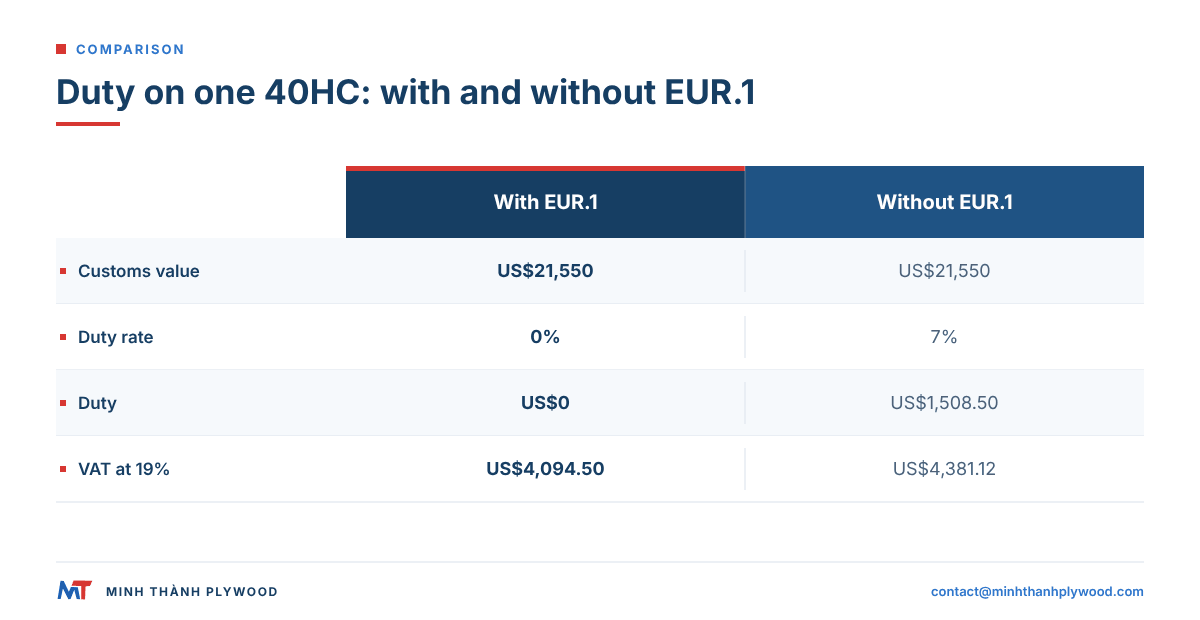
| Customs value | US$21,550 |
| Duty with EUR.1, 0% | US$0 |
| Duty without EUR.1, 7% (4412 33 20, poplar face) | US$1,508.50 |
| German import VAT at 19%, with EUR.1 | US$4,094.50 |
| German import VAT at 19%, without EUR.1 | US$4,381.12 |
On this container, a missing EUR.1 costs US$1,508.50 in duty that cannot be recovered, plus US$286.62 more VAT to pre-finance until the next VAT return. On a programme of 20 containers a year, the duty alone is about US$30,000.
The same arithmetic in euros follows the customs exchange rate of the month of import. The price per cubic metre is a starting point; the final price depends on face, core, glue, thickness, size, quantity and delivery term.
Does the duty differ between EU member states?
No. The EU is a customs union with one Common Customs Tariff, so plywood from Vietnam pays the same duty in all 27 member states: 0% with an EUR.1, 7% or 10% without it. What differs between countries is VAT, the port and the time at sea.
| Member state | Standard VAT | Typical ports for plywood | Days at sea from Hai Phong |
|---|---|---|---|
| Germany | 19% | Hamburg, Bremerhaven | 30–40 |
| Netherlands | 21% | Rotterdam | 30–40 |
| Belgium | 21% | Antwerp | 30–40 |
| France | 20% | Le Havre, Marseille-Fos | 25–40 by coast |
| Italy | 22% | Genoa, La Spezia, Venice | 25–35 |
| Spain | 21% | Valencia, Barcelona | 25–35 |
| Poland | 23% | Gdańsk, Gdynia | 30–40 |
| Bulgaria | 20% | Varna, Burgas | 25–35 |
VAT rates are the national standard rates; the EU only sets a floor of 15%. Times at sea are typical ranges by carrier and route: Northern Europe 30–40 days, Mediterranean 25–35 days.
Several member states let VAT-registered importers account for import VAT on the VAT return instead of paying it at the border; the Netherlands and Belgium are the best known for it. That changes cash flow, not the duty.
So the questions buyers ask by country, “import duty on plywood from Vietnam into Belgium” or “into Bulgaria”, have one answer: 0% with the EUR.1. The country page only adds the VAT rate.
How does the UK compare after Brexit?
The United Kingdom left the EU customs union, so the EVFTA no longer covers it. Plywood from Vietnam into Great Britain follows the UK-Vietnam Free Trade Agreement (UKVFTA), which carried the EVFTA terms over to the UK.
The result for plywood is the same headline: 0%. On 20 October 2026 the UK Trade Tariff showed a “Tariff preference” of 0.00% for Vietnam on commodity 4412331012.
The other plywood commodity codes we checked showed the same preference, against a third-country duty of 6% on birch, poplar, other hardwood and pine-faced lines and 10% on the listed tropical species.
| Line | UK third-country duty | UK-Vietnam preference | EU third-country duty | EVFTA preference |
|---|---|---|---|---|
| Birch face (4412 33 10) | 6% | 0% | 7% | 0% |
| Poplar face (4412 33 20) | 6% | 0% | 7% | 0% |
| Other non-coniferous face (4412 34 00) | 6% | 0% | 7% | 0% |
| Coniferous faces (4412 39 00) | 6% | 0% | 7% | 0% |
| Listed tropical face (4412 31 10) | 10% | 0% | 10% | 0% |
UK import VAT is 20% on the customs value plus duty. The UK origin proof follows the same model as the EU one: an EUR.1 issued in Vietnam under the UK agreement. A shipment split between an EU port and a UK port needs two certificates, one per agreement and consignee.
Which other EU rules apply to plywood from Vietnam?
Duty is one line of the landed cost; four EU rules decide whether the panels can be placed on the market at all. Each has its own date and its own document.
| Rule | What it asks | Applies from | What Minh Thanh supplies |
|---|---|---|---|
| EUDR, Regulation (EU) 2023/1115 as amended | Due diligence statement before the customs declaration; wood legal and deforestation-free after 31 December 2020 | 30 December 2026 for large and medium operators and for micro and small ones already under EUTR; 30 June 2027 for other micro and small operators | EUDR compliance dossier: origin records and geolocation files |
| REACH formaldehyde, Regulation (EU) 2023/1464 | Furniture and wood-based articles at most 0.062 mg/m³ in the chamber test of Appendix 14 | 6 August 2026 | UF glue at E0 emission; CARB P2 / TSCA Title VI certificate and chamber tests; SGS testing to your method on request |
| PPWR, Regulation (EU) 2025/40 | Lead, cadmium, mercury and hexavalent chromium in packaging at most 100 mg/kg in total | 12 August 2026 | SGS test, September 2026, of our four packaging materials: not detected, PASS |
| ISPM 15 | Heat-treatment mark on solid wood packaging | In force | Plywood itself is exempt; solid wood bearers carry the mark |
The EUDR date matters most for 2027 contracts. Vietnam is on the low-risk list in Implementing Regulation (EU) 2025/1093, which allows simplified due diligence when every commodity in the product comes from a low-risk country. The reference number of the due diligence statement must exist before the customs declaration is lodged.
There is no official “EUDR certificate”. The importer files the statement; we supply the EUDR compliance dossier with the order, so the data is ready before the container reaches the port.
Article 9(1) of Regulation (EU) 2023/1115 sets out what the EUDR statement needs from the mill. It lists a description of the product with the wood species by common and full scientific name, the quantity, the country of production, and the geolocation of every plot where the wood was produced, with the date or time range of production. Article 2(28) asks for coordinates with at least six decimal digits, and for polygons rather than single points on plots of more than four hectares. A plywood panel counts every layer: face, core and back.
Three operator rules change how an EU importer organises the file:
- The importer of plywood into the EU is the operator and files the due diligence statement; the mill supplies the data.
- One statement can cover several shipments within the scope and quantity it declares, so a programme buyer does not start from zero on every container.
- A furniture maker that builds from plywood already covered by a statement is a downstream operator under the 2025 amendment: it does not file its own statement, but the first downstream operator keeps the reference numbers for five years.
The older EU Timber Regulation does not disappear overnight. Regulation (EU) 2025/2650 keeps it in force until 31 December 2029 for timber produced before 29 June 2023 and placed on the market from 30 December 2026.
REACH needs the same care with units. The 0.062 mg/m³ limit is measured in the chamber conditions of Appendix 14: 23 °C, 45% relative humidity and a loading of 1 m² per m³. Results from the US method ASTM D6007 are reported in ppm and are not converted to mg/m³; when an EU customer wants a result in its own method, we arrange third-party testing through SGS, for example to EN 717-1.
Is there EU anti-dumping duty on plywood from Vietnam?
No. As of October 2026, no EU anti-dumping or countervailing duty applies to plywood originating in Vietnam. The EU measure on hardwood plywood targets China.
Implementing Regulation (EU) 2025/2333 imposes a definitive anti-dumping duty on hardwood plywood originating in China, other than bamboo and okoumé plywood, with each ply not exceeding 6 mm and an outer ply of tropical or non-coniferous wood. The rates are 43.3% for one named producer and 86.8% for all other Chinese companies, on the net, free-at-Union-frontier price before duty. TARIC applies the measure from 21 November 2025.
For an EU importer, that measure has two consequences for Vietnamese plywood:
- Origin evidence is checked harder. Customs compares the declared origin with the production file; a weak origin file on hardwood plywood now risks the anti-dumping rate as well as the 7%.
- The EUR.1 carries more weight. It is the first document an auditor asks for.
Two exclusions in the measure matter for importers comparing sources. Bamboo plywood and okoumé plywood from China are outside its scope, and so is softwood plywood with both outer plies coniferous. The TARIC codes ending in okoumé and non-okoumé splits exist to separate those lines at the border.
The wider supply picture is shaped by sanctions as well. Since 2022, EU Regulations 2022/576 and 2022/355 have prohibited imports of wood products of chapter 44, plywood included, originating in or exported from Russia and Belarus. Birch-faced plywood from other origins, Vietnam among them, fills part of that gap; it pays 0% with an EUR.1 like every other Vietnamese plywood line.
Duty is never the reason to choose a mill. The reasons to buy are the panel, its documents and the people behind it; the duty position only has to be right.
What should an EU importer put in the purchase order?
Most duty problems are prevented in the contract. Put these lines in the purchase order and the proforma, so they are agreed before production starts:
- The EUR.1 is part of the document set, with the draft sent for approval after loading.
- Description per line: face species, core species, glue and emission class, thickness, size, coating.
- The CN code you expect per line, agreed with your broker in advance.
- Consignee and notify party exactly as on your EORI registration.
- Incoterm and port: FOB Hai Phong, CFR or CIF your port.
- The EUDR dossier and the due diligence data your operator needs, from the December 2026 date.
- Test reports and certificates your customers ask for: CARB P2 / TSCA Title VI, chamber tests, SGS testing to EN 717-1 on request.
The Incoterm also decides who knows the customs value first. On a CIF invoice the freight and insurance are already inside the price, so the invoice value is close to the customs value. On an FOB invoice, your forwarder’s freight and insurance invoice is added by your broker. Either way the duty is the same; only the paperwork that proves the value differs.
Delivery duty paid (DDP) is the one term to avoid for plywood into the EU. Under DDP the exporter becomes responsible for EU import duty, VAT and the EUDR statement, which only the EU operator can file. We sell FOB Hai Phong, CFR or CIF, so the importer of record stays the EU company that holds the EORI number and the VAT registration.
Our standard trade terms work well for EU buyers: minimum order one 40HC, with mixed specifications by agreement; production 15–45 days after the 30% deposit; the 70% balance against the scanned bill of lading, or an irrevocable L/C at sight.
Which mistakes cost EU importers the 0% rate?
The 0% rate is lost on paperwork, not on the product. These are the cases we see most often in buyers’ questions:
| Mistake | What happens | How to prevent it |
|---|---|---|
| EUR.1 not ordered with the shipment | 7% or 10% charged at release | EUR.1 written into the purchase order |
| Weight or volume differs between EUR.1, invoice and B/L | Proof rejected; duty charged | Approve the drafts after loading |
| Consignee on the EUR.1 differs from the declaration | Query from customs, delay | One consignee spelling in every document |
| CN code on the declaration differs from the invoice description | Classification query | Agree the 8-digit code per line in advance |
| REX wording requested instead of EUR.1 | Invoice reissued, time lost | Ask for the EUR.1 number on the invoice |
| Origin file weak on imported faces | Preference refused on verification | Ask the mill for its origin file per order |
If the EUR.1 is late, the shipment does not have to wait. The EVFTA origin protocol allows an EUR.1 to be issued retrospectively, and the French guidance confirms that a proof issued after import supports a refund claim. You pay the duty at release and claim it back when the certificate arrives.
What this means for your order from Minh Thanh
For an EU buyer, the duty question has a short answer: Vietnamese plywood of heading 4412 pays 0% with an EUR.1, and we include the EUR.1 in the document set of every EU order.
The rest of the file is what makes a container clear on the first day:
- Commercial invoice and packing list with face, core, glue and thickness per line, and pack numbers.
- Bill of lading and the EUR.1, drafts approved by you or your broker.
- Phytosanitary and fumigation certificates where needed, insurance with CIF.
- Certificates and reports on order: CARB P2 / TSCA Title VI (ICTT mill no. 23024), six ASTM D6007 chamber tests between April 2025 and June 2026 averaging 0.014–0.032 ppm against the 0.05 ppm limit, ISO 9001:2015, TCVN 11902:2017, the PPWR packaging test and the EUDR compliance dossier.
- Photos and video of your container before loading, with every shipment.
The factory is built for top-grade furniture and interior plywood, with Europe as its main market. FSC and CE are available* for orders that need them.
*Supplied directly or through qualified partner mills.
What to send for an EU quotation
To quote a container for the EU with the duty and documents right, send these lines to contact@minhthanhplywood.com or WhatsApp +84 988 586 601 (Lisa):
- Application: furniture, cabinets, interior fit-out, packaging.
- Core: Styrax or Eucalyptus; Acacia and Pine made on order.
- Glue and emission: UF glue at E0 emission, MR or phenolic (WBP).
- Face and back grade: for example poplar A/B, birch D+/D, okoume or EV.
- Thickness and size: 3–40 mm; 1220 × 2440 or 1250 × 2500 mm, or a custom size.
- Packing and quantity: sheets or cubic metres per specification, one 40HC or more.
- Port and Incoterm: your EU port, FOB Hai Phong, CFR or CIF.
We reply within hours on working days, and free samples go out with the first quotation. Prices start from US$350/m³ for furniture plywood (October 2026); for the full list of global duty rates see our guide to import duty on plywood from Vietnam, and for current plywood prices see the plywood price guide.
Buyer questions, answered
What is the EU import duty on plywood from Vietnam?
0% for plywood of heading 4412 with a valid EVFTA proof of origin, in force in TARIC since 1 January 2025. Without the proof, the standard third-country rate applies: 7% for most hardwood, eucalyptus, poplar and coniferous plywood, 10% for plywood faced with the listed tropical species and for LVL.
What is the HS code for plywood from Vietnam into the EU?
Heading 4412. Furniture plywood with a poplar face is 4412 33 20, eucalyptus face 4412 33 30, birch face 4412 33 10, okoume face 4412 31 10 and pine face 4412 39 00. TARIC adds two more digits for the anti-dumping and statistical splits.
Which proof of origin do I need for plywood from Vietnam to the EU?
An EUR.1 movement certificate issued in Vietnam for any consignment worth more than EUR 6,000. Below that value, an origin declaration on the invoice by the exporter is accepted. The customs declaration carries code N954 for the EUR.1.
Can a Vietnamese exporter use REX for plywood shipments to the EU?
Not for shipments over EUR 6,000. REX is the EU exporters' system for goods going to Vietnam; for goods from Vietnam into the EU above that value, French customs guidance states the EUR.1 is the only accepted proof.
What is the plywood import duty from Vietnam into Belgium or Bulgaria?
The same as in every other member state: 0% with an EUR.1, 7% or 10% without it. The EU is one customs union with one tariff. Only VAT differs: 21% in Belgium and 20% in Bulgaria.
Is there anti-dumping duty on Vietnamese plywood in the EU?
No EU anti-dumping duty applies to plywood of Vietnamese origin as of October 2026. The 2025 duty of 43.3% to 86.8% covers hardwood plywood originating in China, not in Vietnam.
Is the EU duty calculated on FOB or CIF value?
On the customs value, which is the transaction value plus freight and insurance to the EU border, so a CIF-type value. Import VAT is then charged on the customs value plus the duty.
What happens if the EUR.1 arrives after the goods?
Customs charges the standard 7% or 10% at release. The EVFTA origin protocol lets an EUR.1 be issued retrospectively, and with it you claim the duty back from your customs office.
Does EVFTA cover film-faced and LVL plywood?
Yes. Film-faced plywood stays in heading 4412 under the subheading of its outer ply species, and LVL falls under 4412 41 to 4412 49. TARIC shows 0% for Vietnam on those lines from 1 January 2025.
Do I need EUDR documents to import plywood from Vietnam?
From 30 December 2026 large and medium operators must file a due diligence statement before the customs declaration, and its reference goes on the declaration. Vietnam is a low-risk country, which allows simplified due diligence. Minh Thanh supplies the EUDR compliance dossier with orders.
Is Vietnamese plywood cheaper to land in the EU than Chinese plywood?
On duty alone, Vietnamese plywood with an EUR.1 pays 0%, while Chinese hardwood plywood pays the 7% third-country rate plus the anti-dumping duty. Price per cubic metre, specification and freight still decide the landed cost.
Do I need an EORI number to import plywood into the EU?
Yes. Every business importing goods into the EU needs an EORI number from the customs authority of its member state, and the consignee on the EUR.1, invoice and bill of lading should match that registration.
Can I import Russian or Belarusian birch plywood into the EU instead?
No. EU sanctions have prohibited imports of wood products of chapter 44, plywood included, originating in or exported from Russia since 2022 and from Belarus since 2022. Birch-faced plywood from Vietnam is one of the sources EU buyers use instead.
How long does shipping take from Vietnam to Europe?
Typically 30–40 days at sea from Hai Phong to Northern Europe and 25–35 days to the Mediterranean, by carrier and route, after 15–45 days of production from the deposit.
What does Minh Thanh send for EU customs?
Commercial invoice, packing list, bill of lading, EUR.1, phytosanitary and fumigation certificates where needed, insurance with CIF, and on order the CARB P2 / TSCA Title VI certificate, test reports, the EUDR dossier and the PPWR packaging test.