
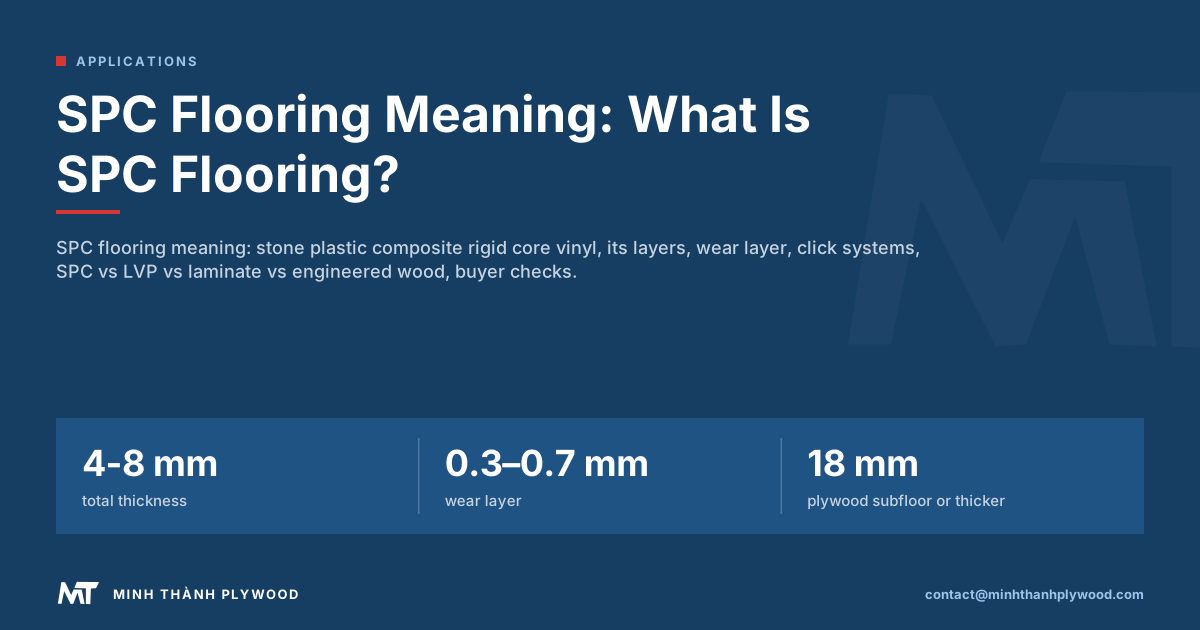
SPC flooring means stone plastic composite flooring: a rigid-core vinyl plank or tile whose core is limestone powder bound with PVC. It is waterproof, stable and clicks together over most flat floors. This guide from the Minh Thanh Plywood technical team explains the layers, wear layers, thickness and click systems, compares SPC with LVP, laminate and engineered wood, and lists what buyers check at a factory.
SPC flooring meaning: what is it, in one sentence?
SPC flooring means stone plastic composite flooring: a rigid-core vinyl plank or tile whose core is made of limestone powder, PVC and stabilisers, topped with a printed decor film, a clear wear layer and a UV coat. Shops sell it as rigid core vinyl, rigid LVP or SPC LVP; some catalogues read SPC as stone polymer composite.
Three things define the product:
- The core is mineral and plastic. No wood fibre, so it does not swell in water.
- The core is rigid. It does not bend to follow small dips in the subfloor, and it carries a click joint.
- The look is printed. The wood or stone pattern is a decor film protected by the wear layer.
The rest of this guide answers what SPC flooring is in detail: how it is built, how thick it should be, how it clicks together and how it compares with the floors buyers weigh against it.
What is SPC flooring made of?
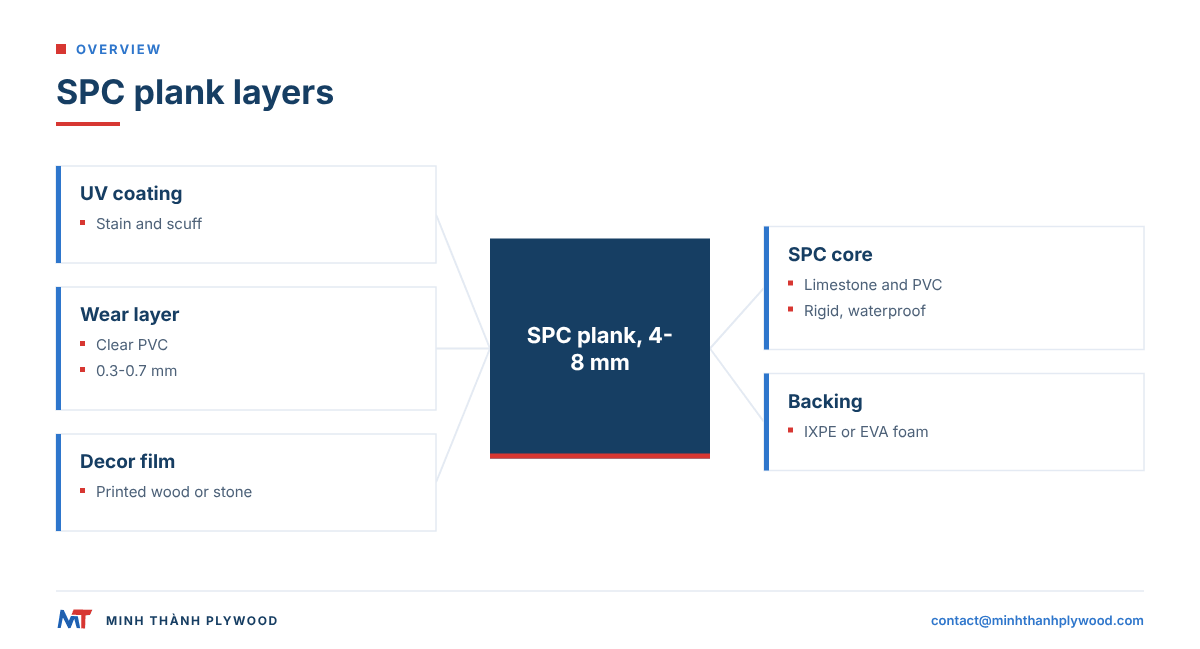
SPC flooring is made of five or six bonded layers, from the top down:
| Layer | Material | Job |
|---|---|---|
| UV coating | Cured acrylic or ceramic-bead lacquer | Stain and scuff resistance, sheen |
| Wear layer | Clear PVC film | Protects the print; its thickness sets wear life |
| Decor layer | Printed PVC film | Wood or stone pattern |
| SPC core | Limestone powder (calcium carbonate), PVC resin, stabilisers | Rigidity, stability, waterproofness, click profile |
| Backing (attached underlay) | IXPE or EVA foam, sometimes cork | Sound reduction, comfort, smooths minor flaws |
The core is the defining layer. Limestone usually makes up the larger share of the core by weight, which is why SPC is heavy and dense for its thickness. The proportion of stone, the PVC grade and the use of virgin or recycled PVC differ by factory and decide hardness, weight and how the core reacts to heat.
How is SPC flooring made?
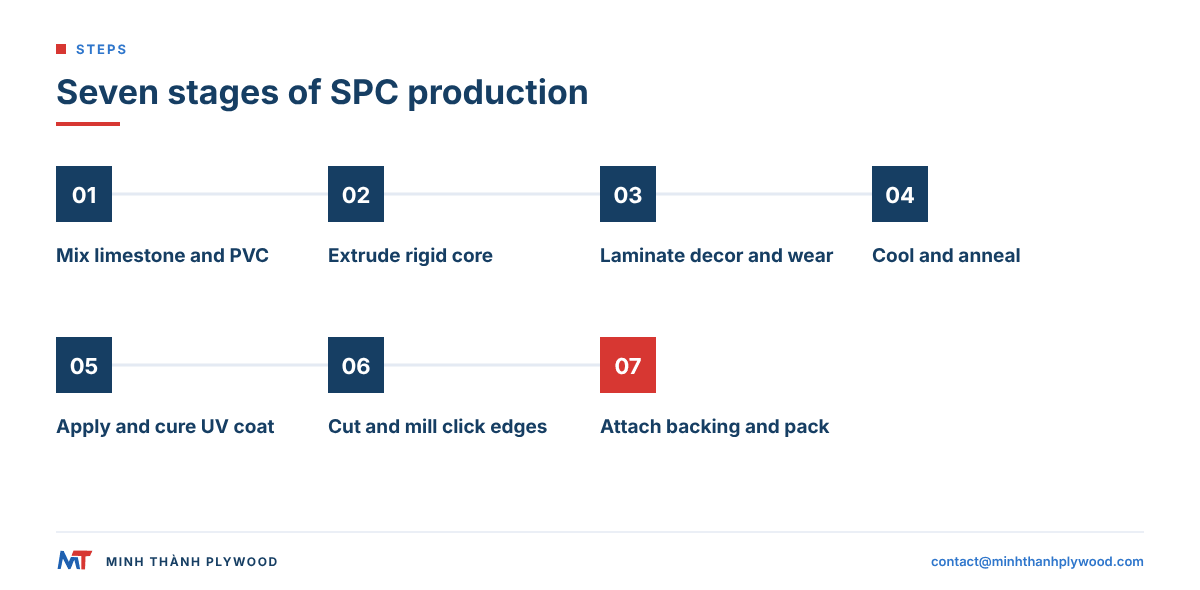
SPC flooring is made in a continuous line, then cut and profiled:
- Mix. Limestone powder, PVC resin and stabilisers are blended.
- Extrude. The hot mix is extruded through a flat die into a continuous core sheet.
- Laminate. Decor film and wear layer are pressed onto the hot core by heated rollers, often with embossing in register with the print.
- Cool and anneal. The sheet is cooled and stress-relieved so it stays flat and stable.
- UV coat. The surface lacquer is applied and cured.
- Cut and profile. Sheets are cut into planks or tiles and the click profile is milled on all four edges; bevels are cut and painted if specified.
- Back and pack. The attached underlay is glued on, then planks are inspected and boxed.
Annealing and cooling decide dimensional stability. A poorly cooled core can shrink or curl after installation in a sunny room, which is why buyers test heat stability before ordering.
SPC wear layer, thickness and plank sizes
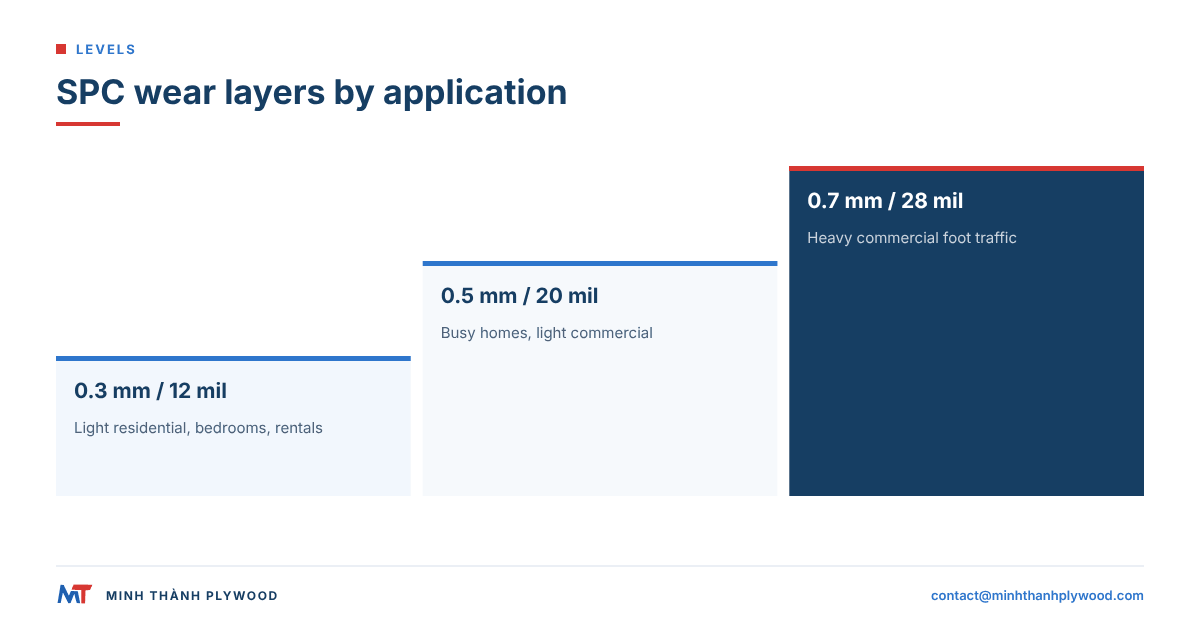
The wear layer is the line to read first on an SPC specification; total thickness comes second.
| Wear layer | In mil | Typical use |
|---|---|---|
| 0.3 mm | 12 mil | Light residential, bedrooms, rentals |
| 0.5 mm | 20 mil | Busy homes, light commercial |
| 0.7 mm | 28 mil | Commercial areas with heavy foot traffic |
Total thickness is commonly 4–8 mm, including any attached underlay of about 1–2 mm. A thicker core spans small subfloor flaws better and feels more solid, but the wear layer, not the core, decides how long the surface lasts.
Common formats are wood-look planks around 180 × 1220 mm and stone-look tiles around 305 × 610 mm, plus long, wide planks and herringbone. Europe classifies resilient floors by use class under EN ISO 10874, for example class 23 for heavy domestic and class 33 for heavy commercial use.
How do SPC click systems work?
SPC planks lock together with a tongue-and-groove click profile milled into the rigid core, so the floor floats without glue or nails. Two families are common:
- Angle-angle: the long side is angled into the previous row and folded down, then the short side is angled in as well.
- Angle-drop: the long side is angled in and the short end drops onto its neighbour and locks vertically.
Most profiles are licensed designs from a few patent holders, and the licence is a quality signal: a licensed profile has been tested for joint strength. A core that is too soft or brittle cracks at the lip of the profile, so click strength and core quality go together. Fit the floor with expansion gaps at the walls, as the plank maker specifies.
SPC vs LVP: what is the difference?
SPC is a type of LVP, not its rival: luxury vinyl plank is the family, and SPC is its rigid stone-core branch. When buyers compare SPC vs LVP, they mean rigid-core SPC against flexible, glue-down LVP.
| Metric | SPC (rigid core) | Flexible LVP (glue-down) |
|---|---|---|
| Core | Limestone and PVC, rigid | PVC with plasticiser, flexible |
| Total thickness | 4–8 mm | About 2–3 mm |
| Installation | Floating click | Glued to the subfloor, or loose lay |
| Subfloor tolerance | Spans minor flaws | Shows every flaw |
| Feel underfoot | Firm; softer with underlay | Softer, warmer |
| Dent resistance | High | Lower |
| Stability in sun and heat | Good when well annealed | Moves more |
| Repair | Replace planks in a row | Lift and re-glue single planks |
Choose SPC for floating floors in homes, rentals and light commercial spaces. Choose flexible glue-down LVP for large commercial areas where rolling loads and repairs to single planks matter.
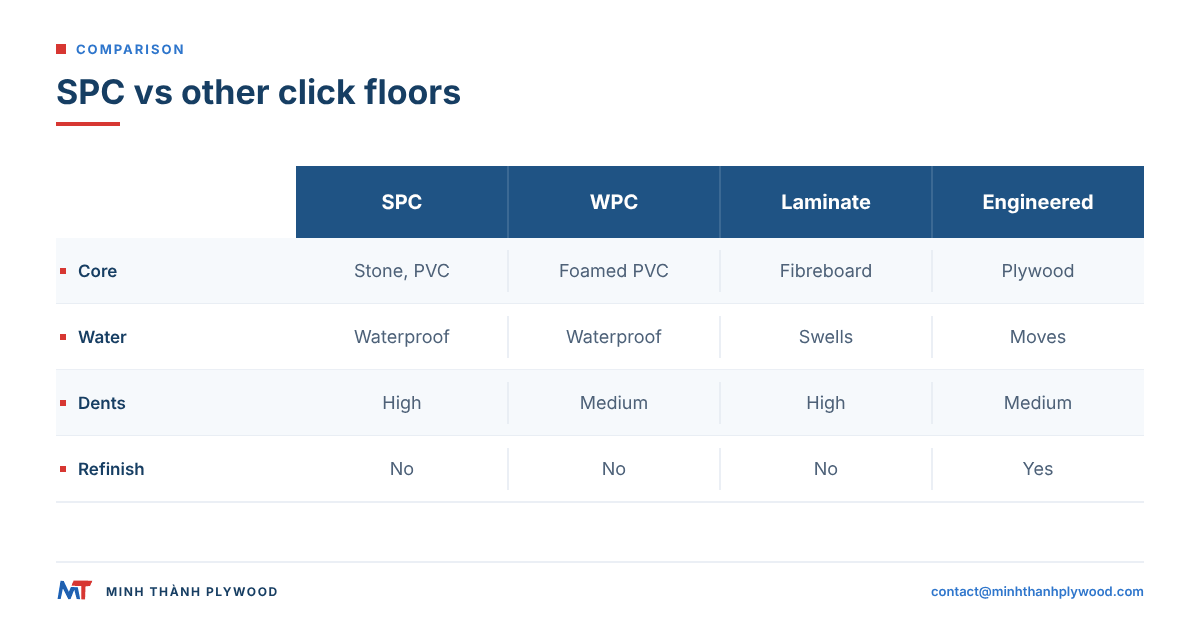
SPC vs WPC, laminate and engineered wood
SPC competes with three other click floors. One metric per row:
| Metric | SPC | WPC | Laminate | Engineered wood |
|---|---|---|---|---|
| Core | Limestone and PVC | Foamed PVC with fillers | High-density fibreboard | Plywood or softwood lamellas |
| Surface | Printed film, PVC wear layer | Printed film, PVC wear layer | Printed paper under melamine overlay | Real wood veneer or lamella |
| Water | Waterproof plank | Waterproof plank | Swells if water gets in the joints | Moves with moisture |
| Dent resistance | High | Medium | High | Medium, by species |
| Scratch resistance | Good | Good | Very good | Lower, can be refinished |
| Feel and sound | Firm, cool | Softer, quieter | Hard, louder without underlay | Warm, natural |
| Refinishing | No | No | No | Yes, by wear layer thickness |
| Best fit | Kitchens, bathrooms, basements, rentals | Comfort-focused homes | Dry living areas | Living areas where real wood is wanted |
Laminate is often confused with SPC because both are click floors with a printed pattern. The difference is the core: laminate’s fibreboard swells when water reaches it, SPC’s stone core does not. Our overview of wood flooring types covers the real-wood options.
What are the pros and cons of SPC flooring?
SPC flooring’s strengths come from its core; its weaknesses come from being plastic.
Strengths:
- Waterproof planks for kitchens, bathrooms, basements and laundries.
- Dimensionally stable, so long runs need fewer transition strips.
- Resists dents from furniture and heels better than flexible vinyl.
- Clicks together over most flat, hard subfloors, including old tile.
- Realistic wood and stone looks with embossing in register.
Limitations:
- The surface cannot be sanded or refinished; a worn plank is replaced.
- Feels firm and cool without a good underlay.
- Long direct sun behind large windows can move a poorly made core.
- It is a PVC product: buyers specify phthalate-free formulations and indoor-air certification.
How long does SPC flooring last, and what does it cost?
SPC flooring lasts about 10 to 15 years in a home with a 12 mil wear layer and 15 to 20 years or more with a 20 mil layer; a 28 mil layer is the commercial choice. These are typical industry estimates, because life depends on foot traffic, grit, sun, the subfloor and the click joint, and the wear layer sets the ceiling. A budget floor with a thin layer and a soft core falls short of these figures; a floor built to the table above reaches them.
| Wear layer | Typical life in use | Typical US residential warranty |
|---|---|---|
| 12 mil (0.3 mm) | 10 to 15 years | Often 10 to 15 years, commercial limited or excluded |
| 20 mil (0.5 mm) | 15 to 20 years or more | Often 15 years to lifetime residential, shorter light commercial |
| 28 mil (0.7 mm) | Commercial traffic | Lifetime residential, with a commercial term set by the maker |
Read the warranty for what it excludes: moisture from the subfloor, wrong underlay and missing expansion gaps are the usual conditions.
On cost, US retail pages show SPC planks at about US$2 to US$7 per sq ft for the material depending on tier, labour of US$1 to US$3 per sq ft, and a budget of US$3.00 to US$4.50 per sq ft installed for a living area built to last 15 to 20 years, per D and G Flooring (checked 21 October 2026). Herringbone lays, stairs and subfloor repair cost more. Planks with a thicker wear layer sit at the upper end of each range.
Scratch and dent behaviour follows the same layers. The UV coat and the wear layer take scuffs, so a thicker wear layer resists pet claws and chair legs better; the dense stone core resists dents better than flexible vinyl. Felt pads under furniture help on any plank.
Is SPC flooring waterproof?
SPC planks are waterproof; an SPC floor is water-resistant. The stone core does not swell or lose strength in water, so a spill, a wet mop or a flooded room does not damage the planks.
Water can still pass through the joints and around the perimeter to the subfloor. In bathrooms and kitchens, seal the perimeter with flexible sealant, keep wood subfloors dry, and lift the floor to dry out the subfloor after a flood. A plywood subfloor in a wet room needs the right grade; our guide to plywood in bathrooms explains which.
Where is SPC flooring used?
SPC flooring is used where a waterproof, stable click floor is wanted at a moderate cost:
- Homes: kitchens, bathrooms, basements, hallways and whole-house floors.
- Rentals and hotels: waterproof, quick to install, planks replaceable.
- Light commercial: shops, offices and clinics, with a 0.5 mm wear layer or more.
- Renovation: over existing tile or sound floors, because the rigid core spans small flaws.
It suits heated floors within the plank maker’s surface temperature limit. Heavy rolling loads, workshops and areas under direct, strong sun call for another floor or a glued commercial product.
Can you install SPC flooring over plywood?
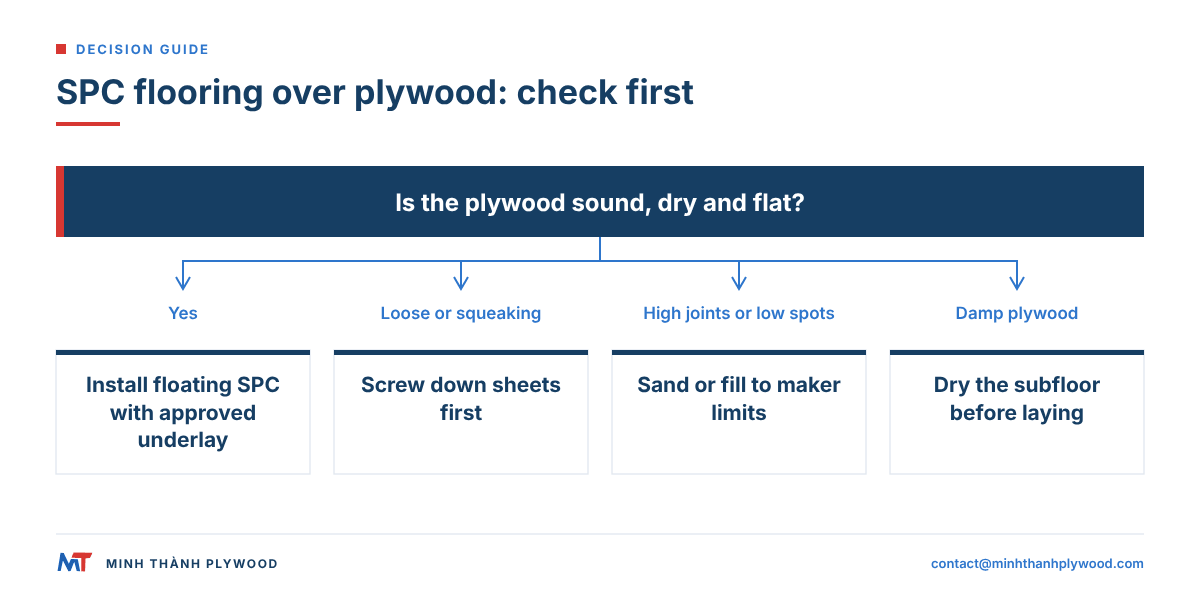
Yes. A plywood subfloor is a good base for floating SPC when it is sound, dry and flat. Plank makers set the flatness limit in their installation guides; the rigid core spans small dips, but not humps, open joints or loose sheets.
Prepare a plywood subfloor in five steps:
- Fix it. Screw down every loose sheet to stop squeaks and movement.
- Level it. Sand high joints and fill low spots with a compound the plank maker approves.
- Dry it. Wood subfloors should be dry before the floor goes down; plywood dispatched at 8–12% moisture suits interior use.
- Clean it. Vacuum dust and grit that would press through the underlay.
- Underlay. Use the attached backing or the underlay the plank maker lists; add a vapour barrier over crawl spaces if specified.
New plywood subfloors are usually 18 mm or thicker on joists. Our article on plywood plank flooring shows plywood used as the finished floor, and tile backer board vs plywood covers the base for tiled rooms.
SPC flooring factories: what buyers check
Buyers sourcing SPC flooring from Vietnam, China or elsewhere check the core, the surface and the paperwork before price.
| Check | What to ask for | Why |
|---|---|---|
| Core formulation | Stone-to-PVC ratio, virgin or recycled PVC, phthalate-free | Hardness, weight and heat stability |
| Wear layer | Thickness measured on the sample, in mm | Wear life |
| Click profile | Licence holder, joint strength result | Joints that stay closed |
| Dimensional stability | Heat stability and curling tests | Gaps and peaking in sun |
| Indentation | Residual indentation test | Furniture marks |
| Product standard | ASTM F3261 for the US, EN ISO 10582 and EN ISO 10874 for Europe | Inspection and tender acceptance |
| Indoor air | FloorScore or equivalent | Retail and project requirements |
| Capacity and QC | Lines, schedule, inspection before loading | Repeat orders that match the sample |
A factory that makes its own core controls the formulation; a plant that only laminates bought-in cores cannot change it. Ask which steps happen on site.
Does SPC flooring contain formaldehyde?
SPC flooring is not built with the urea-formaldehyde resins used to glue many wood panels, because its core is limestone and PVC. Indoor-air questions on SPC are about VOC emissions and plasticisers, so buyers ask for phthalate-free formulations and certification of the finished plank.
Wood-based floors and subfloors raise the formaldehyde question instead. The plywood under an SPC floor is a wood panel, and Minh Thanh Plywood makes interior plywood with UF glue at E0 emission. Six ASTM D6007 chamber tests between April 2025 and June 2026 on 9, 15 and 18 mm panels averaged 0.014–0.032 ppm against the 0.05 ppm CARB Phase 2 / TSCA Title VI limit. That limit, for veneer-core hardwood plywood, is written in 40 CFR 770.10.
Where does plywood fit in an SPC floor?
Plywood is the subfloor under many SPC floors, especially on timber joists, in renovations and in prefabricated buildings. SPC is a finish; the subfloor carries the load, and its flatness and dryness decide how the click joints behave.
Minh Thanh Plywood, a manufacturer in Phu Tho, Vietnam, makes subfloor-ready plywood alongside its furniture panels. We do not make SPC flooring. For subfloors and underlayment we supply:
- Exterior and CDX-type plywood with phenolic (WBP) or melamine-fortified glue for floors exposed to moisture during building; see our exterior plywood.
- Thickness: 3–40 mm; 18 mm and thicker for subfloors on joists.
- Sizes: 1220 × 2440 mm, 1250 × 2500 mm or custom.
- Tolerance: commercial panels ±0.5 mm, sanded panels down to ±0.2 mm for thin underlayment.
- Moisture: 8–12% at dispatch.
- Terms: MOQ one 40HC, mixed by agreement; FOB Hai Phong, CFR or CIF; free samples.
Send this line for a subfloor quote: “Subfloor plywood under floating SPC, [phenolic/MR] glue, [thickness] mm, 1220 × 2440 mm, sanded [yes/no], tolerance ±0.5 mm, moisture 8–12%, [quantity] × 40HC, [port].”
Buyer questions, answered
What is SPC flooring?
SPC flooring is rigid-core vinyl flooring with a stone plastic composite core: limestone powder, PVC and stabilisers extruded into a dense board, topped with a printed decor film and a clear wear layer. It is waterproof and usually installed as a floating click floor.
What does SPC stand for in flooring?
SPC stands for stone plastic composite, sometimes stone polymer composite. The stone is limestone (calcium carbonate) powder; the plastic is PVC.
What is the difference between SPC and LVP?
LVP, luxury vinyl plank, is the wider family. SPC is a rigid-core LVP with a stone-based core; classic LVP is flexible and usually glued down. SPC hides minor subfloor flaws better and clicks together; flexible LVP is softer and thinner.
Is SPC flooring waterproof?
The planks are waterproof: the core does not swell in water. The floor as a whole is water-resistant, because water can still pass through the joints and around the edges to the subfloor.
Is SPC better than laminate?
For wet rooms, yes: SPC does not swell, while laminate has a wood-fibre core that swells when water gets into the joints. Laminate has a harder surface against scratches and feels more like wood underfoot.
How thick should SPC flooring be?
Most SPC planks are 4–8 mm thick in total. Choose by the wear layer first: 0.3 mm for light residential use, 0.5 mm or more for busy homes and light commercial areas.
Can SPC flooring be installed over plywood?
Yes. A sound, dry, flat plywood subfloor is a good base for floating SPC. Screw down loose sheets, sand high joints and use the underlay the plank maker approves.
What is the wear layer on SPC flooring?
The wear layer is the clear PVC layer over the printed decor. Its thickness, quoted in mm or mil, decides how long the pattern resists wear: 0.3 mm (12 mil), 0.5 mm (20 mil) and 0.7 mm (28 mil) are common.
Does SPC flooring contain formaldehyde?
The SPC core is PVC and limestone with no wood-glue resin, so it does not contain the urea-formaldehyde resins used in some wood panels. Buyers still ask for indoor-air certification such as FloorScore for the finished plank.
Does SPC flooring scratch or dent?
It can scratch, but less than flexible vinyl. The UV coat and the wear layer take the scuffs, so a 20 mil (0.5 mm) wear layer resists pet claws and chair legs better than 12 mil. The dense stone core resists dents from furniture and heels better than foam-backed vinyl, though a heavy point load can still mark any plank.
How long does SPC flooring last?
Typically 10 to 15 years in a home with a 12 mil wear layer and 15 to 20 years or more with 20 mil. Commercial 28 mil planks are built for heavier foot traffic. Wear layer, subfloor and care decide the real figure.
What is the difference between SPC and WPC flooring?
WPC (wood plastic composite) has a foamed core of PVC and wood flour or other fillers; SPC has a denser limestone core. WPC is thicker, softer and quieter underfoot; SPC is thinner, harder and more resistant to dents.
Where is SPC flooring made?
Most SPC flooring is made in Asia, mainly China and Vietnam, and in some plants in Europe and North America. Buyers check the core formulation, wear layer, click licence and test reports at the factory.