
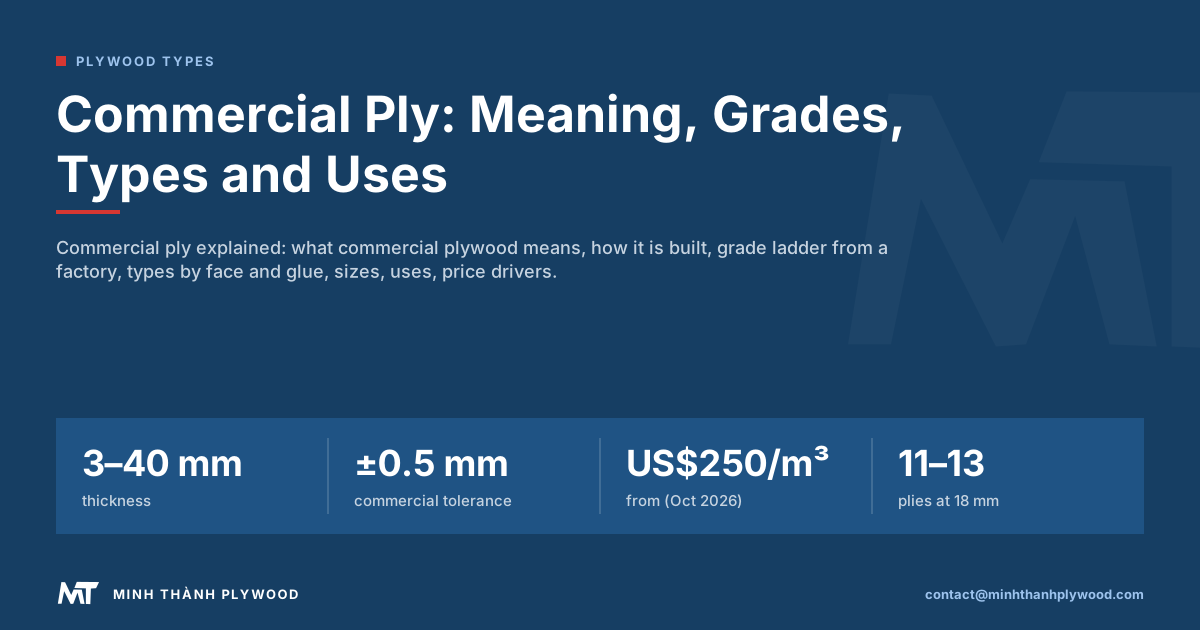
Commercial ply is general-purpose plywood: a hardwood or plantation-wood core with a decorative or utility face veneer, bonded for interior or semi-exterior use and sold for fit-outs, covered furniture parts and packing. It costs less than furniture-grade or marine plywood because the core and finish are simpler. Minh Thanh Plywood makes it in Vietnam alongside its furniture range.
What is commercial ply?
Commercial ply, short for commercial plywood, is a general-purpose veneer panel: a hardwood or plantation-wood core, a utility or decorative face and back, and an interior or moisture-resistant glue. It is made for fit-outs, covered furniture parts, shop fittings and packing, where the panel needs strength and a decent face but not a furniture-grade finish.
In one line: commercial plywood is the everyday grade between packing plywood below and furniture or marine plywood above.
Three things make a panel “commercial”:
- Core: sound, economical veneers, laid loose or jointed rather than stitched layer by layer.
- Finish: unsanded or lightly sanded, with a wider thickness tolerance than calibrated furniture panels.
- Bond: interior UF or moisture-resistant (MR) glue as standard, with water-resistant bonds on order.
What does “commercial plywood” mean in different markets?
The meaning of commercial plywood changes with the market, and a quote can only be compared once you know which meaning the buyer has in mind.
| Market | What “commercial plywood” usually means |
|---|---|
| India | MR-grade general-purpose plywood (Indian Standard IS 303), used under laminates in furniture; “commercial ply” is the trade name |
| Gulf and Middle East | Imported hardwood-faced plywood for interiors and joinery, often called commercial or Far Eastern plywood |
| Europe | Interior hardwood or plantation-faced plywood for fit-outs, often called utility or project panel |
| North America | Hardwood plywood sold for cabinets and fixtures, as opposed to structural sheathing |
| South Africa | Sold as commercial interior ply or WBP commercial exterior ply, faces graded B/C, per sheet of 2440 × 1220 mm from merchants |
| Vietnam (factory language) | Commercial line: AB core, loose or jointed lay-up, unsanded or lightly sanded, ±0.5 mm tolerance |
The common thread is use: commercial plywood is for interior and covered work, not structural sheathing, concrete formwork or boats. Regional names are compared in Far Eastern, utility and project panel plywood.
In construction, commercial plywood means interior panels for partitions, ceilings, shop fittings and hoardings. In manufacturing, it means the economical substrate for laminated furniture, cabinets and display fixtures. Examples: an 18 mm Okoume-faced panel for a shop counter under laminate, a 9 mm Poplar-faced panel for a drawer bottom, a 12 mm Bintangor panel for a fitted wardrobe back.
How is commercial plywood built?
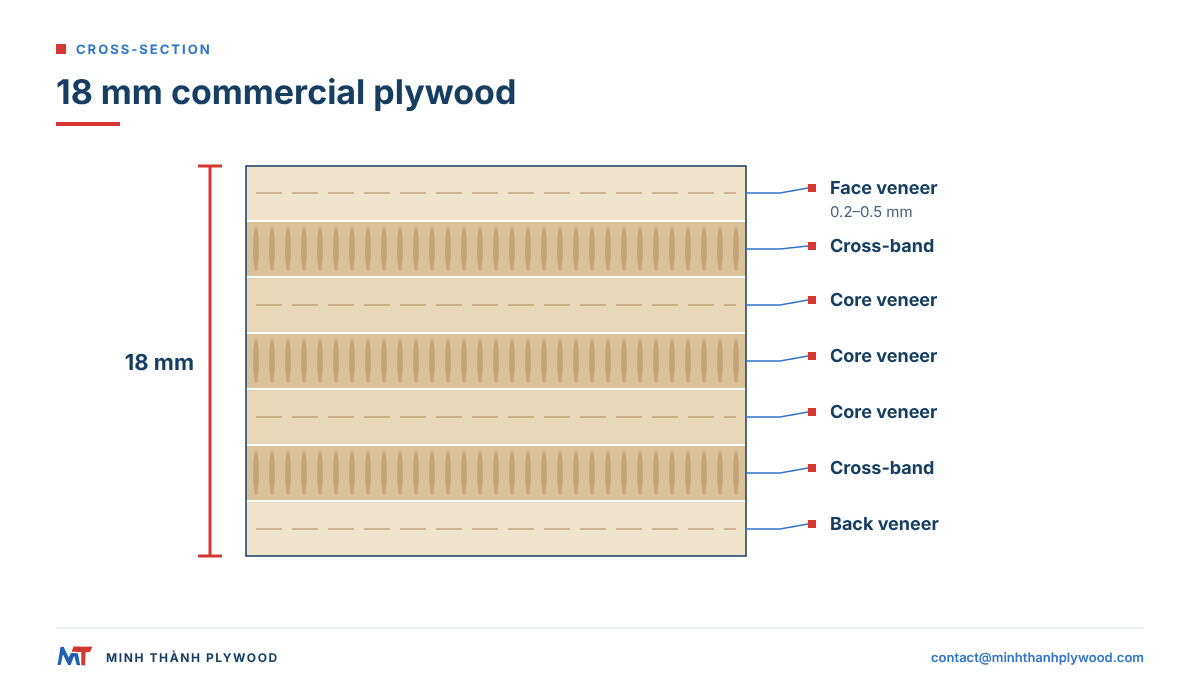
Commercial plywood is built from an odd number of veneers laid crosswise, glued and hot-pressed into a panel, with a face and back veneer chosen for the look.
- Core veneers are peeled from plantation logs, dried and graded. A commercial build uses AB-grade core veneers.
- Lay-up: core veneers are laid crosswise, loose or edge-jointed. Furniture cores are stitched as well; commercial cores usually are not.
- Glue: UF glue for interiors, melamine-fortified (MR) or phenolic (WBP) for damp or exterior use.
- Pressing: the stack is hot-pressed until the glue cures.
- Face and back: the decorative or utility veneers go on the outside.
- Trim and finish: sawn to size, then left unsanded or lightly sanded.
An 18 mm panel usually has 11 to 13 plies, most often 11. The face veneer is thin, typically 0.2–0.5 mm; the strength comes from the core.
Commercial plywood grades: the ladder from a factory
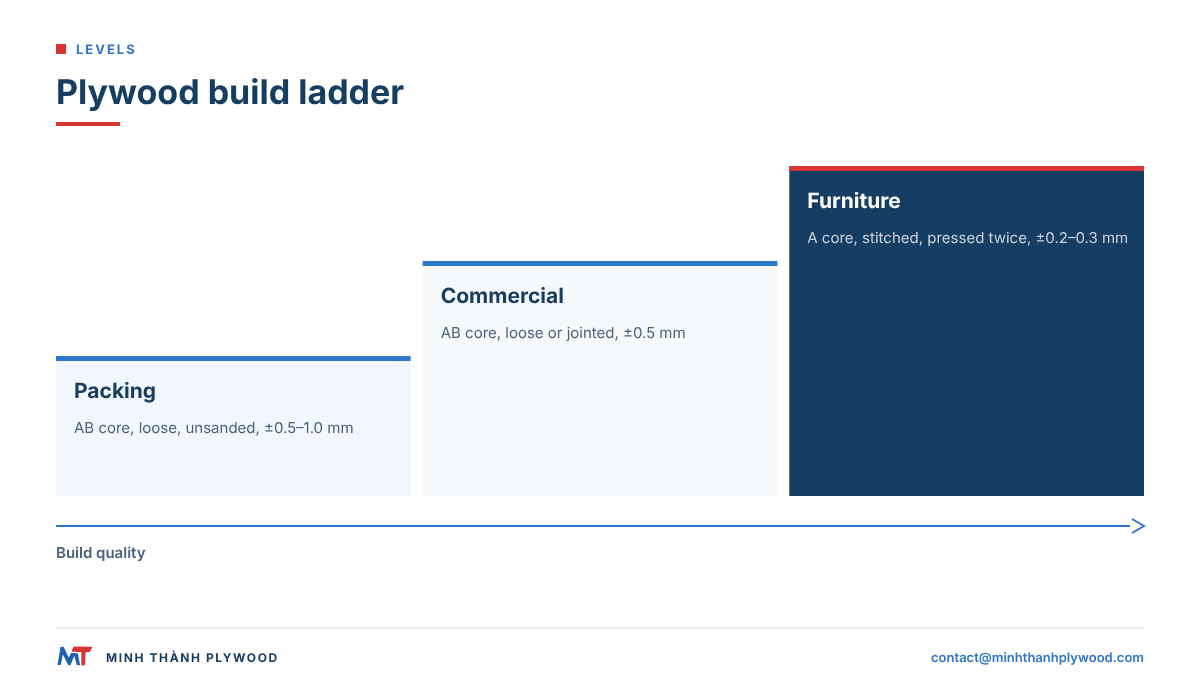
A Vietnamese plywood factory sells three builds from the same press, and commercial plywood sits in the middle. The core grade, lay-up, sanding and tolerance change as you move up the ladder.
| Build | Core veneer | Lay-up | Surface | Thickness tolerance | Typical glue |
|---|---|---|---|---|---|
| Packing | AB | Loose-laid | Unsanded | ±0.5–1.0 mm | UF |
| Commercial | AB | Loose or jointed | Unsanded or lightly sanded | ±0.5 mm | UF, MR or WBP |
| Furniture | A | Stitched, pressed twice | Sanded and polished | ±0.2–0.3 mm, down to ±0.2 mm | UF glue at E0 emission |
Face grades are separate from the build. Poplar and Eucalyptus faces are quoted as A/A, A/B or B/B (face/back); Birch faces as D+, D or E. A commercial panel can carry an A-grade face on an AB core, which looks good but machines like a commercial panel.
At Minh Thanh, furniture panels are pressed twice as standard: the core board is pressed and calibrated, then face and back are pressed on. That step is what moves a panel from commercial to furniture tolerance.
Commercial plywood types
Commercial plywood types are named three ways: by face veneer, by glue and by use. A complete description uses all three.
By face:
- Bintangor: warm reddish-brown, the classic commercial face for joinery and paint.
- Okoume: pink-beige, smooth, light; for fit-outs and furniture substrates.
- Poplar: pale cream, takes paint, foil and laminate evenly.
- Eucalyptus: natural pink-brown, for utility interiors and covered parts.
- Gurjan and Pine: on order, for specific looks and markets.
By glue:
- UF (interior): dry interiors, the most common commercial bond.
- MR (melamine-fortified): humid interiors such as kitchens and bathrooms.
- WBP (phenolic): damp or exterior exposure.
By use: furniture substrate, fit-out and partition, shop fitting, and packing. Thin commercial panels (3–6 mm) serve as drawer bottoms and backs; thick ones (15–18 mm and up) as carcasses and shelves. Heavier builds for loads are covered in heavy-duty plywood.
Which faces does Vietnamese commercial plywood use?
Vietnamese commercial plywood is usually faced with Bintangor, Okoume, Poplar or Eucalyptus, on an Acacia, Eucalyptus or white Styrax core. Vietnamese plywood is made only on these plantation cores (plus mixed cores); there is no poplar or birch core in Vietnam, and Bintangor, Okoume and Gurjan are always face veneers.
| Face | Look | Best finish | Product page |
|---|---|---|---|
| Bintangor | Reddish-brown, open grain | Stain, paint, clear lacquer on utility parts | Bintangor plywood |
| Okoume | Pink-beige, fine grain | Paint, laminate, clear finish | Okoume plywood |
| Poplar | Pale cream, quiet grain | Paint, foil, laminate | Poplar plywood |
| Eucalyptus | Pink-brown | Paint, laminate, covered parts | Eucalyptus-faced plywood |
| Gurjan | Reddish-brown, dense | Joinery, Indian and Gulf markets | Gurjan plywood |
Minh Thanh’s commercial line uses selected faces from our 10+ face veneers on Styrax or Eucalyptus cores, with the bond, sanding and dimensions matched to the job.
Commercial plywood thickness and sizes
Commercial plywood is made from 3 mm to 40 mm thick, in 1220 × 2440 mm (4 × 8 ft) and 1250 × 2500 mm sheets, with custom sizes on order.
| Thickness | Typical commercial use |
|---|---|
| 3–6 mm | Drawer bottoms, cabinet backs, door skins, linings |
| 9–12 mm | Partitions, ceilings, wardrobe backs, display fixtures |
| 15–18 mm | Carcasses, shelves, counters under laminate, shop fittings |
| 21–25 mm | Worktops under laminate, heavy shelving, stair and stage parts |
The thickness tolerance on a commercial build is ±0.5 mm; length and width are held to ±2 mm. If your parts are machined to tight dimensions or edge-banded, order a calibrated furniture build instead.
Custom sizes such as 1220 × 2500 and 1220 × 2280 mm are made to order. We do not press sheets larger than 1250 × 2500 mm; larger parts are cut from standard sheets.
Commercial ply in South Africa: sizes and price guide
South African merchants sell commercial ply as interior or WBP exterior panels in one sheet size, 2440 × 1220 mm. Cape Lumber Marketing lists its WBP commercial exterior plywood in 3.6, 5.2, 6, 9, 12, 15, 18 and 21 mm, with a 3 mm interior sheet beside it, at R230.00 to R1,650.59 per sheet including VAT (read October 2026), the thin sheet at the low end and the 21 mm sheet at the top. Timbuild Somerset West stocks exterior commercial ply in 4, 6, 9, 12, 15, 18 and 21 mm.
A raw FOB example shows what an importer works from. At US$250/m³, an 18 mm sheet of 1220 × 2440 mm holds 0.0536 m³ (2.44 × 1.22 × 0.018), so the wood costs about US$13.4 FOB Hai Phong before freight, port charges, import duty and VAT. That is not a sheet price: the final price depends on the build, quantity and delivery term, and SARS charges duty and VAT at clearance, at the rate your clearing agent confirms for the plywood heading.
A 40HC to Durban or Cape Town travels on the same Asia to southern Africa lanes as Chinese cargo, which take about 26 to 30 days from Shanghai to Durban (June 2026); ask your forwarder for the Hai Phong schedule. A merchant who buys by the container, rather than a few packs from a distributor, keeps the difference between that landed cost and the shelf price.
Commercial plywood uses by grade
Commercial plywood uses split by how much of the panel shows and how much moisture it sees. Match the build to the part, not the other way round.
| Use | Face grade | Glue | Notes |
|---|---|---|---|
| Laminated furniture carcass | B/B | UF | Laminate hides the face |
| Painted cabinet doors and fronts | A/B | UF or MR | Order a lightly sanded face |
| Kitchen and bathroom cabinets | A/B | MR | Humid, not wet |
| Partitions and ceilings | B/B | UF | Covered or painted |
| Shop fitting and display | A/A or A/B | UF | Visible faces get the better grade |
| Hoarding and temporary covered work | B/B | MR or WBP | Short-term, under cover |
| Crates and protective packing | Packing build | UF | See packing plywood |
For packing, a commercial build is often more than the job needs. What packing grade plywood is explains the lighter option.
Is commercial plywood good for furniture?
Commercial plywood is good for furniture parts that are covered or painted: carcasses under laminate, drawer bottoms, cabinet backs and shelves. It is not the best choice for clear-finished visible surfaces or for parts machined to tight thickness.
The reasons are in the build. A commercial core is not stitched, so small core gaps can show at a cut edge. The thickness tolerance is ±0.5 mm, against ±0.2–0.3 mm on a sanded furniture panel, which matters for hinges, drawer runners and edge banding. And an unsanded face needs preparation before a clear finish.
For visible furniture, Minh Thanh makes furniture-grade panels with stitched cores, double pressing, sanded and polished UV-ready faces and UF glue at E0 emission. Many furniture makers buy both: commercial for the hidden parts, furniture grade for fronts and tops, in one container.
Commercial vs marine plywood
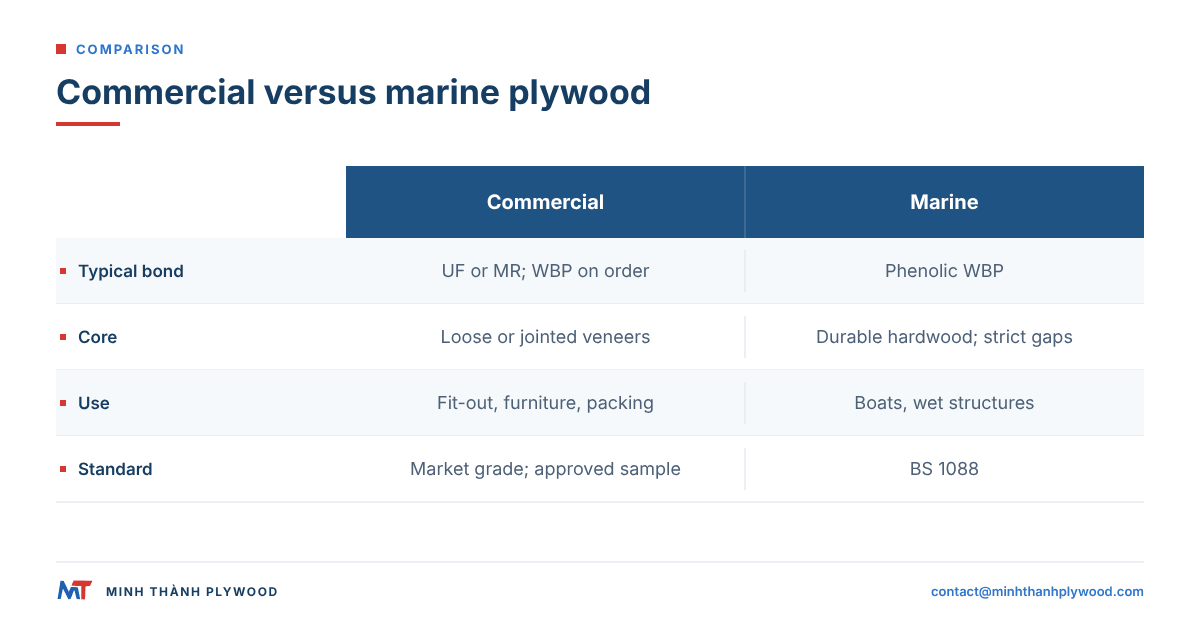
The difference between marine plywood and commercial plywood is the bond, the core and the use: marine is made for permanent wet exposure, commercial for dry and covered work.
| Point | Commercial plywood | Marine plywood |
|---|---|---|
| Glue | UF or MR as standard, WBP on order | Phenolic WBP |
| Core | Plantation veneers, loose or jointed | Durable hardwood veneers throughout |
| Core gaps | Small gaps allowed | Strict limits |
| Standard | Market grade, sample-approved | BS 1088 or equivalent marine standard |
| Typical use | Furniture, fit-out, packing | Boats, docks, permanently wet structures |
| Price | Lower | Higher |
The marine standard is BS 1088:2018, which specifies standard and lightweight marine plywood made from untreated tropical hardwood veneers.
If the panel will get wet but is not a boat, a commercial panel with a phenolic WBP bond and sealed edges often does the job at a lower price. The full comparison is in commercial vs marine plywood.
Commercial plywood vs MDF and particleboard
Commercial plywood is stronger, lighter for its stiffness and holds screws better than MDF or particleboard of the same thickness; MDF is flatter and smoother for paint and routing.
| Point | Commercial plywood | MDF | Particleboard |
|---|---|---|---|
| Screw holding at the face | Good | Fair | Fair to poor |
| Edge screws | Good | Needs care | Poor |
| Moisture tolerance | Good with MR or WBP glue | Swells unless moisture-resistant grade | Swells |
| Surface for paint | Needs preparation | Very smooth | Needs a laminate |
| Weight | Lighter for its stiffness | Heavy | Medium |
| Spanning shelves | Good | Sags over time | Sags |
Choose commercial plywood for structure, shelves and carcasses; MDF for painted doors and routed profiles. Many cabinets use both.
Is commercial plywood waterproof or termite resistant?
South African and other merchants split commercial ply into interior grade and WBP exterior grade, and only the WBP exterior grade is made for weather. Standard interior commercial plywood is neither waterproof nor termite resistant. It handles indoor humidity with an MR bond and occasional damp with a WBP bond, but it is not made to sit in water, and untreated wood can be attacked by termites.
Three ways to use it safely:
- For damp areas, order an MR or phenolic WBP bond and seal every cut edge.
- For outdoor use, choose WBP, protect the faces with paint or a coating, and keep end grain off wet surfaces.
- For termite-prone sites, specify preservative-treated panels to your local standard, and keep wood dry and clear of soil.
The general-purpose plywood standard BS EN 636:2012+A1:2015 covers dry, humid and exterior conditions.
Glue type and formaldehyde emission are separate specifications. For US orders, interior panels must meet the TSCA Title VI formaldehyde limits in 40 CFR 770.10. Minh Thanh holds CARB P2 / TSCA Title VI certification as ICTT mill no. 23024.
What does commercial plywood cost, and why do quotes differ?
Commercial plywood from Minh Thanh started from US$250/m³ in October 2026, against from US$350/m³ for furniture and interior plywood. Two quotes for “18 mm commercial plywood” can differ widely because seven lines change the price:
- Face veneer and its grade pair (for example Okoume A/B vs Poplar B/B).
- Core species and grade: Eucalyptus, Acacia or Styrax; AB core vs A core.
- Glue and emission class: UF, MR or WBP; E0, E1 or E2.
- Thickness: thin panels have more glue lines per cubic metre.
- Sanding and tolerance: unsanded ±0.5 mm vs calibrated.
- Sheet size and cutting: standard or custom sizes.
- Quantity and delivery term: FOB Hai Phong, CFR or CIF.
Ask each supplier to quote the same written build, and ask whether the price is FOB Hai Phong, CFR or CIF: freight and insurance alone can move a CIF price well above an FOB price for the same panel. A quote that leaves the core grade, glue or tolerance blank is not finished, and the gap usually hides the cheaper option.
Compare quotes line by line on the build first, then on the price. A lower price for a loose core and an unsanded face is not the same panel as a jointed core with a lightly sanded face.
How many sheets of commercial plywood fit in a 40HC?
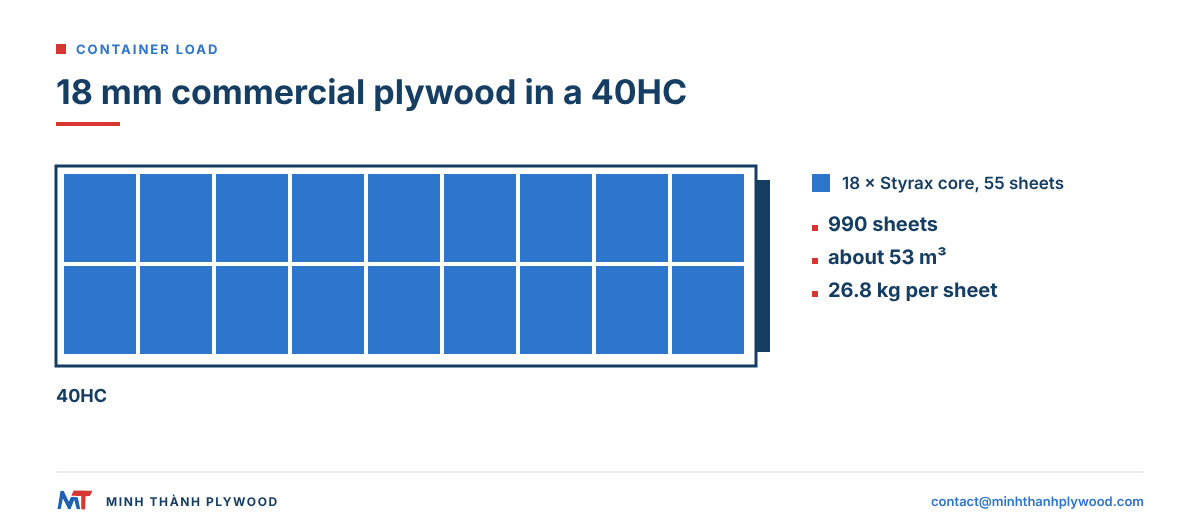
A 40HC holds about 795 to 990 sheets of 18 mm commercial plywood in 1220 × 2440 mm, depending on the core. The core’s density decides how many packs fit before the container reaches its weight limit.
| Core (18 mm, 1220 × 2440 mm) | Packs × sheets | Sheets per 40HC | Volume | Sheet weight |
|---|---|---|---|---|
| White Styrax | 18 × 55 | 990 | about 53 m³ | 26.8 kg |
| Acacia | 16 × 55 | 880 | about 47 m³ | 31.1 kg |
| Eucalyptus | 15 × 53 | 795 | about 43 m³ | 34.8 kg |
The plan uses a planning payload of 28,000 kg unless the booking is lower, with packs about 1,000 mm high. Mixed thicknesses share a container by agreement, usually one or two specifications per container.
How to choose a commercial plywood manufacturer in Vietnam
A good commercial plywood manufacturer in Vietnam makes the panel itself, quotes a written build and backs it with certificates and shipment photos. Check five things before the first order:
- A real factory: a live video of the press and packing line.
- A written build: core, glue, face grade, thickness tolerance and packing on the proforma.
- Certificates in the factory’s name: for example CARB P2 / TSCA Title VI with a mill number.
- A sample of the exact build, kept as the approved reference.
- Shipment proof: photos and video of each container before loading.
Minh Thanh Plywood is a manufacturer in Ha Hoa, Phu Tho, with 50,000+ m³ of annual capacity. Our main lines are furniture and interior plywood for Europe; commercial, packing and film-faced plywood are made in the same factory. We supply the EUDR compliance dossier (origin records and geolocation files) with orders.
How do you check commercial plywood when it arrives?
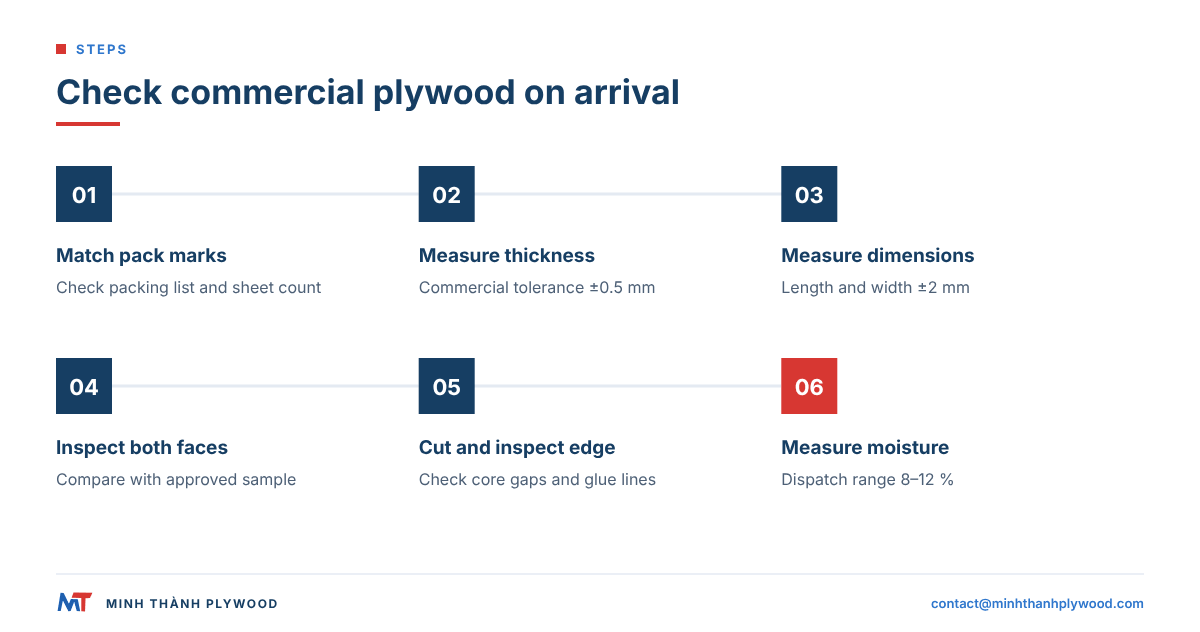
Check commercial plywood on arrival against the written build and the approved sample, in the first days after the container is opened. Ten sheets per thickness, taken from different packs, give a fair picture.
- Match the packs to the packing list: bundle reference, thickness, size and sheet count.
- Measure thickness at several points on each sheet; a commercial build is within ±0.5 mm.
- Measure length and width; both are held to ±2 mm.
- Look at both faces against the approved face and back grade, in daylight.
- Cut one sheet and check the edge for open core gaps and glue lines.
- Check moisture with a meter; 8–12 % at dispatch is the normal range.
Keep photos of anything outside the order with the bundle reference. Every Minh Thanh container is photographed and filmed before loading, so the arrival photos can be compared with the loading record, sheet by sheet.
What to send for a commercial plywood quote
A commercial plywood quote comes back right the first time when the request names the use and the build. Send these lines:
- Application: what the panel becomes and where it goes.
- Face and back: species and grade pair, for example Okoume A/B.
- Core: Eucalyptus, Acacia or Styrax.
- Glue and emission: UF, MR or WBP; emission class if your market sets one.
- Thickness and tolerance, for example 18 mm ±0.5 mm.
- Size: 1220 × 2440, 1250 × 2500 mm or custom.
- Packing, quantity and port.
MOQ is one 40HC; production is 15–45 days after the 30 % deposit, balance against the scanned B/L. Samples are free. Send your list to contact@minhthanhplywood.com or WhatsApp +84 988 586 601 (Lisa), and see the full range on our commercial plywood page.
Buyer questions, answered
What is commercial ply?
Commercial ply is general-purpose plywood with a hardwood or plantation-wood core and a utility or decorative face, bonded for interior or semi-exterior use. It is the everyday grade for fit-outs, covered furniture parts and packing.
What does commercial plywood mean in construction?
On a building site, commercial plywood means interior-grade panels for partitions, ceilings, shop fittings and temporary work, as opposed to structural sheathing or concrete formwork panels.
Is commercial plywood waterproof?
No. Standard commercial plywood uses an interior or moisture-resistant glue and survives humidity, not soaking. For wet use, order a phenolic WBP bond or choose marine or film-faced plywood.
Is commercial plywood good for furniture?
Yes, for carcasses, drawer bottoms and parts covered by laminate, veneer or paint. For clear-finished visible faces and tight machining, a calibrated furniture-grade panel is the better choice.
What is the difference between marine plywood and commercial plywood?
Marine plywood uses durable hardwood veneers throughout, a phenolic WBP bond and strict limits on core gaps, for boats and permanently wet use. Commercial plywood uses an interior or moisture-resistant bond and a simpler core for dry or covered use, at a lower price.
Is commercial plywood termite resistant?
Not by itself. Untreated plywood can be attacked by termites; termite-prone sites need preservative-treated panels or a design that keeps wood dry and off the ground.
What is the standard size of commercial plywood?
The standard size is 1220 × 2440 mm (4 × 8 ft). 1250 × 2500 mm is common for European buyers, and custom sizes such as 1220 × 2500 mm are made to order.
What thickness does commercial plywood come in?
Commercial plywood is made from 3 mm to 40 mm. The most ordered thicknesses are 9, 12, 15 and 18 mm, with a thickness tolerance of ±0.5 mm on a commercial build.
What faces does commercial plywood from Vietnam use?
Bintangor, Okoume, Poplar and Eucalyptus are the usual commercial faces, with Gurjan and Pine on order. The face is chosen for the look and finish; the core and glue are separate order lines.
How much does commercial plywood cost?
Indicative prices for commercial plywood from Minh Thanh started from US$250/m³ in October 2026. The final price depends on the face, core, glue, thickness, size, quantity and delivery term.
What is the minimum order for commercial plywood from Vietnam?
The usual minimum is one 40HC container. Minh Thanh accepts one 40HC with mixed specifications by agreement, usually one or two per container.