
For a boat floor, use BS 1088 marine plywood, 12 to 18 mm thick depending on stringer spacing, sealed with epoxy on every face, edge and screw hole. Decks take the same grade with a non-skid finish; transoms are laminated from two or more sheets. This guide gives thickness by part, compares marine, treated and composite floors, and lists the cutting and sealing steps. Minh Thanh Plywood makes exterior and anti-slip panels, not BS 1088 marine plywood.
Marine plywood for boat floor: the short answer
Marine plywood for boat floor replacement should be BS 1088 grade, 12 to 18 mm thick for most small boats, cut to a template and sealed in epoxy on every face and edge. The grade gives a gap-free core and a boil-proof glue line; the sealing keeps water out of the wood.
Four decisions make the floor:
- Grade: BS 1088 marine plywood, or exterior plywood specified under BS EN 636:2012+A1:2015 as EN 636-3 (often sold as WBP) with a solid core for budget refits.
- Thickness: set by the spacing between stringers and the load on the floor.
- Species: okoume for light weight, meranti or other dense hardwoods for heavy wear.
- Sealing: epoxy on all six sides, every hole sealed, glass cloth and non-skid on top.
Get one of them wrong and the floor goes soft. Most failed floors had the right plywood but unsealed screw holes.
What plywood to use for a boat floor
Use marine plywood made to BS 1088:2018 for any boat floor that sits over a bilge or below the waterline. BS 1088 sets a boil-proof phenolic bond, durable face and core species, and strict limits on core gaps, which is what lets the panel survive years of damp.
The choices buyers meet:
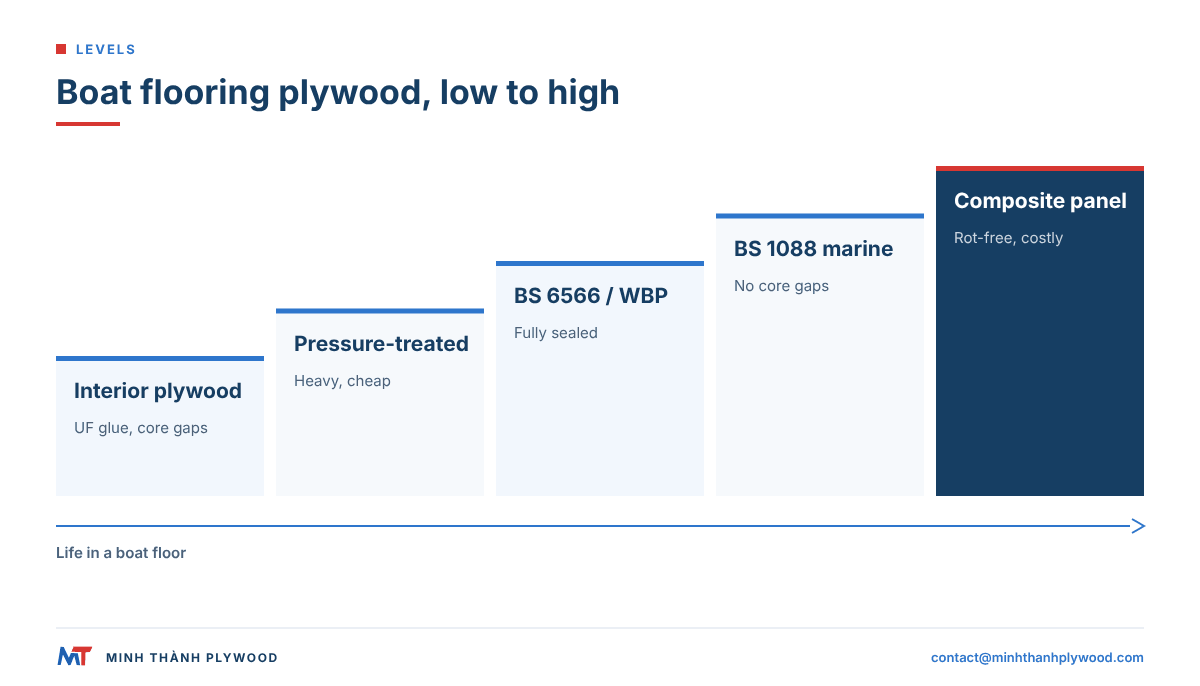
| Panel | Core gaps | Glue | Weight | Life in a boat floor | Cost |
|---|---|---|---|---|---|
| BS 1088 marine plywood | Not allowed | Phenolic, boil-proof | Light (okoume) to medium (meranti) | Long, when sealed | Highest |
| EN 636-3 / WBP exterior plywood | Few, limited | Phenolic WBP | Medium | Medium, when fully sealed | Medium |
| Pressure-treated plywood | Can have gaps | Exterior | Heavy, wet when delivered | Medium; common on pontoons | Low |
| Regular interior plywood | Common | UF | Medium | Short | Lowest |
| Foam or composite panels | None | Resin system | Lightest | Very long, rot-free | Very high |
For a deeper comparison, read marine plywood vs regular plywood and the guide to marine plywood grades.
What thickness marine ply for a boat floor?
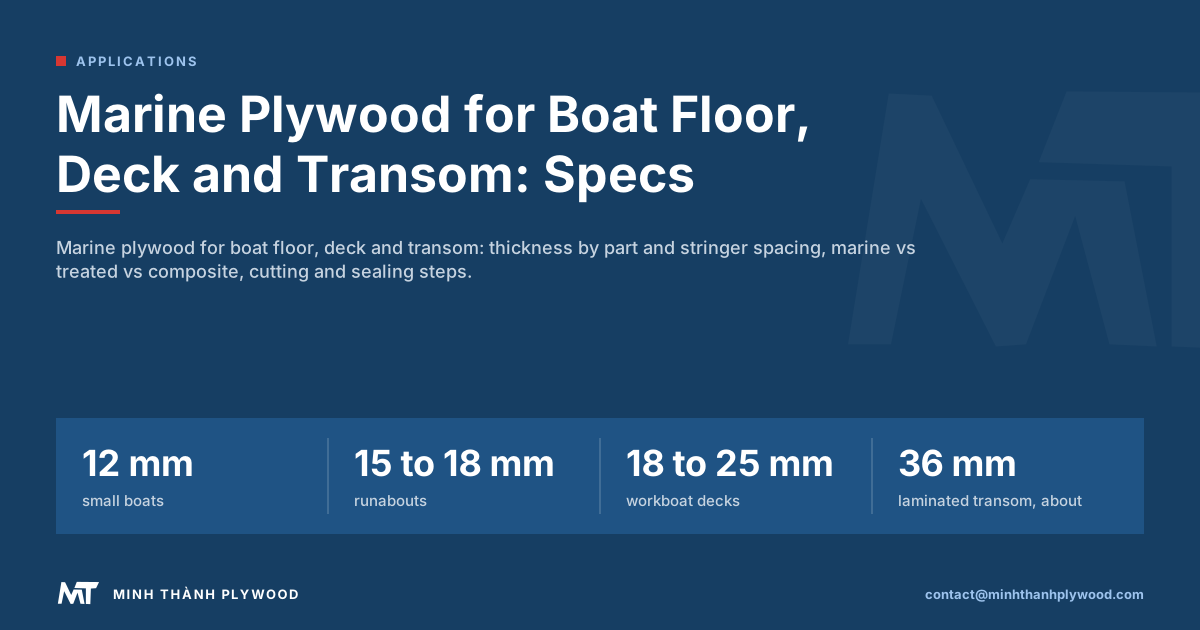
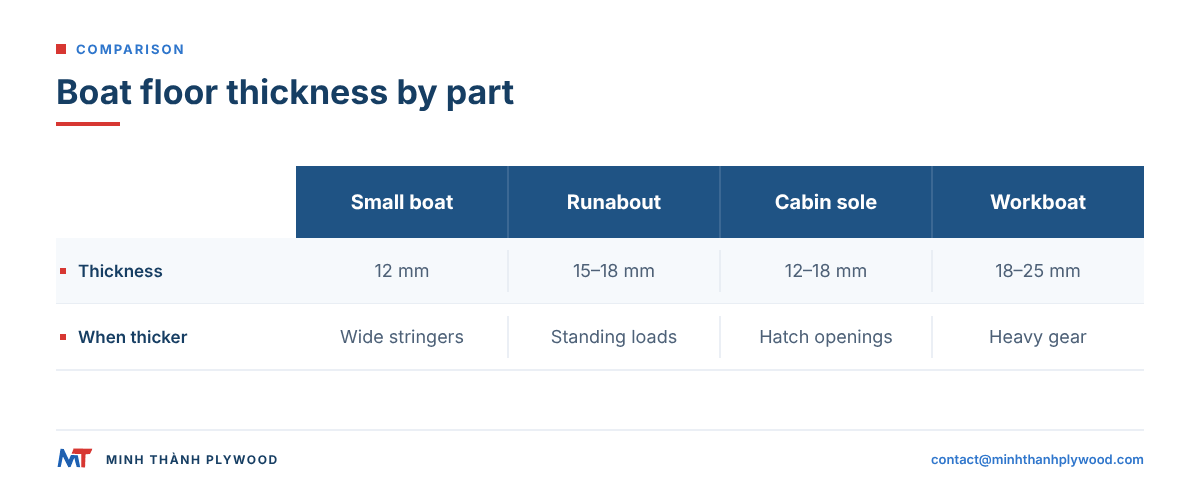
Use 12 mm marine ply for small boats with closely spaced stringers, 15 to 18 mm for most runabouts and fishing boats, and 18 to 25 mm for workboat decks. The span between supports matters more than the boat’s length.
| Part | Typical thickness | When to go thicker |
|---|---|---|
| Small boat floor, close stringers | 12 mm | Wider stringer spacing, heavy anglers |
| Runabout or bass boat floor | 15 to 18 mm | Standing loads, coolers, seat bases |
| Cabin sole | 12 to 18 mm | Hatches cut into the panel |
| Workboat deck | 18 to 25 mm | Gear, pots, nets, vehicles on ramps |
| Pontoon deck | 18 mm | Wide cross-member spacing |
| Layered floor (core + wear layer) | 9 to 12 mm core + 6 to 9 mm wear layer | Heavy wear areas |
Ranges follow common marine trade guidance, such as this guide from an okoume marine plywood maker. A simple field check: stand between two stringers on a test piece. If it flexes visibly, go one thickness up or add a support.
In imperial sizes, the common choices are 1/2 inch for small boats and 3/4 inch for most floors; 5/8 inch sits between. Metric marine sheets are 12, 15 and 18 mm.
What size marine ply for a boat floor?
Standard marine plywood sheets are 1220 × 2440 mm (4 × 8 ft), and 1250 × 2500 mm in many European ranges; some marine ranges also stock longer sheets. Most small-boat floors need two to four sheets. Template the floor first, then choose the sheet size that nests the parts with the fewest joints.
Plan the layout before you buy:
- Measure the floor at its longest and widest points, then sketch how sheets will fit.
- Put joints over stringers or cross-members, never in the middle of a span.
- Use a butt block or scarf joint where two sheets meet, glued and screwed in epoxy.
- Add one sheet extra for templates, test pieces and mistakes.
Scarf joints at a ratio of about 8:1 give the strongest, flattest join on long floors and are standard in boat building. Our guide to marine plywood for boat building explains scarfing and epoxy sheathing.
How to cut plywood for a boat floor
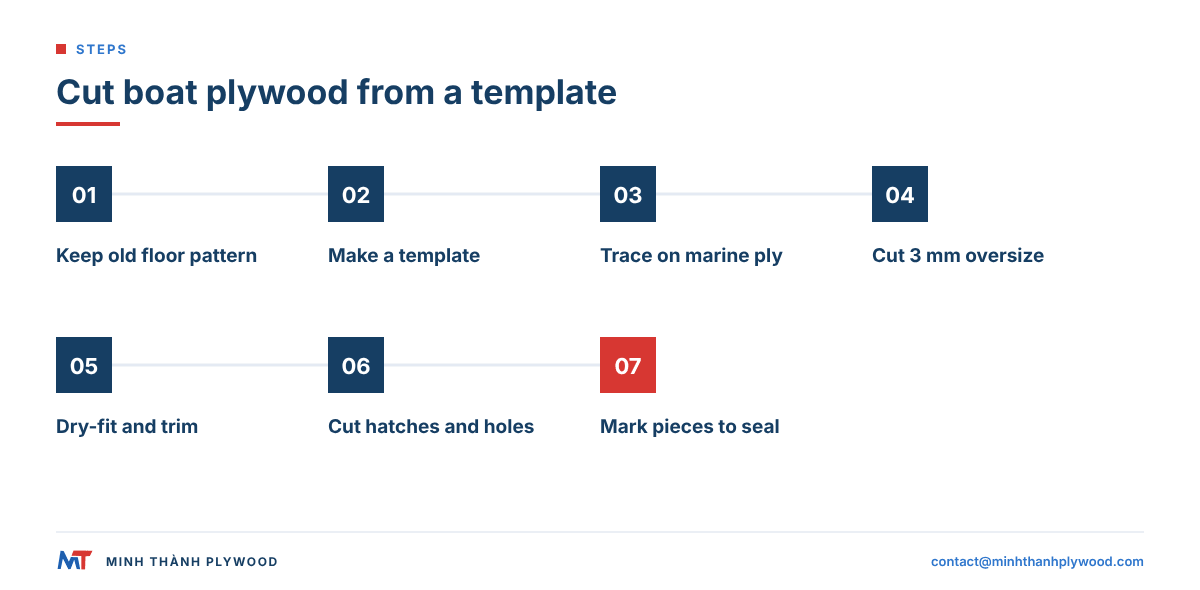
Cut a boat floor from a template, never from measurements alone. Hulls are curved and stringers rarely run parallel, so a template catches every angle.
- Remove the old floor in large pieces if you can, and keep it as a pattern.
- Make a template from cardboard or thin hardboard, taped together, and mark the stringer lines and hatch openings.
- Transfer the template to the marine plywood with the best face up.
- Cut about 3 mm oversize with a jigsaw or circular saw and a fine blade to limit face splintering.
- Dry-fit the panel, trim the high spots and check it sits flat on every stringer.
- Cut hatch openings and drill fastener holes while the panel is out of the boat.
- Mark each piece and its position before sealing.
Use a sharp blade and tape the cut line on okoume faces; the thin face veneer chips easily.
How to seal a plywood boat floor
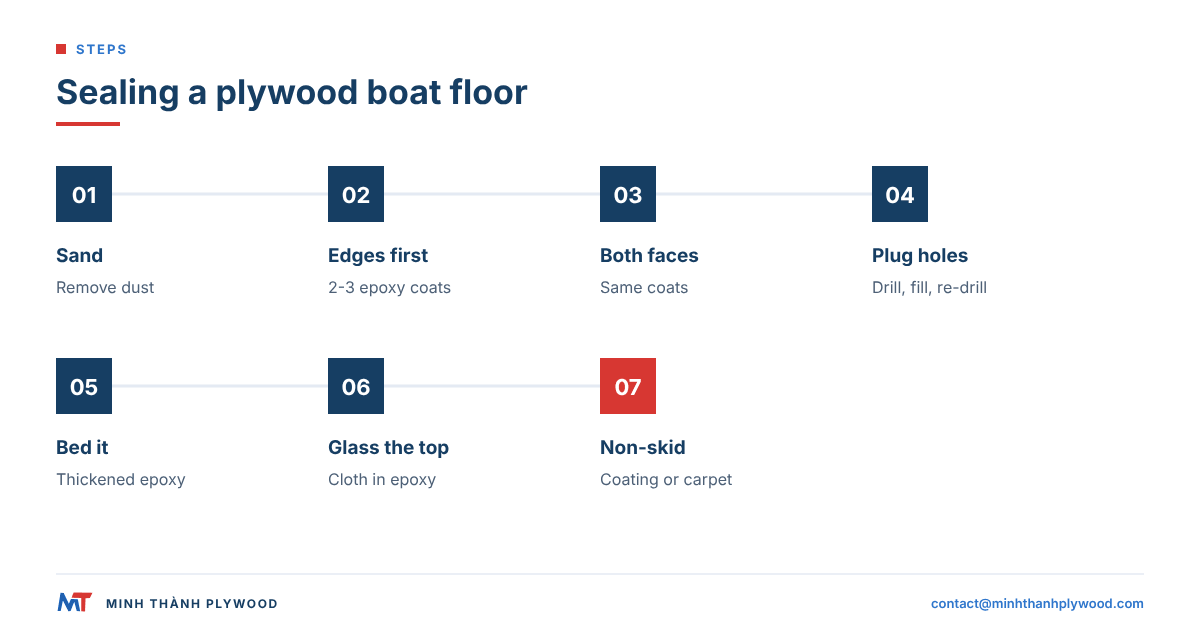
Seal a plywood boat floor with penetrating epoxy on all six sides before installation, then glass and finish the top face. Water enters plywood through edges and fastener holes far faster than through the faces, so those get the most attention. The USDA Forest Service Wood handbook: wood as an engineering material explains how moisture drives decay in wood, which is why every cut edge needs sealing.
- Sand the panel lightly and remove dust.
- Coat edges first with thin penetrating epoxy, two or three coats until they stop soaking it up.
- Coat both faces with epoxy; give the underside the same number of coats as the top.
- Over-drill fastener holes, fill them with thickened epoxy, then re-drill a pilot hole through the cured plug. Screws then bite into epoxy, not bare wood.
- Bed the floor onto the stringers in thickened epoxy or marine adhesive.
- Lay fibreglass cloth in epoxy on the top face and wrap it onto the hull sides.
- Finish with a non-skid deck coating, or marine carpet or vinyl over a fully cured surface.
Plywood should be dry before sealing. Marine trade guidance asks for moisture content below about 12 %; panels that sat in a wet store need drying first.
Marine plywood for boat deck: grade and finish
Marine plywood for boat deck work is the same BS 1088 grade as the floor, but the top face takes sunlight, foot traffic and standing water, so the finish matters more. Use a non-skid deck coating or teak strips on epoxy-sealed plywood.
Deck choices by use:
| Deck use | Plywood | Finish |
|---|---|---|
| Light sailing dinghy | Okoume BS 1088, 6 to 9 mm | Epoxy, glass cloth, painted non-skid |
| Runabout casting deck | Okoume or meranti, 12 to 18 mm | Glass, non-skid or marine carpet |
| Wooden cruiser deck | Marine plywood under laid teak | Epoxy-bedded teak strips |
| Workboat or ferry ramp | Dense hardwood marine plywood, 18 to 25 mm | Anti-slip coating or film |
| Pontoon or floating walkway | Marine, treated or phenolic film-faced | Anti-slip film or coating |
For decks that must give grip when wet, a textured phenolic film is a tested option. Anti-slip film-faced plywood carries a hexagonal or mesh phenolic film of about 220 g/m² pressed onto the face.
Marine plywood for boat transom: thickness and build
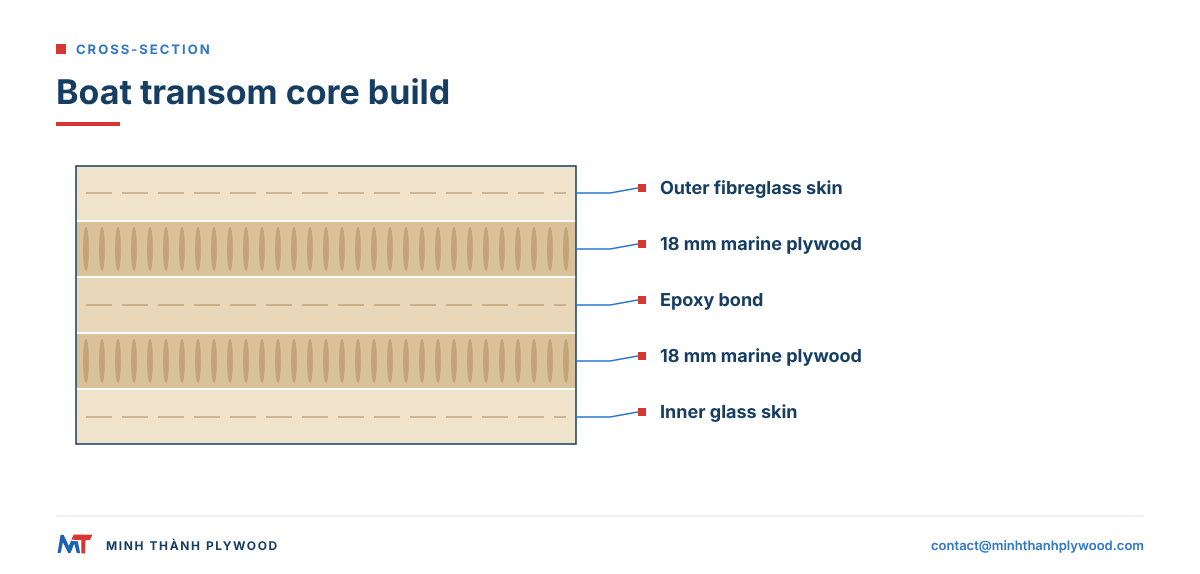
Marine plywood for boat transom cores is usually two layers of 18 mm sheet laminated in epoxy, about 36 mm thick, then glassed into the hull. A transom carries the full thrust and weight of an outboard engine, so it is built thicker and stiffer than any floor.
How a transom core is built:
- Remove the old core completely, down to dry, sound fibreglass skins.
- Cut two pieces of marine plywood from a template of the transom.
- Laminate them with thickened epoxy, clamped or screwed, and let it cure.
- Seal every face and edge with epoxy before fitting.
- Bond the core to the outer skin with thickened epoxy, then glass the inner side.
- Drill engine bolt holes oversize, fill with epoxy and re-drill, so water cannot reach the wood.
Transom thickness and height follow the boat and engine maker’s figures. Larger outboards may need a thicker laminate of 1-1/2 to 2 inches. Many restorers now use composite transom board, which is lighter and rot-free, at a higher price.
Pontoon boat redeck: plywood, sizes and fasteners
A pontoon deck is not a hull floor, and US retailers sell it as a separate product: 3/4 in (18 mm) CCA-treated “marine” plywood, 7 plies on a 4 × 8 ft sheet and 6 plies on a 4 × 8.5 ft sheet, treated to a 0.40 retention rating or better (Pontoon Specialists, Boat Carpet Central, checked 21 October 2026). Makers say it is the plywood most new pontoon builders use and claim a life of up to 20 years. The treatment is a preservative, not a marine glue line, so leave the sheet uncoated until it is fixed down and cover it with vinyl or marine carpet.
| Item | Typical US spec |
|---|---|
| Plywood | 3/4 in, 7 ply, CCA treated, 0.40 retention or better |
| Sheet sizes | 4 × 8 ft for an 8 ft deck, 4 × 8.5 ft (8 ft 6 in) for a wide deck |
| Minimum order | 4 sheets at most retailers |
| Retail price per 4 × 8 ft sheet | US$125–146 (4 × 8.5 ft sheet from US$135) |
| Deck screws | 2 in stainless steel, about US$33 per 100 |
| Deck bolts | 1.5 in stainless steel, about US$35 (pack size not stated) |
| Deck sheet count | Deck length in feet ÷ 4, rounded up: 5 sheets for 20 ft, 6 for 24 ft, 7 for 26 ft |
For comparison, a BS 1088 okoume sheet of 3/4 in (18 mm) is a different product with a waterproof phenolic glue line and no preservative: Menards lists a nine-ply Lloyd’s-certified sheet at US$128.99, and specialist marine suppliers list 18 mm BS 1088 sheets from US$176 to US$322. The pontoon sheet is cheaper per 4 × 8 ft because it is built for the cover that goes over it.
Pontoon docks, floating walkways and boarding ramps are the dock side of the same job. For those, order an anti-slip film-faced plywood: anti-slip plywood of 12–21 mm with hexagonal or mesh phenolic film from Minh Thanh Plywood, in 1220 × 2440 mm sheets by the 40HC.
Boat flooring plywood: marine vs treated vs composite
For boat flooring plywood, marine grade sealed in epoxy gives the best mix of weight, stiffness, cost and repairability. Treated plywood is cheaper but heavy, composite panels last longest but cost most.
| Factor | Marine plywood, sealed | Pressure-treated plywood | Composite / foam panel |
|---|---|---|---|
| Weight | Light to medium | Heavy, especially when new | Lightest |
| Stiffness per thickness | High | Medium | High, by product |
| Rot resistance | Good while sealed | Good, chemical treatment | Total |
| Bonding with epoxy | Excellent | Poor until fully dry | Excellent |
| Effect on aluminium | None | Some treatments corrode it | None |
| Repairs | Easy with wood tools | Easy | Needs product-specific methods |
| Cost | Medium to high | Low | Very high |
Pressure-treated plywood is popular on pontoon boats in North America because it is cheap and rot-resistant. Check that the treatment and fasteners are approved for contact with aluminium, and let the panel dry before gluing anything to it.
Best marine plywood for boat flooring in Australia, the Philippines and Singapore
In Australia, the Philippines and Singapore, the best marine plywood for boat flooring is the same as anywhere: BS 1088 (or the local equivalent, AS/NZS 2272 in Australia) with a stamp on every sheet, bought from a marine timber supplier. Check the stamp, not the label.
A buyer’s checklist that works in any market:
- Stamp on the sheet: BS 1088, AS/NZS 2272 or the standard the supplier names, with the maker.
- Edge check: look along the edge of the sheet for core gaps and overlaps.
- Species: okoume, meranti, gaboon or other durable hardwood, as the standard allows.
- Ply count: an 18 mm marine sheet has many thin plies; few thick plies point to a cheaper construction.
- Paperwork: the invoice names the standard.
In the Philippines, “marine plywood” is often used in trade for any water-resistant plywood. For a boat, ask for BS 1088 by name and look at the core before you pay.
Fixings and fasteners for boat floors
Fix boat floors with stainless steel or bronze screws, bedded in epoxy or marine sealant, into sealed holes. Galvanised and plain steel screws rust, stain the floor and let water travel along the shank into the wood.
Rules marine builders follow:
- Stainless grade A4 (316) in saltwater; A2 (304) is acceptable in freshwater boats.
- Pre-drill and seal every hole with epoxy, as in the sealing steps.
- Glue as well as screw: bonding the floor to the stringers with thickened epoxy makes it stiffer and quieter.
- Avoid fasteners through the hull skin below the waterline.
Removable hatch panels need the same care at their edges, which are cut, handled and wetted more often than any other part of the floor.
What Minh Thanh Plywood supplies for decks and platforms
Minh Thanh Plywood does not make BS 1088 marine plywood, so buy hull, floor and transom panels from a marine timber supplier. We make panels for the dock side of the job: walkways, ramps, platforms and work decks where an exterior bond and grip matter.
- Anti-slip plywood on order: hexagonal or rice/mesh phenolic film, about 220 g/m², smooth film back, 12–21 mm, Eucalyptus or Acacia core, ±0.5 mm thickness tolerance.
- Exterior plywood with phenolic WBP or melamine-fortified glue, C/D utility faces, 3–40 mm, for covered or finished outdoor parts.
- Sizes: 1220 × 2440 mm and 1250 × 2500 mm.
- Slip tests: testing to the method your specification names is arranged through SGS on request.
- Product and test records are on our quality page.
- Order terms: MOQ one 40HC, production 15–45 days after deposit, FOB Hai Phong, CFR or CIF.
Our marine plywood buying guide explains how to buy certified marine panels, and the BS 1088 marine plywood standard guide covers what the stamp means. The BSI record for BS EN 314-2:1993 separately identifies the requirements standard for plywood bonding quality.
Send a deck or platform panel specification
A typical line: “Anti-slip plywood, 18 mm, hexagonal phenolic film about 220 g/m² face, smooth film back, Eucalyptus core, phenolic WBP glue, 1250 × 2500 mm, for pontoon walkways, one 40HC, CIF your port.” Send it through the contact page or to contact@minhthanhplywood.com; we reply within hours, and samples are free.
Buyer questions, answered
What thickness marine ply for a boat floor?
Use 12 mm on small boats with closely spaced stringers and 18 mm on most runabouts, bass boats and fishing boats. Heavy workboat decks use 18 to 25 mm. The stringer spacing decides, not the boat length.
What plywood should I use for a boat floor?
BS 1088 marine plywood, or at least EN 636-3 exterior plywood (EN 314-2 Class 3 bond, often sold as WBP) with a gap-free core, fully sealed in epoxy. Interior plywood and construction sheathing rot quickly once water reaches their core.
Can I use regular plywood for a boat floor?
Only as a short-term repair. Regular plywood has core gaps and weaker glue, so water collects inside and the floor softens within a few seasons, even under fibreglass.
How do I seal a plywood boat floor?
Coat all six sides with penetrating epoxy, fill and seal every screw hole, then lay fibreglass cloth in epoxy on the top face and finish with a non-skid coating or marine carpet.
How do I cut plywood for a boat floor?
Make a template from the old floor or from cardboard, transfer it to the sheet, cut slightly oversize with a jigsaw or circular saw, then dry-fit and trim until it sits flat on every stringer.
What thickness plywood for a boat transom?
Most transoms are two layers of 18 mm marine plywood laminated in epoxy, about 36 mm, then glassed to the hull. Larger outboards need a thicker core; follow the boat or engine maker's transom height and thickness.
Is pressure-treated plywood good for a pontoon deck?
It is common on pontoon decks, but it is heavy and some preservatives corrode aluminium. Use fasteners and isolation the treatment supplier approves, or choose marine plywood or a composite panel.
Is marine plywood waterproof?
The glue is boil-proof, but the wood still absorbs water. Marine plywood lasts in a boat because its core has no gaps and it is sealed; unsealed, it will still rot over time.
What is the best plywood for a boat deck?
BS 1088 marine plywood in okoume for light decks or meranti and other dense hardwoods for heavy wear, sealed and finished with non-skid. Anti-slip phenolic film-faced panels suit work platforms and pontoons.
Does Minh Thanh sell BS 1088 marine plywood?
No. Minh Thanh Plywood makes exterior plywood with phenolic WBP glue and anti-slip film-faced panels on order, used for platforms, ramps and walkways, but it does not sell BS 1088 marine plywood.