
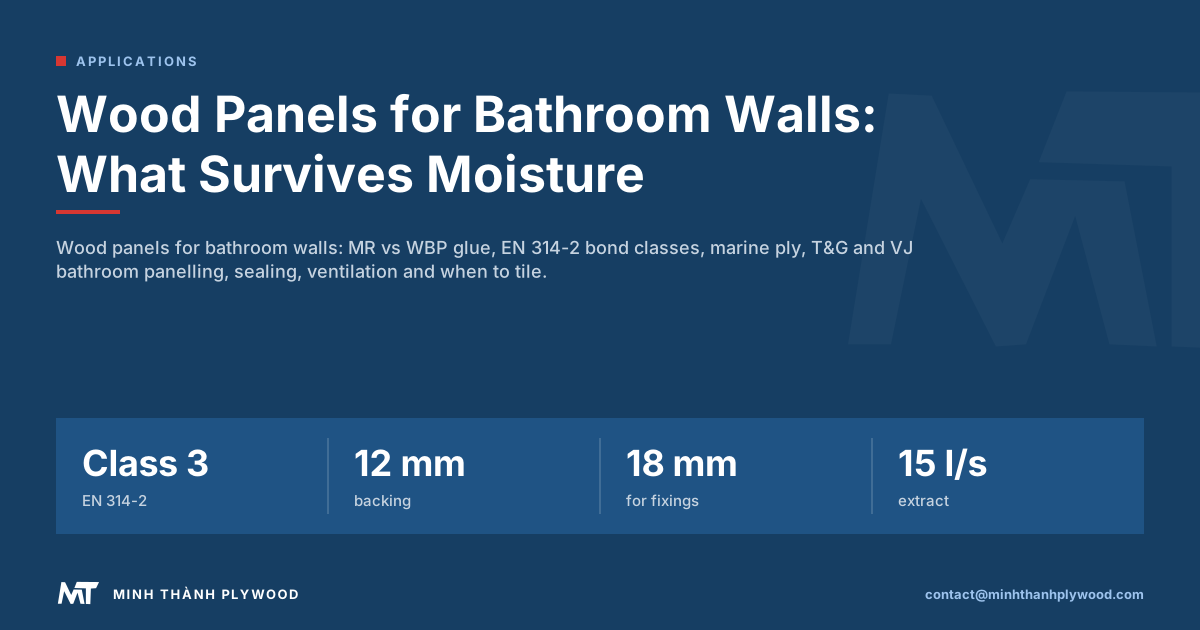
Wood panels for bathroom walls last when three things match the zone: a phenolic (WBP) bond for anything near water, sealed faces and edges, and an extractor that clears steam. Plywood and T&G panelling suit dry walls and splash areas; inside a shower, wood is a backing for tile or a waterproof sheet. Minh Thanh Plywood, a Vietnamese plywood manufacturer, explains each choice.
Can you use wood panels for bathroom walls?
You can use wood panels for bathroom walls outside the direct water zone, provided the panel’s glue survives moisture, the wood is sealed on every side and the room is ventilated. Wooden panelling in a bathroom fails for one of three reasons: the wrong glue, an unsealed edge or steam that never leaves the room.
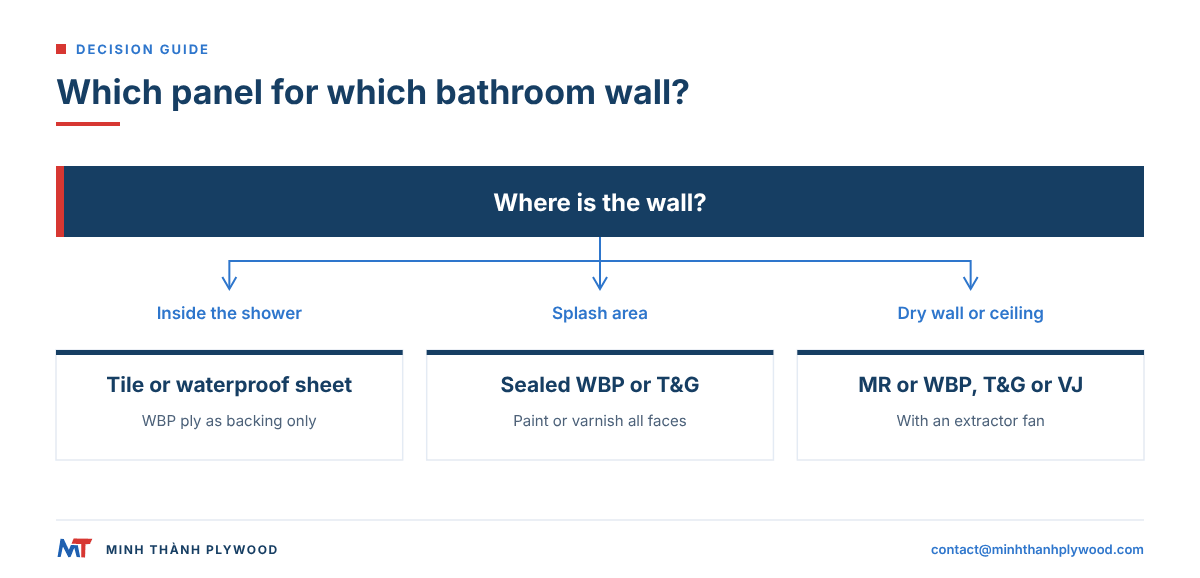
A bathroom has three moisture zones, and each wants a different wall:
| Zone | Where | Wood panels? | What to use |
|---|---|---|---|
| Wet | Inside the shower, bath surround below the shower head | Only as backing | WBP plywood under tile, waterproof sheet or membrane |
| Splash | Around the basin, behind the toilet, beside the bath | Yes, sealed | WBP plywood or T&G panelling, painted or varnished |
| Dry | Walls away from water, ceilings in a ventilated room | Yes | MR or WBP plywood, T&G or VJ panelling |
The rule of thumb: the closer the wall is to running water, the more the panel is a backing and the less it is the finished surface.
Bathroom panelling options compared
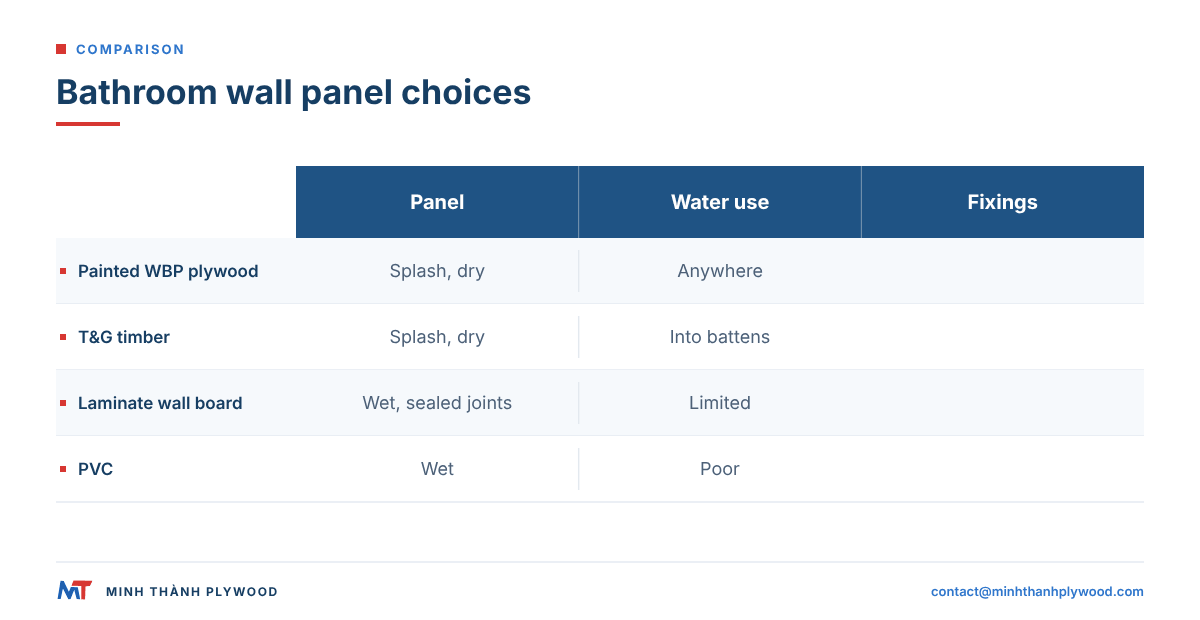
Bathroom panelling comes in five common forms, and each suits a different zone and budget. Wood options look warmer and take fixings; PVC and laminate options are fully waterproof.
| Option | Water resistance | Look | Takes fixings | Best zone |
|---|---|---|---|---|
| WBP plywood sheet, painted | Good with sealed edges | Smooth painted wall | Yes, anywhere | Splash, dry |
| T&G or VJ timber boards | Good when sealed and ventilated | Cottage, panelled | Into battens | Splash, dry |
| Grooved plywood panels | Good with WBP bond, sealed | Panelled, fewer joints | Yes | Splash, dry |
| Laminate-faced wall boards | High on the face, edges sealed | Tile or stone pattern | Limited | Wet with sealed joints |
| PVC wall panels | Waterproof | Gloss or stone pattern | Poor | Wet |
Plywood sheets give the cleanest wall with the fewest joints. Grooved plywood imitates boards in one 1220 × 2440 mm sheet, which means fewer gaps for water to enter than separate boards.
Cost and sizes of bathroom wall panel options (UK)
UK shoppers for wood panels for a bathroom usually compare five products by pack size and price. The table gives the panel size, thickness and a retail price read from UK listings on 21 October 2026; prices move weekly, so treat them as a guide to the order of cost.
| Option | Typical panel size and thickness | Indicative UK retail price | Water use |
|---|---|---|---|
| PVC bathroom wall and ceiling panels | 250 mm × 2.6 m, 8 mm, pack of 4 (about 2.6 m² a pack) | from £28 a pack at Easypanels, about £11 per m² | Wet zone |
| Solid-core shower and wall panels | 2.4 m × 600 mm (pack of 2), 300 × 600 mm (pack of 8) or 450 × 900 mm (pack of 4) | quoted per pack | Wet zone |
| Wood-veneer acoustic slat panels | 2400 × 600, 2400 × 300 or 1200 × 600 mm, Trepanel-type | about £32 to £80 per panel | Dry zone and outside the splash area only |
| MDF or plywood slat and cut-to-size panels | 6, 9 or 12 mm thick; slats 28 mm wide with 12 mm grooves, boards 50 to 120 mm wide, as sold by Cutmy | priced by cut size | Dry and splash zones, sealed |
| WBP plywood sheet, painted | 1220 × 2440 mm, 9 to 18 mm | 18 mm WBP at about £36 to £38 a sheet. Merchant listings: Topwood Timber and Smithfield Timber. About £12 to £13 per m² | Splash and dry zones, sealed |
Plywood costs about the same per square metre as PVC panels and carries fixings anywhere, which PVC does not. A 1220 × 2440 mm sheet covers 2.98 m² and has no joint across its 1220 mm width, where 250 mm strips have four. For a bathroom ordered by the container for a hotel or housing project, our 1220 × 2440 mm and 1250 × 2500 mm sheets can also be cut to the slat or board size on the drawing.
Wood slat and acoustic panels in a bathroom
Wood slat and acoustic panels, the product most UK shoppers search for, belong on dry bathroom walls only. The common slat panel is a wood veneer on an MDF carrier with a felt backing, so water that reaches the edge or the felt swells the MDF and does not dry out.
How to use them in a bathroom without a claim:
- Stay out of the splash zone. Keep them outside the shower and the bath surround, and away from the basin, on a wall that the extractor fan keeps dry.
- Seal the cut ends and the back with primer or lacquer, and fix to battens with an air gap.
- Check the maker’s rating. Most slat panels are sold for living rooms and offices, and bathroom use is the buyer’s risk unless the maker states a moisture rating.
- Choose a plywood-backed or WBP alternative for a wet-room look: grooved WBP plywood gives the slat effect in one sheet, with a phenolic bond that survives steam. See grooved plywood.
Glue type decides: MR vs WBP plywood
The glue between the veneers decides how plywood behaves in a bathroom, more than the wood species does. A phenolic (WBP) bond holds through steam, splashes and drying cycles; a urea-formaldehyde (UF) or melamine-fortified (MR) bond is made for drier service.
- UF glue at E0 emission. The standard for furniture plywood. Made for dry interiors; it suits bathroom furniture carcasses but not wall lining near water.
- MR (melamine-fortified UF). Better resistance to humidity. Suits dry bathroom walls, ceilings in a ventilated room and the inside of cabinets.
- WBP (phenol-formaldehyde). Weather and boil proof. Suits splash walls, backing boards inside the shower and the subfloor.
Glue type and emission class are two separate lines on an order. A panel can have a WBP bond and still be specified for low emission; writing “E0 glue” mixes the two. At Minh Thanh, MR and WBP bonds are made to the buyer’s specification, and the exterior plywood line uses them.
EN 314-2 bond classes 1, 2 and 3 explained
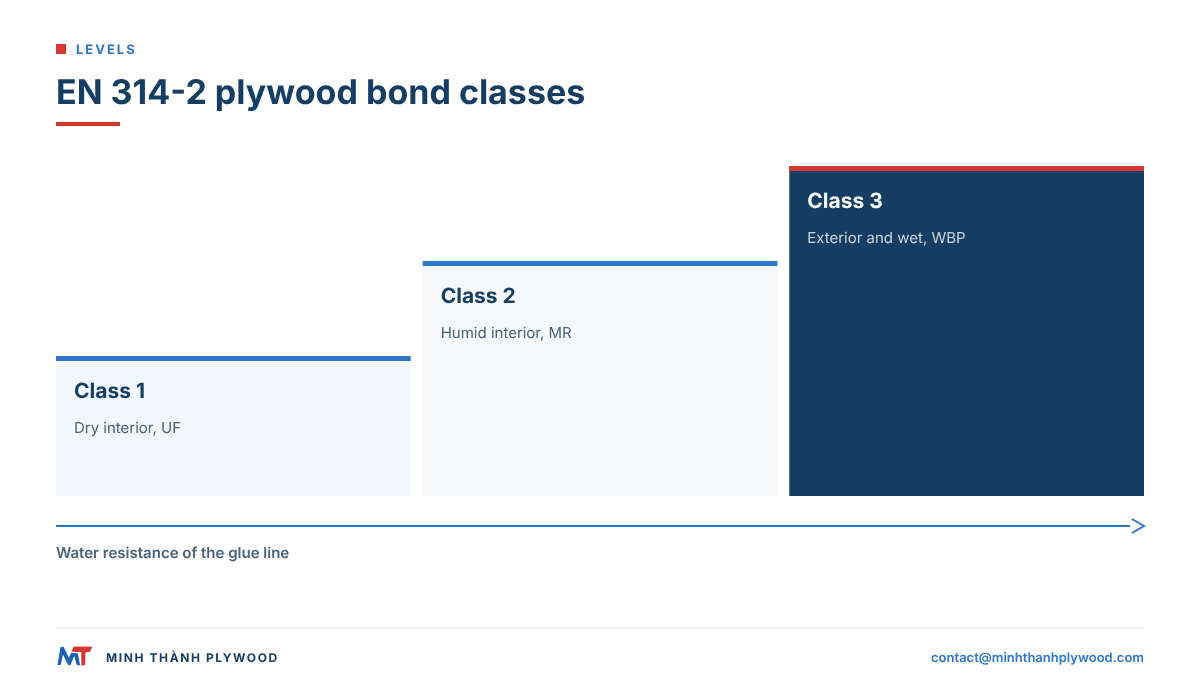
EN 314-2 is the European standard that classes a plywood glue line by the water test it survives: class 1 for dry interiors, class 2 for humid interiors, class 3 for exterior and wet conditions. For a bathroom wall near water, ask for class 3.
| Bond class | Test it passes | Service conditions | Typical glue | Bathroom use |
|---|---|---|---|---|
| Class 1 | Soak in cold water | Dry interior | UF | Furniture, dry walls |
| Class 2 | Soak in hot water | Humid interior, occasional wetting | MR (melamine-fortified UF) | Dry walls, ceilings, inside cabinets |
| Class 3 | Boil and cycle | Exterior, repeated wetting | Phenolic (WBP) | Splash walls, shower backing, subfloor |
The class describes the glue line only. It does not make the wood waterproof: a class 3 panel left wet still swells, grows mould on an unsealed face and can check at the surface. That is why sealing and ventilation still matter. BSI lists the bonding-quality requirements as BS EN 314-2:1993, and the plywood itself for dry, humid or exterior conditions as BS EN 636:2012+A1:2015.
When a buyer needs test evidence for a bond class, third-party testing to the buyer’s method can be arranged through SGS on request.
Is marine plywood necessary for bathrooms?
Marine plywood is not necessary for bathroom walls. Its extra cost buys a void-free core and better face veneers built to BS 1088, the marine plywood standard, which matter in a boat hull. A bathroom wall needs a WBP bond and a sealed face, and standard exterior plywood gives both.
Marine plywood earns its price in a few bathroom cases:
- A clear-varnished wall where the face veneer is on show and must be defect-free.
- A wet room built as a timber box under a membrane, where the panel stays damp for long periods.
- A boat or motorhome bathroom, where the panel is also structural.
For everything else, a WBP panel with a good face, sealed on all six sides, is the better buy. For the full grade comparison see the marine plywood buying guide.
Tongue and groove bathroom panelling
Bathroom panelling in tongue and groove works well in the splash and dry zones when it is fixed to battens, sealed on every face and left an air gap behind. T&G and VJ boards are the classic half-height panelling in British bathrooms.
How to make bathroom panelling tongue and groove last:
- Use treated battens, fixed horizontally for vertical boards, at about 400 mm centres.
- Prime the boards on all sides before fixing, including the tongue and the groove.
- Leave an air gap of at least the batten depth behind the boards, open at the top and bottom.
- Secret-fix through the tongue so the face stays unbroken.
- Keep the bottom edge clear of the floor by a few millimetres and seal it; this end grain is where water enters.
- Cap the top with a dado rail or shelf that sheds splashes.
- Finish with two coats of a moisture-resistant paint or varnish.
Plywood T&G and V-groove sheets do the same job with fewer joints. The trade-offs between boards and sheets are covered in the guide to tongue and groove panelling.
Bathroom wall boards: WBP plywood as tile and fixing backer
WBP plywood is a good backing board for bathroom walls that carry tile, a basin, a wall-hung toilet frame or heavy cabinets. It takes screws anywhere and stays flat; the tile or a membrane on top provides the waterproofing.
- Thickness: 12 mm for tile backing on studs at 400 mm centres; 18 mm where a basin or cabinet hangs on it.
- Inside a shower: apply a continuous waterproofing membrane over the plywood before tiling. Tile and grout are not waterproof on their own.
- Fixing loads: plywood behind plasterboard carries grab rails and towel radiators; this local backing is a plywood pattress.
- Tile weight: check the tile adhesive maker lists plywood as a substrate, and use a flexible adhesive.
Bathroom wallboard panels: wood vs PVC, laminate and FRP
Bathroom wallboard panels made of PVC, laminate or fibreglass-reinforced plastic (FRP) are waterproof on the face; wood panels are warmer to look at and easier to fix to. The choice is usually both: a waterproof board in the shower and wood elsewhere.
| Metric | PVC panels | Laminate wall boards | FRP-faced plywood | Painted WBP plywood |
|---|---|---|---|---|
| Face | Waterproof | Waterproof | Waterproof, hygienic | Water-resistant when sealed |
| Joints | Click joints, sealed | Sealed joints and trims | Sealed joints | Few joints, filled |
| Impact | Dents | Good | Very good | Good |
| Fixings | Weak | Into backing only | Good | Good, anywhere |
| Look | Plastic sheen | Tile or stone pattern | Plain, commercial | Any paint colour |
| Best use | Shower, budget rooms | Shower walls | Commercial washrooms | Splash and dry walls |
FRP-faced plywood is the standard in commercial washrooms and food areas because the face can be washed down. For a home bathroom, painted WBP plywood or panelling outside the shower gives the look most people want.
How to seal wooden panelling in a bathroom
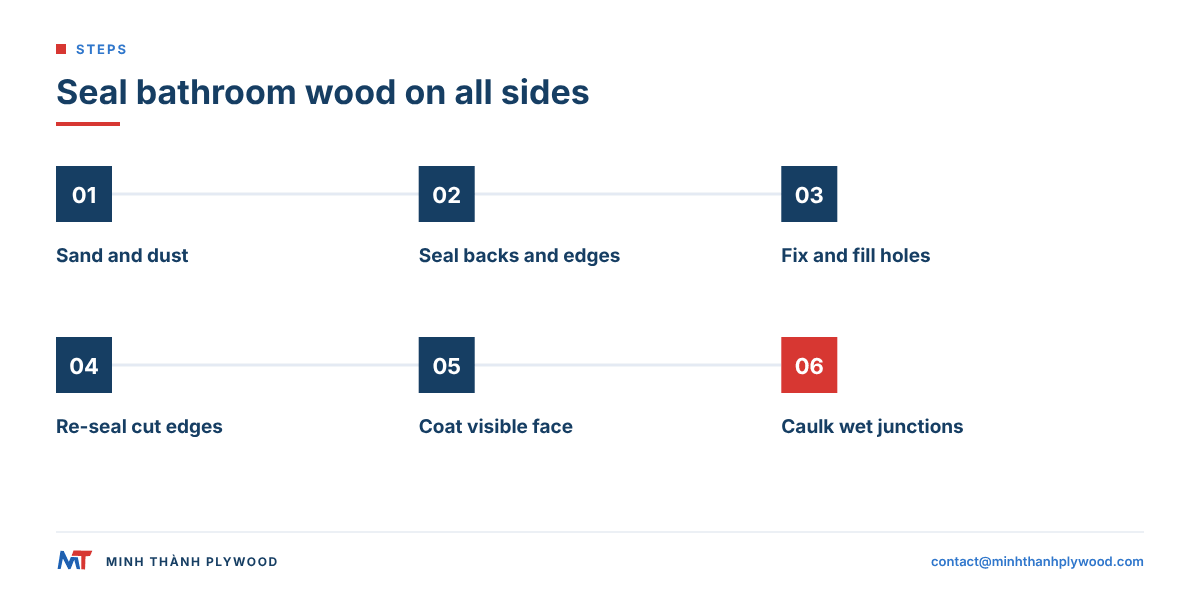
Seal wooden panelling in a bathroom on all six sides before it goes up, then finish the face with two coats of a moisture-resistant coating. Unsealed backs and cut edges are where most failures start.
- Sand the face lightly and remove dust.
- Seal the back and edges with primer, a wood sealer or the first coat of finish.
- Fix the panels and fill nail holes.
- Re-seal every edge cut during fitting, especially around pipes and sockets.
- Finish the face: bathroom paint (a satin or eggshell with mould inhibitor), yacht varnish or a hardwax oil.
- Caulk the joints at the bath, basin and floor with a flexible sanitary sealant.
Our faces are sanded and polished at the mill, and both faces are made UV-ready, which gives a smooth base for paint or a factory-applied UV coat.
Ventilation rules for wood in bathrooms
Wood panels in a bathroom need an extractor fan that removes steam during and after every shower. Without it, any panel, whatever its glue, stays damp and grows mould.
In England, Approved Document F sets the minimum intermittent extract rate for a bathroom at 15 litres per second. In practice:
- Fit a fan ducted to outside, on a timer or humidity sensor so it runs after the room is empty.
- Leave a gap under the door so replacement air can enter.
- Keep the air gap behind panelling open at top and bottom.
- Heat the room briefly after use; warm air carries moisture to the fan.
When to use tile backer instead of wood
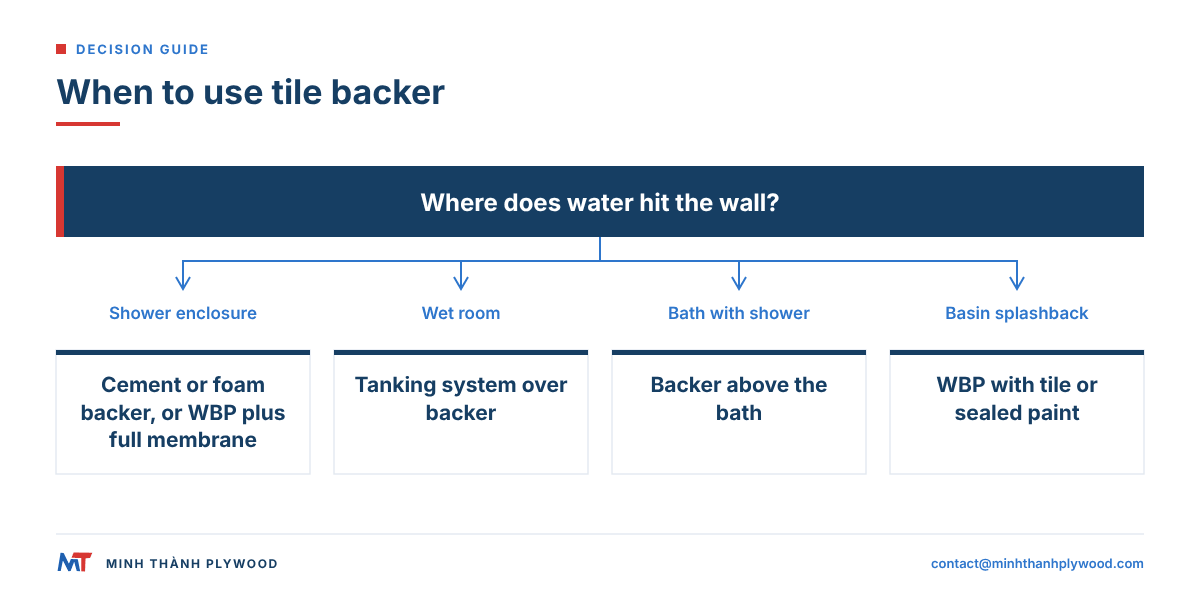
Use a cement or foam tile backer instead of wood wherever water runs down the wall every day: the shower enclosure, a wet room and the wall behind a bath with an overhead shower. Plywood can sit behind those boards for strength, but it should not be the surface the membrane relies on alone in a wet room.
- Shower enclosure: cement or foam backer, or WBP plywood with a full membrane.
- Wet room: a tanking system over a backer, with falls to the drain.
- Bath with shower over: backer board above the bath to the ceiling or the top of the tile.
- Basin splashback: WBP plywood with tile or a sealed paint finish.
What plywood for a bathroom floor?
The plywood for a bathroom floor is 18 mm or thicker T&G plywood with a phenolic (WBP) bond, glued and screwed to the joists, with tile backer or a membrane on top. On joists at 600 mm centres, step up to 22 mm or add a second layer.
The full answer, including thickness by joist spacing and waterproofing build-ups, is in the guide to plywood for subfloors. The point that matters for wall panels: the floor and wall waterproofing must lap at the junction, or water runs behind both.
Bathroom vanity and cabinet plywood
Bathroom vanities and cabinets are usually built from 18 mm furniture plywood with UF glue at E0 emission, or MR for units under a basin, with every edge banded or sealed. The carcass sees humidity but rarely standing water.
- Carcass: 18 mm plywood, faces to the approved sample.
- Back and shelves: thinner plywood, sealed.
- Under the basin: MR or WBP bond, or a laminate-faced shelf that can be wiped.
- Edges: edge band or seal every cut edge before assembly.
For furniture makers, our furniture plywood is pressed twice as standard, with a sanded, flat face for lacquer or laminate.
Common mistakes with wood panels in bathrooms
The common mistakes with wood panels in bathrooms are an interior glue near water, unsealed cut edges, panels fixed tight to a cold wall and no extractor fan. Each causes swelling, mould or delamination within a few years.
| Mistake | What happens | Do instead |
|---|---|---|
| Interior UF plywood beside the bath | Glue line weakens, plies part | WBP bond near water |
| Edges cut on site and left bare | End grain soaks up water and swells | Seal every cut edge before fixing |
| Panels fixed straight to a cold outside wall | Condensation behind the panel, mould | Battens and an air gap |
| Panelling run down to the floor tiles | Bottom edge sits in mop water | Leave a small gap, seal and caulk |
| Wood used as the shower wall surface | Water gets behind joints | Tile or waterproof sheet over a membrane |
| No extractor, or a fan on a short timer | Steam stays, all surfaces stay damp | Ducted fan with overrun |
A one-line check before buying: name the zone, then name the bond. If the wall is in the splash or wet zone and the bond is not WBP, change the panel.
What to write on a bathroom plywood order
A bathroom plywood order should name the zone, the bond and the face, so the supplier quotes the right panel.
- Use: bathroom wall lining, splash zone; or tile backing; or vanity carcass.
- Bond: phenolic (WBP), EN 314-2 class 3; or MR for dry walls.
- Thickness: 12 mm for lining and tile backing; 18 mm for fixings and cabinets.
- Size: 1220 × 2440 mm or 1250 × 2500 mm, or cut to size.
- Face: sanded, paint-grade or a named veneer; both faces UV-ready if a UV coat follows.
- Profile: square edge, T&G or V-groove with the groove drawing.
- Packing and quantity: sheets per pack, number of 40HC containers, destination port.
Minimum order is one 40HC, with mixed specifications by agreement, and production takes 15–45 days after the 30% deposit. Minh Thanh Plywood sends free samples so the face and bond can be checked first. Send the seven lines to contact@minhthanhplywood.com or through our contact page; we reply within hours.
Buyer questions, answered
Can you use wood panels in a bathroom?
Yes, on walls outside the shower and bath splash zone, if the panels have a water-resistant bond, every face and edge is sealed, and the room has a working extractor fan. Inside a shower, use wood only as a backing for tile or a waterproof sheet.
What plywood is best for bathroom walls?
Use plywood with a phenolic (WBP) bond, tested to EN 314-2 class 3, 12 to 18 mm thick. It holds its glue line through steam and splashes; the face still needs a sealed finish.
Is MR plywood OK in a bathroom?
MR plywood suits dry bathroom walls away from the bath and shower, such as behind a vanity in a ventilated room. Near water, use a WBP bond, because MR glue is made for humid conditions, not repeated wetting.
Is marine plywood necessary for a bathroom?
No. Marine plywood adds a void-free core and higher face grades, which a bathroom wall does not need. A WBP-bonded panel, sealed on all sides, does the same job at a lower price.
Is tongue and groove panelling OK in a bathroom?
Yes, as half-height or full-height panelling outside the shower, fixed to treated battens with a ventilation gap behind, primed on the back and edges, and finished with a moisture-resistant paint or varnish.
What do you put behind bathroom wall panels?
Fix the panels to treated timber battens over a sound wall, leave a small air gap behind, and seal any gaps where pipes pass through. On a timber frame, use a vapour control layer on the warm side.
How do you seal wood panels in a bathroom?
Prime or seal the back, all cut edges and the face before fixing, then apply two coats of a moisture-resistant finish such as a bathroom paint, yacht varnish or hardwax oil. Re-seal edges cut during fitting.
Wood or PVC bathroom panelling?
PVC panelling is fully waterproof and suits the shower itself. Wood panelling looks warmer, can be painted any colour and carries fixings for shelves and cabinets, so it is the better choice outside the wet zone.
What plywood should be used for a bathroom floor?
Use 18 mm or thicker tongue-and-groove plywood with a phenolic (WBP) bond, glued and screwed to the joists, with tile backer or a waterproof membrane on top. Thickness follows joist spacing.
Can Minh Thanh supply WBP plywood for bathroom wall lining?
Yes. We make plywood with a phenolic (WBP) or melamine-fortified (MR) bond to the buyer's specification, from 3–40 mm thick, in 1220 × 2440 mm or 1250 × 2500 mm sheets or cut to size.