
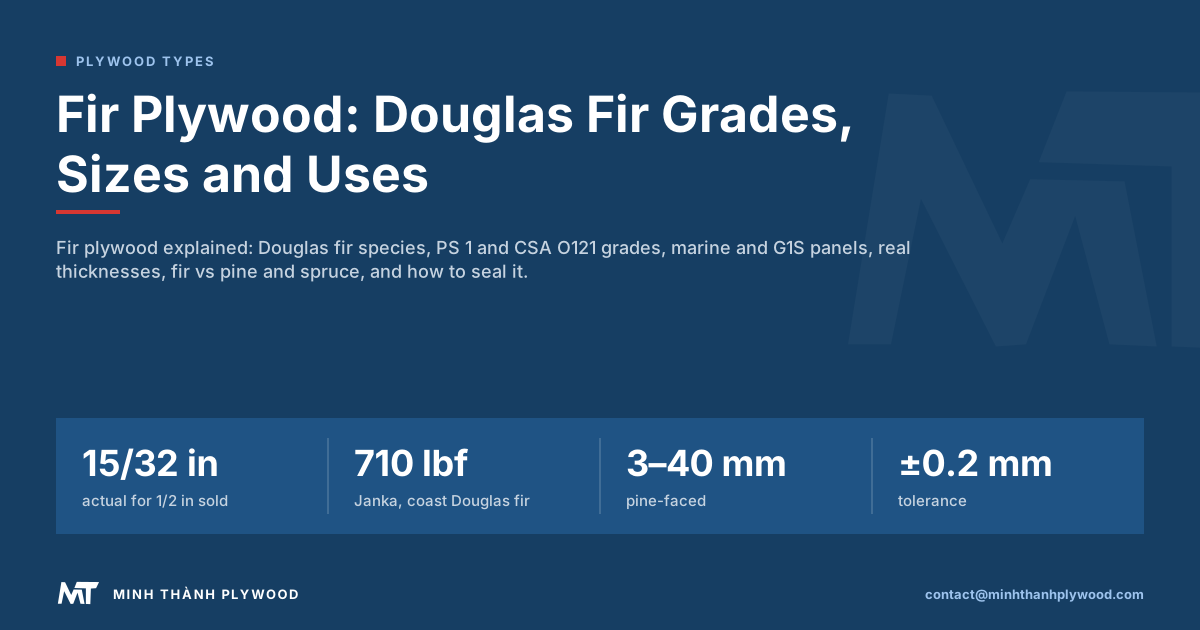
Fir plywood is softwood plywood made mostly from Douglas fir veneers, peeled from Pseudotsuga menziesii logs grown in western North America and graded under US PS 1 or Canadian CSA O121. It is stiff, strong and widely used for sheathing, subfloors, marine and sanded panels. Minh Thanh Plywood explains grades, sizes and the pine-faced alternative for furniture.
What is fir plywood?
Fir plywood is softwood plywood whose face, back and inner veneers are mostly Douglas fir. Douglas fir (Pseudotsuga menziesii) grows in western North America, from British Columbia to California, and its large, straight logs peel into long veneers that press into strong, stiff panels.
Two naming points cause confusion:
- Douglas fir is not a true fir. True firs belong to the genus Abies; Douglas fir has its own genus. In the plywood trade, “fir plywood” almost always means Douglas fir.
- “Fir” on a panel does not always mean all-fir. US grade rules group species: Douglas fir and western larch sit in Group 1, the strongest group, and a fir-faced panel can contain other species in its inner plies, within the grade’s rules.
Fir plywood is made under two standards. In the United States it is Voluntary Product Standard PS 1, consulted 20 October 2026, administered through grading agencies such as APA. In Canada, Douglas fir plywood is CSA O121, while Canadian softwood plywood from spruce, pine and fir mixes is CSA O151.
Is Douglas fir plywood good?
Yes, for structural, exterior and heavy-wear work. Douglas fir is among the stiffest and strongest North American softwoods for its weight, which is why fir plywood became the reference panel for floors, roofs, walls, concrete forms and boats.
What makes it good:
- Stiffness. A fir sheet deflects less under load than most softwood panels of the same thickness.
- Fastener holding. Dense late-wood bands hold nails and screws well.
- Exterior glue. Most fir plywood is bonded with phenolic glue, rated Exterior or Exposure 1.
- Long, clear veneers from large logs, which give fewer core gaps in the higher grades.
Where it is weaker: the rotary-cut face shows wild, uneven grain, early-wood bands are soft and dent, and the face can check (fine cracks along the grain) when it dries and wets outdoors under paint. For painted signs and cabinets, medium density overlay (MDO) fir, or a hardwood or pine-faced panel, gives a better finish.
What grades does fir plywood come in?
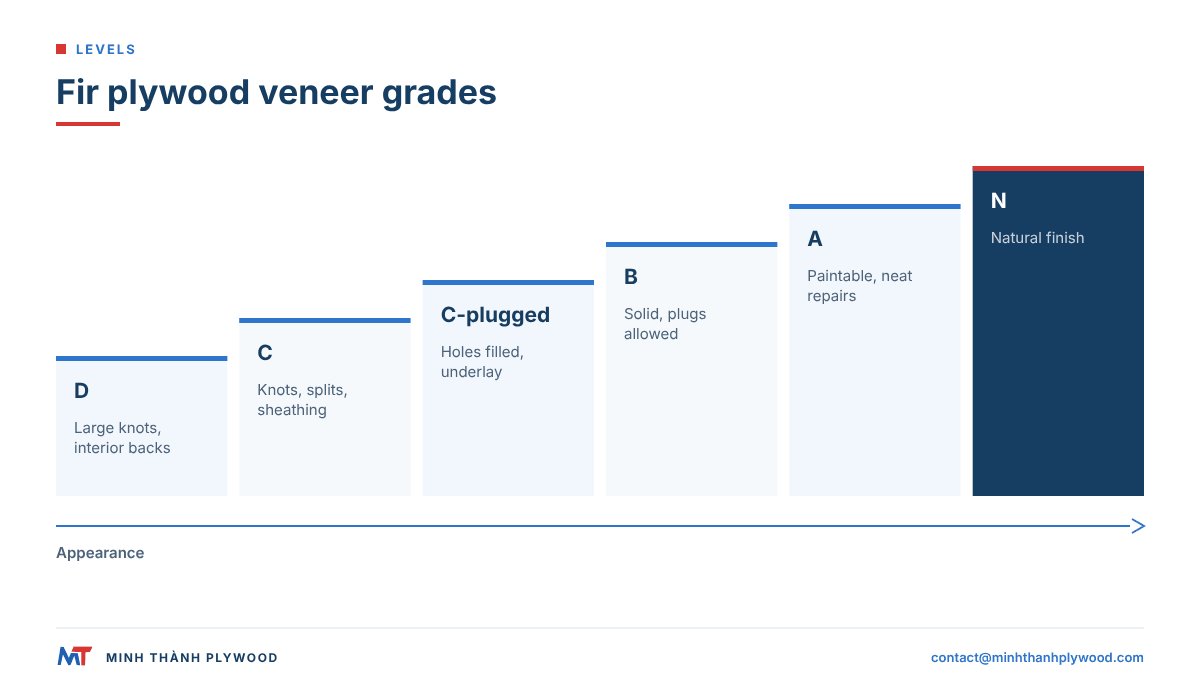
Fir plywood is graded twice: each veneer gets a letter for its appearance, and the whole panel gets a grade name for its use and bond.
| Veneer grade | What the face may show | Typical use |
|---|---|---|
| N | Natural finish, all heartwood or all sapwood, no open defects | Clear-finished cabinets and furniture |
| A | Smooth, paintable; neat boat-shaped repairs allowed | Visible faces, painted work |
| B | Solid surface; repair plugs and tight knots allowed | Backs, concealed faces, sanded utility |
| C-plugged | Improved C, splits and knot holes filled | Underlayment, floor bases |
| C | Knots up to about 1-1/2 in, some splits | Sheathing, exterior backs |
| D | Larger knots and holes allowed; interior or Exposure 1 only | Inner plies and backs of sheathing |
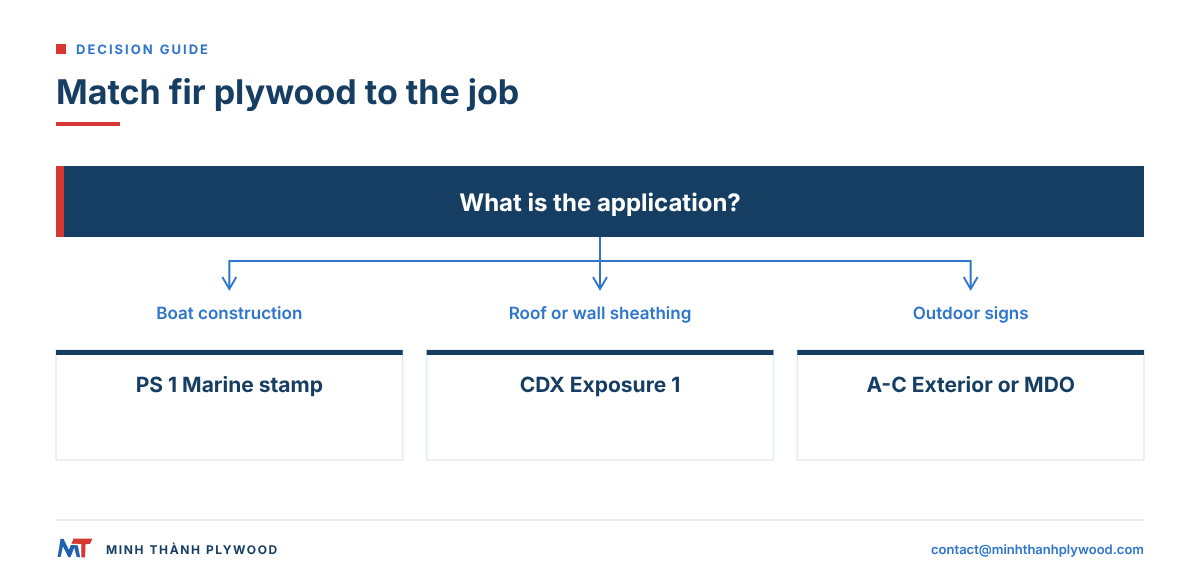
Panel grades combine two faces and the bond. A-C Exterior has one good face for outdoor work, B-C suits utility exterior jobs, and C-D Exposure 1 (CDX) is roof and wall sheathing. Underlayment goes under floors, Marine into boats, and MDO or HDO, with a resin-paper overlay, into signs and concrete forms. In Canada, sanded fir panels are sold as Good One Side (G1S), Good Two Sides (G2S), Select and Select-Tight Face, with Sheathing as the unsanded structural grade.
The grade stamp on the back or edge is the only proof of grade. It shows the standard, the span rating, the bond (Exterior or Exposure 1), the thickness category and the mill number.
Is Douglas fir plywood marine grade?
Only when it is stamped Marine. Under PS 1, Marine grade plywood is made only of Douglas fir or western larch, with A or B face and back veneers, B-grade or better inner plies with solid jointed cores, and exterior glue, so no voids can trap water.
Douglas fir marine plywood is therefore a specific North American grade, not a description of any fir panel. Three points for boat builders and importers:
- CDX is not marine. Its C and D veneers allow knot holes and core gaps that hold water.
- BS 1088 is a different standard. The British marine standard is written for durable tropical hardwood veneers; a fir marine panel is sold to PS 1, not to BS 1088.
- Stamp and documents: ask for the Marine grade stamp and the mill’s certificate with every shipment.
For non-boat outdoor uses such as signs, shopfronts and trailer sides, A-C Exterior or MDO fir is the usual and cheaper choice.
What sizes and thicknesses is fir plywood sold in?
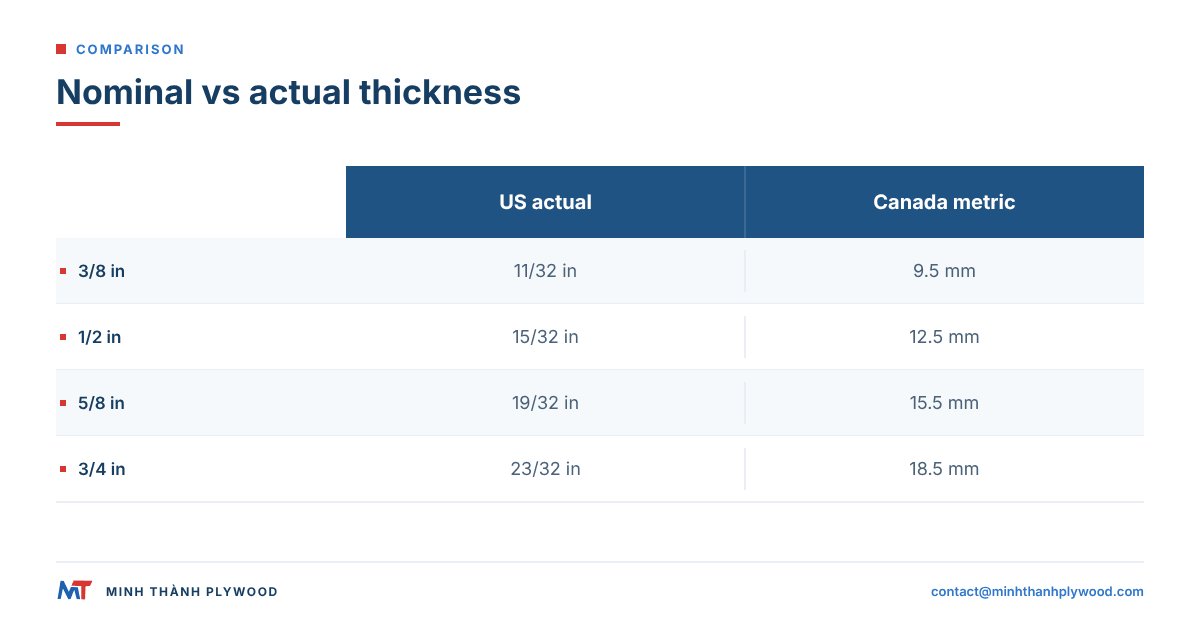
Fir plywood is sold in 4 × 8 ft sheets in North America (about 1220 × 2440 mm), and its thickness is a nominal “performance category” that measures slightly less than the name.
| Sold as | US actual (PS 1) | US actual, metric | Canadian metric panel |
|---|---|---|---|
| 1/4 in | 7/32 in | about 5.5 mm | 6 mm |
| 3/8 in | 11/32 in | about 8.7 mm | 9.5 mm |
| 1/2 in | 15/32 in | about 11.9 mm | 12.5 mm |
| 5/8 in | 19/32 in | about 15.1 mm | 15.5 mm |
| 3/4 in | 23/32 in | about 18.3 mm | 18.5 mm |
This is why a buyer who orders “1/2 fir plywood” receives a 15/32 in panel, and why a “5/8 spruce plywood” sheet from a Canadian mill measures 15.5 mm. Spans, fasteners and edge details in the building code are written for the performance category, so the slightly thinner panel is correct, not short.
Sanded grades lose a little more in sanding. When a cabinet or shelf design needs an exact thickness, specify the measured thickness and a tolerance rather than the nominal name.
How does fir plywood compare with pine, spruce and birch?
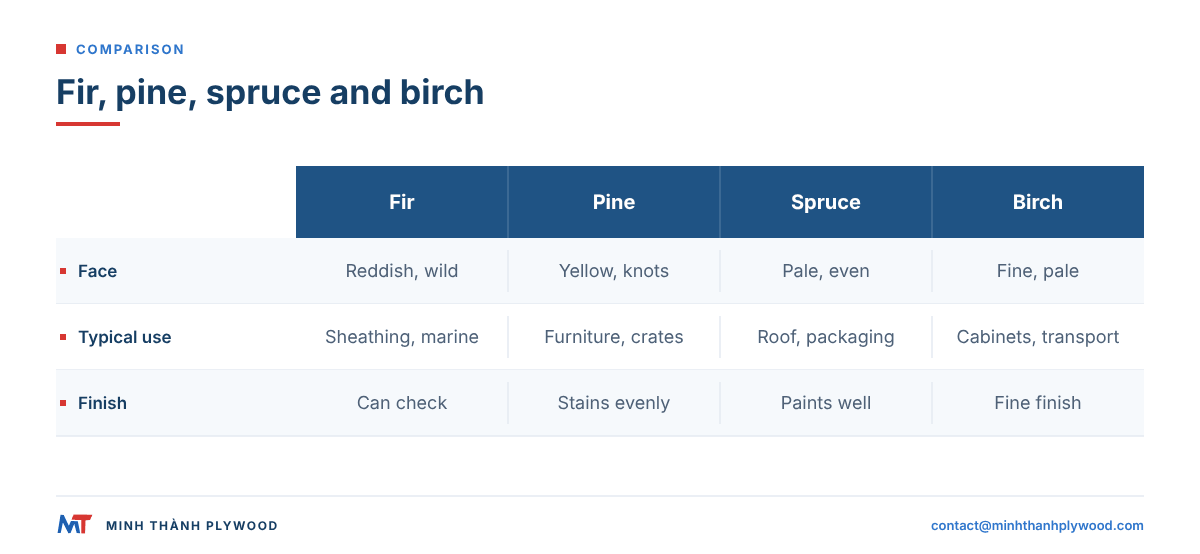
Fir is the stiffest and hardest of the common softwood plywoods; spruce is lighter and paler, pine is softer and easier to finish, and birch is a much harder hardwood with a fine, even face.
| Property | Douglas fir | Spruce (SPF, European) | Pine (radiata, southern, elliottii) | Birch |
|---|---|---|---|---|
| Wood group | Softwood | Softwood | Softwood | Hardwood |
| Face colour | Reddish-orange with strong late-wood bands | Pale cream, even | Pale yellow to honey, visible knots | Pale cream, fine and even |
| Janka hardness of the solid wood | About 710 lbf (coast fir) | About 510 lbf (Sitka spruce) | About 690–870 lbf (southern pines) | About 1,260 lbf (yellow birch) |
| Typical panel standards | PS 1, CSA O121 | CSA O151, EN 636 | PS 1, AS/NZS 2269, EN 636 | EN 636, EN 635 grades |
| Main uses | Sheathing, subfloors, marine, forms | Sheathing, roofing, packaging | Sheathing, furniture backs, shelving, crates | Furniture, cabinets, transport, laser cutting |
| Finish quality | Wild grain, checks outdoors | Plain, takes paint well | Knotty, takes stain and clear coats | Best paint and clear finish |
Hardness values are for the solid wood, from the USDA Forest Products Laboratory Wood Handbook, 2021 edition, consulted 20 October 2026. A panel’s real performance also depends on its grade, bond and core.
For a full look at the pine options, see radiata pine plywood vs elliottis, southern yellow pine and spruce.
What are the key differences between fir and pine plywood?
Fir plywood is stiffer, harder and darker; pine plywood is lighter in colour, softer, usually lighter in weight and cheaper per sheet.
- Appearance: fir has orange-red late-wood stripes and wild grain; pine is pale yellow to honey with round knots.
- Structure: both are rated by the stamp; for the same span rating, either can be used. Fir panels sometimes reach the rating at a slightly thinner build.
- Finishing: pine takes stain and clear lacquer more evenly; fir needs a sealer or primer to calm the grain.
- Price: in most markets, pine and spruce sheathing cost less than fir sheathing of the same rating.
For furniture, shelving and interior panels, many buyers move from fir to pine-faced plywood because the face is calmer and the panel is easier to finish. See pine plywood properties and uses for the furniture side.
Is Douglas fir plywood waterproof?
The bond of exterior-rated Douglas fir plywood is waterproof; the wood is not. Phenolic glue in an Exterior or Exposure 1 panel survives wetting and drying without delaminating, but the fir veneers still absorb water, swell, check and can decay if they stay wet.
What the bond labels mean:
- Exterior: made for permanent exposure to weather, with phenolic glue and C-grade or better veneers throughout.
- Exposure 1: same waterproof glue, built to survive construction delays and occasional wetting, then to be covered. CDX is Exposure 1.
- Interior: made for dry use only; rare in fir.
Treat outdoor fir as a wood product that needs protection: a sloped top edge, sealed cut edges and a maintained finish.
Does Douglas fir need to be sealed?
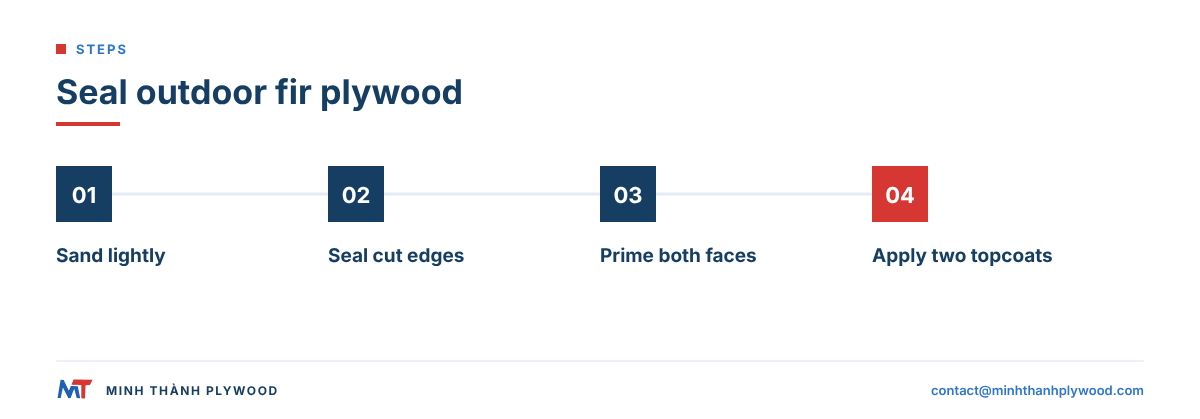
Yes. Any fir plywood used outdoors, painted or stained should be sealed on both faces and on every edge before or right after installation, because water enters fastest through end grain at the edges.
A reliable sequence:
- Sand lightly to remove raised grain and splinters from the face.
- Seal all edges with an exterior primer, edge sealer or thinned paint; edges absorb many times more water than faces.
- Prime both faces with an exterior primer suited to softwood; a primer that bridges small face checks gives a longer-lasting film.
- Top-coat with two coats of exterior acrylic paint or a pigmented stain; clear finishes on fir outdoors last the shortest time.
For painted outdoor work that must stay smooth, MDO fir saves the priming labour, because its resin-paper overlay already hides the grain.
What are the disadvantages of Douglas fir plywood?
The main disadvantages of Douglas fir plywood are cosmetic and finishing issues, not strength.
| Disadvantage | Why it happens | How buyers handle it |
|---|---|---|
| Wild, blotchy grain under stain | Rotary peeling cuts across the growth rings | Use a pre-stain conditioner, or choose MDO or a hardwood face |
| Face checking outdoors | The face veneer shrinks and swells across its grain | Prime with a crack-bridging primer, or use overlaid fir |
| Dents in early-wood bands | Soft spring wood between hard late-wood bands | Use a harder face for floors and worktops |
| Splintered edges | Coarse fibres tear on cutting | Use a fine-tooth blade and tape the cut line |
| Visible patches on A and B faces | Grade rules allow neat boat-shaped repairs | Order N grade or a sanded hardwood face where looks matter |
| Core gaps in C and D grades | Lower grades allow open knot holes inside | Order Marine or solid-core grades for edge-exposed work |
None of these affect the structural rating on the stamp. They decide where fir is the right face and where another species looks better.
Is Douglas fir plywood cheap?
No; Douglas fir is a mid-priced softwood. Fir sheathing sells close to other softwood structural panels of the same rating, sanded fir grades and MDO cost more, marine fir costs the most of the fir range, and birch and hardwood-faced panels usually sit above fir.
US buying table: grade, thickness and indicative price per 4 x 8 ft sheet
Indicative US retail prices, checked October 2026 from published Lowe’s and Home Depot price guides, so confirm at the counter. All are 4 x 8 ft sheets; project panels (2 x 2 ft and 2 x 4 ft) are sold at Home Depot in 1/2 in BCX and 3/4 in BC sanded.
| Panel grade | Thickness (nominal) | Typical use | Indicative US retail per sheet |
|---|---|---|---|
| CDX (Exposure 1) | 1/2 in | Wall and roof sheathing | US$30-45 |
| CDX (Exposure 1) | 3/4 in (23/32 in actual) | Subfloor, heavy sheathing | US$30-50; one Home Depot listing US$49.88 |
| BCX / ACX sanded | 1/2 and 3/4 in | Exposed exterior, cabinets, shop projects | US$50-80 |
| AC / BC sanded | 1/4 to 3/4 in | Clear or painted faces | US$50-80 |
| MDO and Marine | 1/2 and 3/4 in | Signs, forms, boats | Above sanded grades; quoted by the sheet |
Fir panels sold in the US carry TSCA Title VI formaldehyde labels, and some, such as the Fir AC panel at Plywood Company, also state LEED v4 low-emitting status. For an importer, the same formaldehyde rule applies to our panels: Minh Thanh’s pine-faced 1220 x 2440 mm plywood holds CARB P2 / TSCA Title VI certification (ICTT mill no. 23024) and starts at US$350/m³ FOB for furniture plywood.
As a raw FOB example, one 1220 x 2440 x 18 mm sheet at US$350/m³ comes to about US$18.8 before freight, duty and margin. That is not a like-for-like swap for stamped fir sheathing, but it is the price anchor for pine-faced furniture and cabinet panels.
What sets the price of a fir sheet:
- Grade: sanded A faces and marine construction cost more than CDX.
- Thickness: price rises roughly with veneer volume.
- Origin and freight: fir is made in North America; buyers in Asia, Africa and the Middle East pay ocean freight on top of the mill price.
- Market cycle: North American panel prices move with housing starts.
Where is fir plywood made, and what do importers compare it with?
Douglas fir plywood is made in the US Pacific Northwest (Oregon and Washington) and in British Columbia, where the logs grow. BC fir plywood is Canadian Douglas fir plywood made under CSA O121.
Importers outside North America who ask for “fir plywood” or “softwood plywood”, for example in Cambodia, Morocco or the Gulf, usually compare four sources:
- North American fir, PS 1 or CSA O121 stamped, for structural and marine use.
- South American pine (radiata from Chile, elliottii and taeda from Brazil), for sheathing, packaging and furniture backs.
- European spruce and pine, EN 636 graded, for construction and packaging.
- Asian pine-faced plywood, a pine face over a hardwood plantation core, for furniture and interior panels.
The right source follows the use: a stamped structural panel for building codes, a pine-faced hardwood-core panel for furniture and interiors.
What is the pine-faced alternative from Vietnam?
For furniture, shelving and interior panels, Minh Thanh Plywood makes pine-faced plywood: a pine veneer face and back over a white Styrax or Eucalyptus core, pressed in Ha Hoa, Phu Tho. It gives the warm softwood look with a calmer face than rotary-cut fir and a dense, flat core for machining.
| Field | Minh Thanh pine-faced plywood |
|---|---|
| Face and back | Pine veneer, graded A/A, A/B or B/B (B/C for utility parts), matched to your approved sample |
| Grade ladder | Comparable to the European softwood face classes I to IV and the US A to D grades |
| Core | White Styrax or Eucalyptus; cores stitched horizontally and vertically |
| Pressing | Pressed twice: core board pressed and calibrated, then face and back |
| Thickness | 3–40 mm, tolerance down to ±0.2 mm on sanded furniture panels |
| Sheet sizes | 1220 × 2440 and 1250 × 2500 mm, custom sizes such as 1220 × 2500 mm |
| Glue and emission | UF glue at E0 emission standard; CARB P2 / TSCA Title VI certified (ICTT mill no. 23024) |
| Moisture | 8–12% at dispatch |
Six ASTM D6007 chamber tests between April 2025 and June 2026 on 9, 15 and 18 mm panels averaged 0.014–0.032 ppm formaldehyde. The CARB composite wood programme regulates formaldehyde emissions in California. The US limit for veneer-core hardwood plywood is 0.05 ppm under EPA’s TSCA Title VI requirements. See our CARB P2 / TSCA Title VI certification page for the reports.
These panels are for furniture and interiors, not stamped structural sheathing. Details are on the pine plywood product page.
How do you order softwood-look plywood for furniture?
Send a specification that names the look and the build separately, so the face species does not decide the core by accident:
- Face and grade pair, for example pine A/B, with a photo or sample of the look you want.
- Core, Styrax for a lighter panel or Eucalyptus for a denser one.
- Thickness and tolerance, for example 18 mm ±0.2 mm for CNC furniture parts.
- Size, 1220 × 2440 mm, 1250 × 2500 mm or a custom size.
- Glue and emission, UF glue at E0 emission for interiors, or a melamine-fortified bond for humid rooms.
- Packing and quantity, with your destination port.
Minimum order is one 40HC with mixed specifications by agreement; production takes 15–45 days after the 30% deposit, FOB Hai Phong, CFR or CIF. From Hai Phong, typical days at sea are 5–12 to South-East Asia and 25–35 to the Mediterranean. Free samples are available: write to contact@minhthanhplywood.com.
Buyer questions, answered
What is fir plywood?
Fir plywood is plywood whose veneers are mostly Douglas fir, a North American softwood. It is made under the US PS 1 or Canadian CSA O121 standards and sold in sheathing, sanded and marine grades.
Is Douglas fir plywood good?
Yes, for structural and exterior work. Douglas fir has one of the highest stiffness and strength values of any softwood, holds nails well and is usually bonded with exterior phenolic glue. Its wild grain and face checking make it a weaker choice for fine paint or clear-finished furniture.
Is Douglas fir plywood marine grade?
Only when the panel is stamped Marine. Under PS 1, Marine grade is made only of Douglas fir or western larch, with A or B faces, solid inner plies and exterior glue. Ordinary fir sheathing is not marine plywood.
Is Douglas fir plywood waterproof?
The glue line of exterior-rated fir plywood is waterproof, but the wood is not. Seal the faces and every cut edge before outdoor use, or the panel absorbs water, checks and can decay.
Does Douglas fir need to be sealed?
Yes, for any exposed or painted use. Prime both faces and all edges with an exterior primer or sealer; on rotary-cut fir faces, a primer that bridges small checks gives a longer-lasting paint film.
What are the disadvantages of Douglas fir plywood?
Wild rotary-cut grain that stains unevenly, face checks under paint outdoors, softer early-wood that dents, splinters on cut edges and boat-shaped patches on A and B faces. Lower grades can have open core gaps.
Is Douglas fir a cheap wood?
No, it is a mid-priced softwood. Fir sheathing costs about the same as other softwood structural panels, while sanded fir grades and marine fir cost noticeably more; birch and hardwood-faced panels sit above both.
What are the key differences between fir and pine plywood?
Fir is stiffer and harder with a strong reddish grain; pine plywood is lighter in colour, softer and often cheaper. For structural sheathing both are rated by stamp; for furniture faces, pine or a pine-faced hardwood-core panel gives a cleaner look.
How thick is 1/2 inch fir plywood?
In the US, 1/2 inch structural plywood is sold as performance category 1/2 and measures 15/32 inch, about 11.9 mm. Canadian metric panels of the same use measure 12.5 mm.
What does BC fir plywood mean?
BC fir plywood is Douglas fir plywood made in British Columbia under CSA O121, sold in grades such as Good One Side (G1S), Good Two Sides (G2S), Select and Sheathing.
Does Minh Thanh sell fir plywood?
Minh Thanh Plywood makes pine-faced plywood on white Styrax or Eucalyptus cores for furniture, shelving and interior panels, graded A/A, A/B or B/B. For stamped structural fir sheathing, buy PS 1 or CSA O121 panels.