
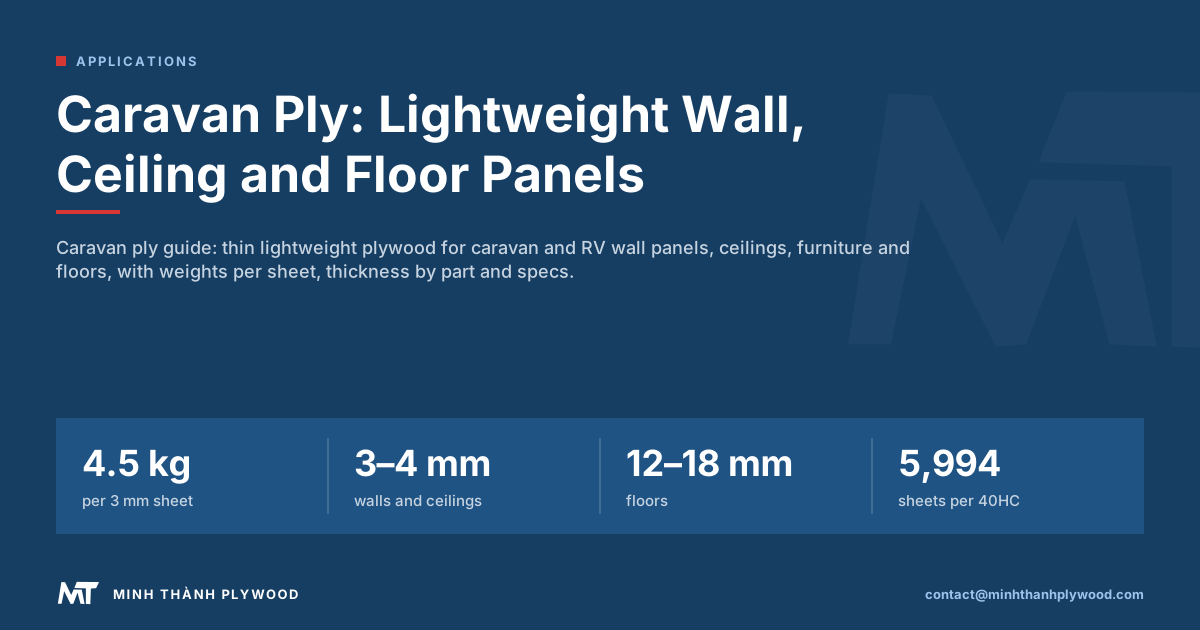
Caravan ply is thin, lightweight plywood for caravan and RV interiors: 3–4 mm for ceilings and wall linings, 9–15 mm for furniture and 12–18 mm for floors. A 3 mm sheet on a white Styrax core weighs about 4.5 kg, light enough to line a whole van without eating into payload. Minh Thanh Plywood makes five-ply thin panels and light-core furniture plywood in Vietnam for caravan builders, panel laminators and distributors.
Caravan ply price in Australia: what does a sheet cost?
Australian shops sell a 1220 × 2440 mm caravan ply sheet for about AUD 97 (3 mm European poplar) to AUD 139 (3 mm decorative Vanply), and one Melbourne caravan range tops out at AUD 119. A distributor who imports a container buys the same size for a fraction of that, which is where the margin sits.
| Sheet, 1220 × 2440 mm | Plyco trade list, 1 Sep 2026 (AUD) | Raw FOB example from Minh Thanh (US$) |
|---|---|---|
| 3 mm poplar plywood | 97.48 | 3.13 |
| 6 mm poplar plywood | 138.70 | 6.25 |
| 9 mm poplar plywood | 155.02 | 9.38 |
| 12 mm poplar plywood | 172.10 | 12.50 |
| 3 mm Vanply, decorative face, one side | 139.00 | not made; see faced panels below |
The right-hand column is arithmetic, not a quote: our furniture and interior plywood starts from US$350/m³, and a 1220 × 2440 mm sheet at 3 mm holds 0.0089 m³. Thin five-ply with a premium face, a specific core or a laminated finish is quoted separately, so use the column as the floor of the range, not the price you will pay. Just Plywood in Melbourne lists its caravan sheets in 3, 6, 9 and 12 mm with a highest price of AUD 119; Ply Online lists more than 20 caravan and laser-cut poplar, birch and lightweight HPL-faced sheets with trade pack quantities.
What an importer adds on top of the FOB price:
- Sea freight: US$1,400–1,900 per 40ft container from Hai Phong to Sydney or Melbourne, 16–18 days direct and 22–28 days with a transhipment. On a 40HC of 3 mm Styrax-core sheets (about 5,994 sheets) that is about US$0.23–0.32 per sheet.
- Duty: Australia’s general rates run 0–5 % (ABF tariff, chapter 44). Vietnam-origin goods that meet the rules of origin can enter at reduced or zero duty under the ASEAN-Australia-New Zealand Free Trade Agreement (AANZFTA), in force for Australia and Vietnam since 1 January 2010. Ask for the preferential rate on your tariff line before you price.
- Biosecurity: clearance follows the import conditions of the Australian Department of Agriculture, listed in BICON.
- GST: 10 % of the customs value plus duty, international freight and insurance.
Our minimum is one 40HC, so single sheets reach builders through the distributors and panel laminators who stock a container. A distributor can load 3 mm lining panels and 12 mm furniture board in the same 40HC and cut, face or sell them by the sheet.
Which Australian standard applies to caravan ply?
Australian buyers specify interior plywood to AS/NZS 2270, structural plywood to AS/NZS 2269.0, and read formaldehyde on the E-class, measured under AS/NZS 2098.11. The E0 class is 0.5 mg/L and E1 is 1 mg/L; structural plywood adds a Super E0 class at 0.3 mg/L. Our panels are tested to ASTM D6007 in ppm (see the emission section below), a different method with its own units, so the two numbers do not convert one-to-one. If your customer needs an AS/NZS result, we arrange third-party testing to your method through SGS on request.
What do Australian caravan shops list that we also make?
| Australian listing | What Minh Thanh supplies |
|---|---|
| Poplar plywood, 3, 6, 9 and 12 mm, AB/BB or laser-cut grade | Poplar-faced five-ply in 3–5 mm, face/back A/A, A/B or B/B (B/BB is the Chinese code for the same ladder) |
| Birch plywood, clear or UV-coated | Birch-faced panels, graded D+, D and E |
| Lightweight HPL-faced white poplar | Sanded poplar-faced substrate on a light Styrax core, ready for your HPL or vinyl press |
| Oversize and custom sheets | 1220 × 2440 and 1250 × 2500 mm, plus custom sizes such as 1220 × 2500 mm |
| Furniture board, 12–18 mm | Furniture plywood on Styrax or Eucalyptus core, thickness ±0.2–0.3 mm |
What is caravan ply?
Caravan ply is thin, lightweight plywood made for caravan and RV interiors: wall linings, ceilings, locker fronts and furniture. Linings are usually 3–4 mm and furniture 9–15 mm, on a light core so the finished van stays within its weight limits.
Three properties separate a good caravan ply board from ordinary thin plywood:
- Low weight. A light core such as white Styrax, about 500 kg/m³, keeps a 3 mm sheet at about 4.5 kg.
- A flat, even face. Vinyl, decor paper and laminate show every bump and gap in the panel beneath them.
- Fixings that hold under vibration. Staples, screws and trim fixings are loaded every time the van moves.
Many modern caravans use composite wall sandwiches, with an inner skin of thin plywood bonded to foam and an outer skin of aluminium or fibreglass. The inner skin is caravan ply; so are the separate linings, ceilings and furniture panels in traditional timber-framed vans and in motorhome conversions.
What plywood is used in caravans?
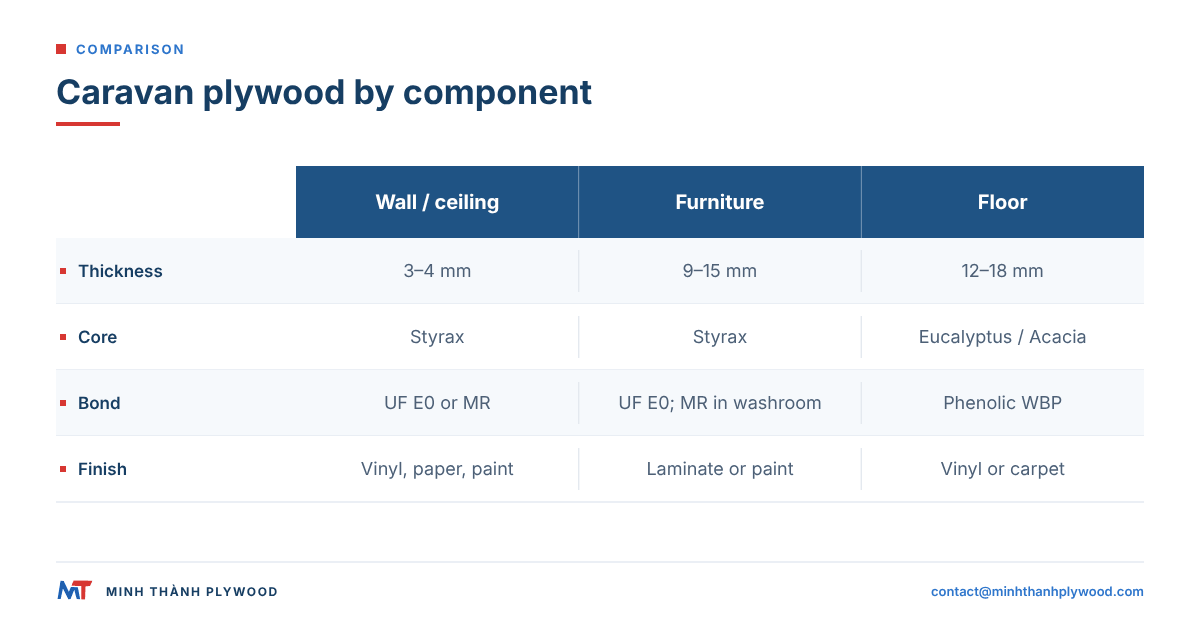
Caravans use four kinds of plywood: 3–4 mm thin plywood for wall linings and ceilings, 9–15 mm light-core plywood for furniture, 12–18 mm exterior-glued plywood for floors, and thin plywood as the inner skin of sandwich wall and roof panels.
| Part | Typical thickness | Core | Glue | Face |
|---|---|---|---|---|
| Ceiling panels | 3 mm | Styrax | UF at E0 or MR | Vinyl, decor paper or paint |
| Wall linings | 3–4 mm | Styrax | UF at E0 or MR | Vinyl, decor paper or laminate |
| Sandwich panel inner skin | 3 mm | Styrax | MR | Laminated by the panel maker |
| Locker fronts and doors | 9–12 mm | Styrax | UF at E0 | Laminate, foil or paint |
| Furniture carcasses | 12–15 mm | Styrax | UF at E0 (MR in washroom) | Laminate or paint |
| Floors | 12–18 mm | Eucalyptus or Acacia | Phenolic WBP | Vinyl or carpet over |
The pattern is simple: the lightest board that holds its fixings for everything inside the living space, and a denser, waterproof-glued board where the panel takes feet, water and road spray.
Caravan ply board: what specification should you order?
Order caravan ply board as five-ply thin plywood on a light core, sanded on both faces, with the glue and emission class written separately. Our thin panels are made in 3, 4 and 5 mm, five plies in every thickness, on white Styrax or Eucalyptus cores.
| Field | Minh Thanh caravan ply |
|---|---|
| Thickness | 3, 4 or 5 mm, always five-ply; furniture panels to 40 mm |
| Core | White Styrax (light) or Eucalyptus (dense) |
| Core joining | Core veneers stitched across and along the panel |
| Glue | UF glue at E0 emission; melamine-fortified MR or phenolic WBP to order |
| Faces | Poplar, EV, birch, okoume, pine and others; each side specified |
| Surface | Sanded and polished; both faces UV-ready |
| Thickness tolerance | ±0.2–0.3 mm on sanded panels, down to ±0.2 mm |
| Length and width tolerance | ±2 mm |
| Sheet sizes | 1220 × 2440 or 1250 × 2500 mm; custom such as 1220 × 2500 and 1220 × 2280 mm |
| Moisture at dispatch | 8–12 % |
The tolerance matters for laminators. A panel that varies by a millimetre across the sheet shows as uneven pressure in a laminating press; ±0.2–0.3 mm keeps the bond line even. Our thin plywood page lists every face and thickness.
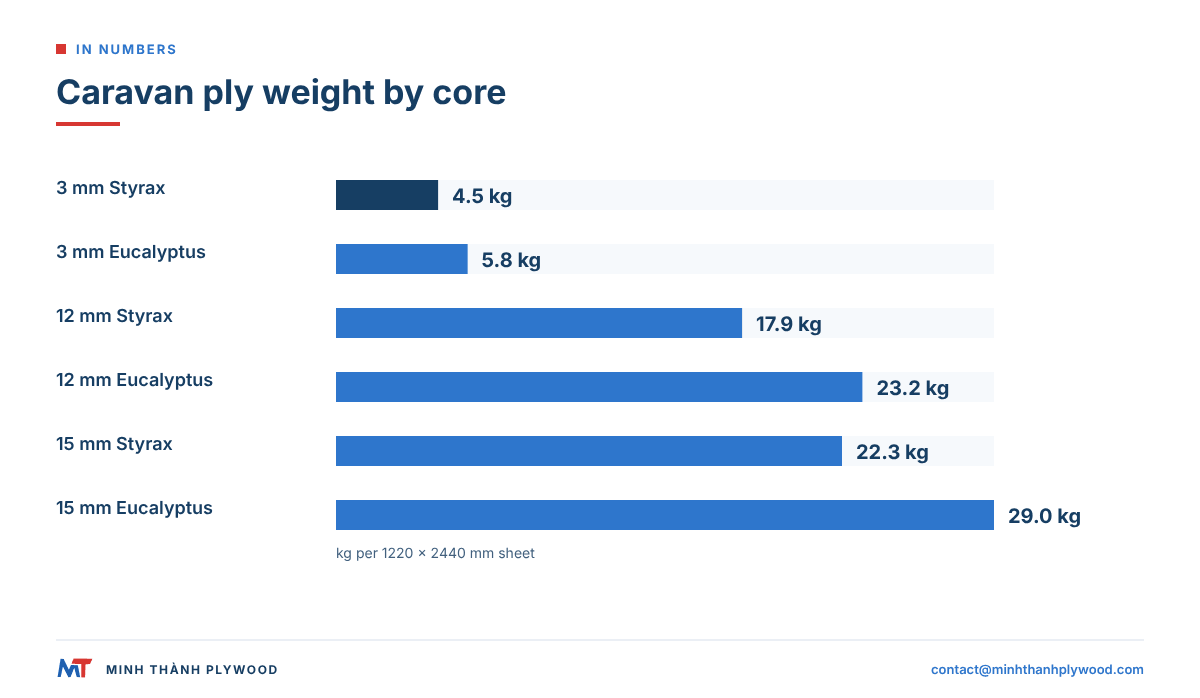
Lightweight plywood for caravans: how much does each sheet weigh?
Lightweight plywood for caravans weighs about 4.5 kg per 1220 × 2440 mm sheet at 3 mm and about 8.9 kg at 6 mm on a white Styrax core. The same sheets on a Eucalyptus core weigh about 30 % more, which adds up fast across a full interior.
| Thickness | White Styrax core (about 500 kg/m³) | Eucalyptus core (about 650 kg/m³) |
|---|---|---|
| 3 mm | 4.5 kg | 5.8 kg |
| 4 mm | 6.0 kg | 7.7 kg |
| 5 mm | 7.4 kg | 9.7 kg |
| 6 mm | 8.9 kg | 11.6 kg |
| 9 mm | 13.4 kg | 17.4 kg |
| 12 mm | 17.9 kg | 23.2 kg |
| 15 mm | 22.3 kg | 29.0 kg |
Weights are calculated as density × volume for a 1220 × 2440 mm sheet. A typical caravan interior uses 20 or more thin sheets for walls and ceilings; at 3 mm, choosing Styrax over Eucalyptus saves about 1.3 kg per sheet. On the furniture board the saving grows to about 6.7 kg per 15 mm sheet.
RV wall panels: what thickness should a replacement be?
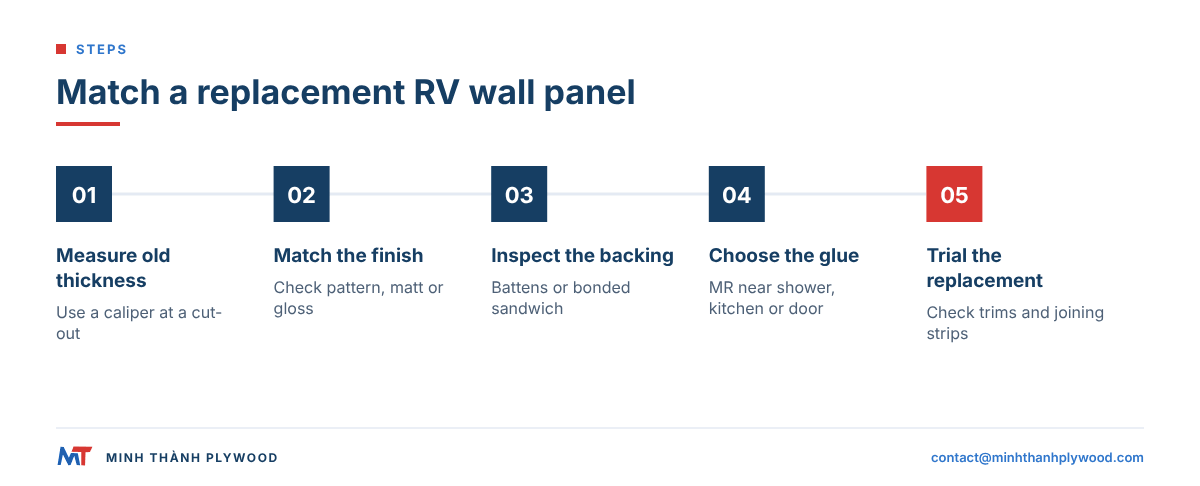
RV wall panels are usually about 3 mm thick, the panel sold as 1/8 inch, with some vans using about 5 mm. A replacement should match the old panel, so window trims, light switches and joining strips still fit without packing.
How to match paneling for RV walls:
- Measure the old panel at a vent, window or switch cut-out, with a caliper, not a tape.
- Check the face. Most RV interior wall panels carry a vinyl or printed paper face; note the pattern and whether it is matt or gloss.
- Check what is behind it. A thin panel on battens can be replaced alone; a panel bonded into a sandwich wall needs a different repair.
- Choose the bond. Use MR glue near the shower, kitchen and entry door, where water reaches the panel edge.
For a workshop or a dealer replacing panels on many vans, a stock of 3 mm and 4 mm five-ply panels in one face covers most repairs. Sanded panels can be faced to match in the workshop.
Caravan wall panels: which faces and finishes work?
Caravan wall panels are finished with vinyl, decor paper, high-pressure laminate or paint, applied to a flat, sanded plywood substrate. The face of the plywood itself matters less than its flatness, because a thin decorative layer copies every flaw underneath.
- Vinyl and decor paper: the most common caravan wall finish; needs a smooth, even substrate with no open joints in the face veneer.
- High-pressure laminate: for wet areas and worktops; bonded in a press or with contact adhesive.
- Paint and lacquer: for camper and motorhome conversions; a poplar face takes paint evenly.
- Clear finish: birch or okoume faces where the wood stays visible.
Our panels are sanded and polished on both faces and UV-ready, so a laminator or a coating line can apply its decorative layer directly. Double pressing helps here too: the core board is pressed and calibrated first, then the face and back are pressed on, which keeps the face flat. For wall lining in buildings, see our plywood wall panels guide.
RV ceiling panels: how are they fitted?
RV ceiling panels are 3 mm five-ply plywood, usually with a vinyl or paper face, fixed to roof battens or bonded to the inner face of the roof sandwich. Thin five-ply is light overhead and bends to the gentle curve of most caravan and van roofs.
Fitting points that save rework:
- Grain direction. Run the face grain across the curve for tighter bends; along it where the roof is nearly flat.
- Joints on battens. Every panel edge needs a batten or a joining strip behind it.
- Light fittings and vents. Cut the openings before fitting, then seal the cut edges.
- Trial first. Fit one sheet on the battens before cutting the set.
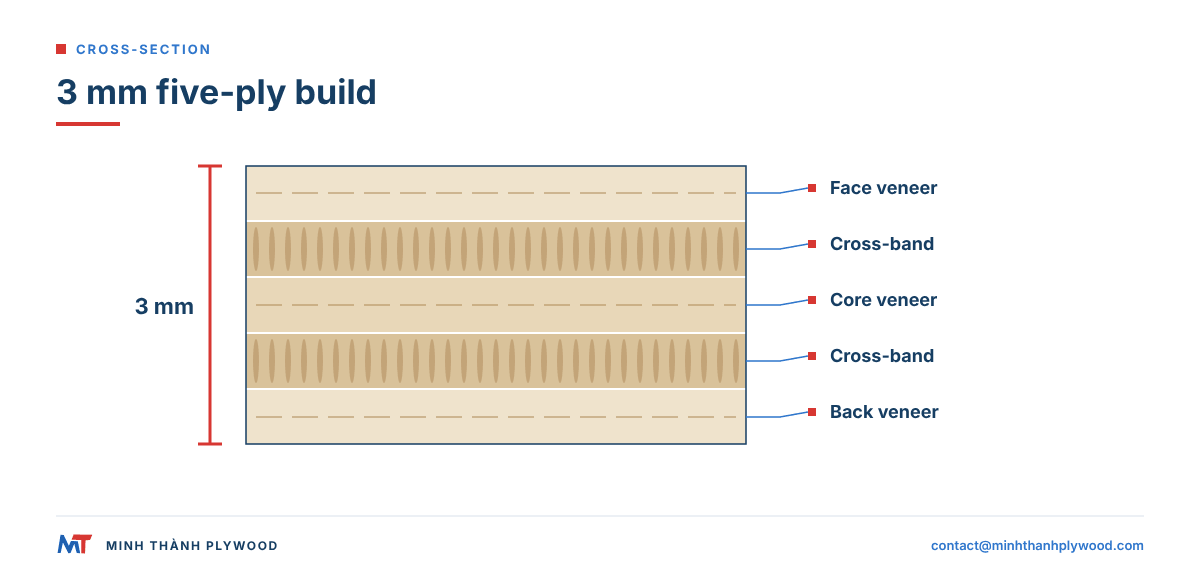
A 3 mm sheet built from five veneers (one core veneer, two cross-band veneers and two face veneers) stays flatter in a heated, damp roof space than a three-ply sheet of the same thickness.
Which plywood suits caravan furniture?
Caravan furniture uses 9–15 mm light-core plywood: 9–12 mm for locker fronts, doors and wall cupboards, 12–15 mm for carcasses, seat boxes and anything carrying a worktop or a fridge. A white Styrax core keeps a 12 mm sheet at about 17.9 kg.
What the board contributes to furniture that survives the road:
- Stitched core. Core layers stitched horizontally and vertically leave no gaps where a hinge or catch screw would find air.
- Flat doors. Panels pressed twice hang flat and close true against the frame.
- Thin backs and drawer bottoms. 4–5 mm five-ply in routed grooves; at ±0.2–0.3 mm they fit without packing.
Furniture faces are usually laminated or foiled for caravans and painted or clear-finished for conversions. Our poplar plywood is the substrate furniture makers order for laminated and painted work. The campervan conversion guide gives part-by-part thicknesses for van builds.
Which plywood suits caravan floors?
Caravan floors use 12–18 mm plywood with phenolic WBP glue on a dense Eucalyptus or Acacia core, or a sandwich floor with plywood skins over foam. The floor takes feet, furniture fixings and water from the door and the washroom, so the bond matters more than the face.
- Glue: phenolic WBP. The underside of a caravan floor sees road spray and condensation.
- Edges: sealed at every cut and around every hole for pipes and cables.
- Thickness: 12 mm where joists are close, 15–18 mm where furniture is fixed through the floor.
- Covering: vinyl or carpet; the plywood face can be a utility grade.
For grip without a covering, such as on ramps and in garages at the back of motorhomes, anti-slip film-faced plywood is the panel used. The subfloor plywood guide covers floor grades in buildings.
Which glue and emission class suit a caravan interior?
Caravan interiors need low-emission panels: a caravan is a small, closed space that warms up in the sun, so formaldehyde from board and glue concentrates faster than in a house. Order UF glue at E0 emission for dry interior panels, and write the emission class separately from the glue type.
Our furniture panels are certified to CARB Phase 2 / TSCA Title VI (ICTT mill no. 23024). Six ASTM D6007 chamber tests between April 2025 and June 2026, on 9, 15 and 18 mm panels, averaged 0.014–0.032 ppm against the 0.05 ppm limit for veneer-core hardwood plywood; three were run by Shanghai Hongjun and three by ICTT Vietnam. The limits are set in 40 CFR 770.10.
By zone:
- Living area, bedroom, lockers: UF glue at E0 emission.
- Washroom and kitchen: melamine-fortified MR glue.
- Floor and lower walls near the door: phenolic WBP glue.
Why is five-ply better than three-ply for thin caravan panels?
Five-ply is better for thin caravan panels because five thinner veneers stay flatter, split less at staples and screws and hide core defects under vinyl better than three thick ones. Our thin plywood is five-ply in every thickness from 3 mm to 5 mm.
How the five plies are built:
- 3 mm: one core veneer, two cross-band veneers and two face veneers.
- 4 and 5 mm: three core veneers and two faces, with the core veneer thickness set to the panel. A 4 mm furniture panel, for example, uses three 1.3 mm Styrax core veneers.
Premium thin face veneer is scarce, so 4 mm panels can take longer to produce. We do not lower the standard to go faster; plan thin-panel orders with that in mind.
How do caravan builders and distributors order by the container?
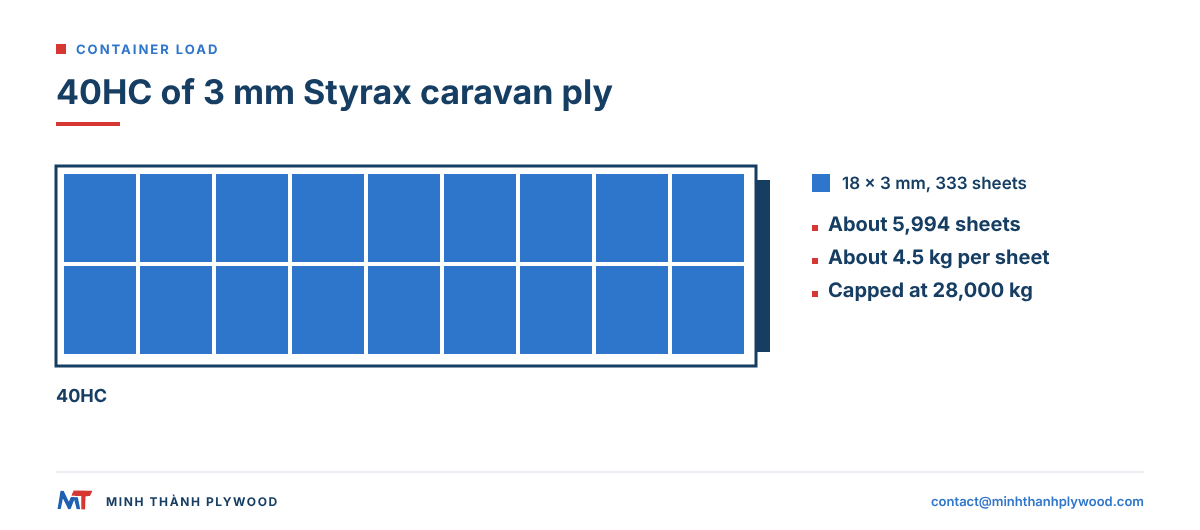
Caravan builders, panel laminators and distributors order caravan ply by the container: our minimum is one 40HC, usually with one or two specifications and up to six by agreement. A 40HC holds 18 packs of Styrax-core thin plywood.
| Thickness on Styrax core | Sheets per pack | Sheets per 40HC | Sheet weight |
|---|---|---|---|
| 3 mm | 333 | About 5,994 | About 4.5 kg |
| 4 mm | 250 | About 4,500 | About 6.0 kg |
| 6 mm | 166 | About 2,988 | About 8.9 kg |
These plans use 1220 × 2440 mm sheets, packs about 1,000 mm high, and are capped by weight at a 28,000 kg planning payload or the lower limit of your booking. A distributor supplying caravan builders in Australia or New Zealand can combine 3 mm lining panels with 12–15 mm furniture board in one load.
Production takes 15–45 days after the 30% deposit, with the 70% balance against the scanned B/L, or by irrevocable L/C at sight. Every shipment is photographed and filmed before loading, and the buyer receives the photos and video.
What should a caravan ply order say?
A caravan ply order should say the part, thickness and ply count, core, glue and emission, face and back, surface, size, tolerance, quantity and packing. One line per specification is enough for an accurate quote.
Caravan ply: 3 mm five-ply, white Styrax core, UF glue at E0 emission, poplar B/B both faces, sanded and polished, 1220 × 2440 mm ±2 mm, thickness ±0.2–0.3 mm, moisture 8–12 %; plus 12 mm poplar A/B on Styrax for furniture; 1×40HC; FOB Hai Phong.
Free samples are available: ask for the thin panel and the furniture board you plan to laminate, and run them through your own press or vinyl line before ordering. Send the specification lines through our quotation page. For heavier industrial panels, see our industrial plywood guide.
Buyer questions, answered
What plywood is used in caravans?
Caravans use thin plywood of 3–4 mm for wall linings and ceilings, usually faced with vinyl, decor paper or laminate, 9–15 mm light-core plywood for furniture, and 12–18 mm exterior-glued plywood for floors.
What is caravan plywood?
Caravan plywood is thin, lightweight plywood made for caravan and RV interiors. It is usually 3–6 mm, built on a light core, and supplied either sanded for finishing or with a decorative face applied by a laminator.
What thickness are RV wall panels?
Most RV and caravan interior wall panels are about 3 mm, the size usually sold as 1/8 inch, with some at about 5 mm. Measure an edge of the old panel at a vent or window cut-out and match it, so trims and fittings still fit.
How much does a sheet of 3 mm caravan ply weigh?
A 1220 × 2440 × 3 mm sheet weighs about 4.5 kg on a white Styrax core at about 500 kg/m³, and about 5.8 kg on a Eucalyptus core at 650 kg/m³.
Is three-ply or five-ply better for caravan wall panels?
Five-ply. At the same thickness, five thinner veneers stay flatter, split less at screws and staples, and resist the telegraphing of core defects through vinyl or paper better than three thicker veneers.
How much does caravan ply cost in Australia?
A 1220 × 2440 mm sheet of 3 mm caravan poplar plywood is about AUD 97 on Plyco's trade list of 1 September 2026, and Melbourne caravan ranges run up to AUD 119 a sheet. A distributor importing a 40HC buys the same size at a raw FOB example of about US$3 for 3 mm.
Where can I buy caravan plywood?
Caravan builders and laminators buy from panel distributors or direct from a plywood factory by the container. Our minimum order is one 40HC, which holds about 5,994 sheets of 3 mm Styrax-core plywood in 18 packs.
Can caravan ply bend around curves?
Yes. 3 mm five-ply follows gentle ceiling curves and rounded locker fronts when fixed to battens or formers. Bend across the face grain for tighter radii and test one sheet on the former first.
Which glue should caravan plywood have?
UF glue at E0 emission for dry interior panels in a living space, melamine-fortified MR for washrooms and kitchens, and phenolic WBP for floors and the lower walls near the door.
Does caravan ply come with a laminated face?
Caravan ply is supplied either with a decorative face applied by a panel laminator, such as vinyl, decor paper or HPL, or sanded for painting. Our panels are sanded, polished and UV-ready on both faces as a flat substrate.