
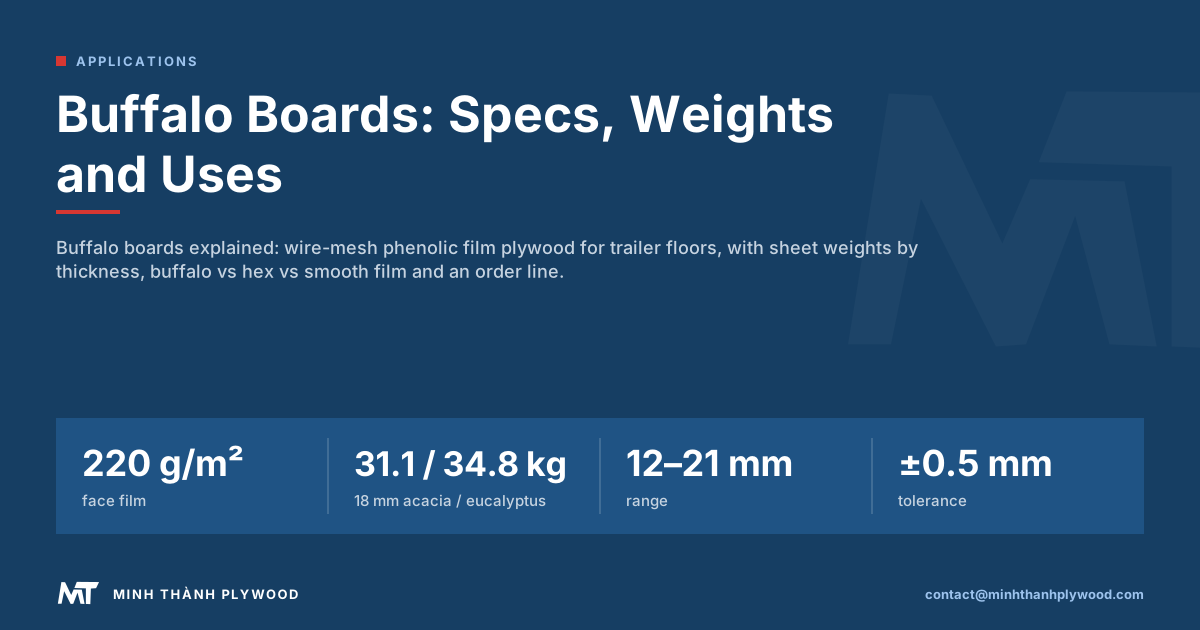
Buffalo boards are plywood sheets faced with a dark phenolic film pressed into a wire-mesh pattern, sold in the UK and Ireland for trailer floors, van floors, ramps and walkways. The mesh provides a textured surface; the film sheds water, while cut edges and fixing holes need sealing. This guide gives sizes, sheet weights, the mesh vs hex vs smooth choice and the order line, from Minh Thanh Plywood, which makes the mesh-film panel in Vietnam.
What is buffalo board? The short answer
Buffalo board is a plywood sheet with a dark phenolic film on its face, pressed into a wire-mesh texture for grip. It is the UK and Irish trade name for mesh-pattern anti-slip plywood, and merchants sell it for trailer beds, horsebox and van floors, loading ramps, scaffold platforms and walkways.
Three things make a panel a buffalo board:
- A textured film face. Paper impregnated with phenolic resin, pressed onto the face veneer in a hot press with a mesh-patterned plate, so the pattern is moulded into the film itself.
- A smooth film back. The underside usually carries a smooth phenolic film, so both faces are sealed and the panel stays balanced.
- An exterior bond. Phenolic (WBP) glue, sold in Europe as EN 314-2 Class 3, so the plies hold together when the floor gets wet.
UK merchants mostly sell birch buffalo boards. The same build is also made on hardwood cores in Vietnam and other plywood countries, and sold under “anti-slip film faced plywood”, “mesh plywood”, “wire mesh plywood” or “trailer flooring plywood”.
Buffalo boards at a glance: sizes, thicknesses and weights
Buffalo boards come in the full 8 × 4 sheet, 1220 × 2440 mm, and many European ranges also stock 1250 × 2500 mm. UK merchants such as Cleveland Timber also list an oversize 3050 × 1525 mm sheet in 18 mm (10 × 5 ft), which lets a trailer bed run with fewer joints. Merchant thicknesses run from 9 mm for light liners to 24 mm for heavy decks; 18 mm is the common trailer floor sheet.
One naming point helps when you search. Buffalo Board is a trade name in the UK. Merchants list the generic product as “buffalo type board”, “anti-slip mesh phenolic plywood” or “trailer flooring plywood”, with a black hex-pattern version beside the dark brown mesh. They are the same build, and a mill can supply any of them under its own name.
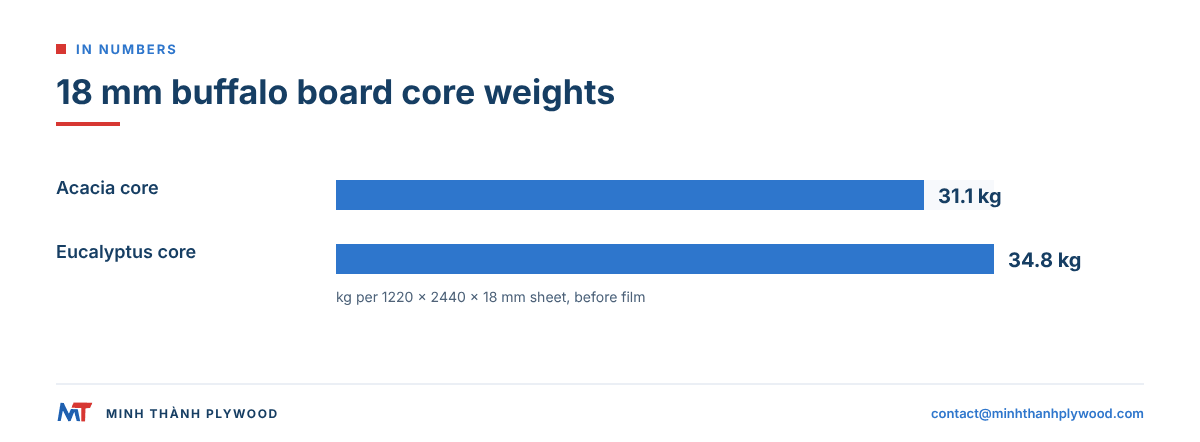
The weight of a sheet comes from its volume and the density of its core. The table gives our Vietnamese mesh-film panel on the two cores we use for it, calculated from the reference densities (acacia 580 kg/m³, eucalyptus 650 kg/m³) for a 1220 × 2440 mm sheet, before the film.
| Thickness | Typical use | Acacia core, kg per sheet | Eucalyptus core, kg per sheet |
|---|---|---|---|
| 9 mm | Light liners on a solid base (merchant size, weights calculated) | 15.5 kg | 17.4 kg |
| 12 mm | Van floor liners on a solid base, ramp skins | 20.7 kg | 23.2 kg |
| 15 mm | Light trailer decks, walkways on close joists | 25.9 kg | 29.0 kg |
| 18 mm | Trailer and horsebox floors, the standard sheet | 31.1 kg | 34.8 kg |
| 21 mm | Heavy trailer and plant floors, wider joist spacing | 36.3 kg | 40.6 kg |
The film adds a small amount on top: a 220 g/m² face film on a 1220 × 2440 mm sheet is about 0.65 kg. Birch-core buffalo boards weigh in the same band as these hardwood cores, so a fitter lifting sheets by hand feels little difference between them.
We make the mesh-film panel 12–21 mm, with a thickness tolerance of ±0.5 mm, in 1220 × 2440 or 1250 × 2500 mm.
What does a UK buyer pay for buffalo board?
UK merchants sell by the sheet and charge for the services around it. Chiltern Timber lists a panel cutting service at £1.00 and sells the 2440 × 1220 × 18 mm sheet and the 220 g/m² mesh and hex films by the board. MDF Direct sells 9, 12 and 18 mm birch buffalo board cut to size, with flat-rate delivery of £25 plus VAT in England and Wales and free delivery over £500 (prices read 21 October 2026). Delivery, cutting and a merchant margin sit in every sheet price.
Factory direct, the price is per 40HC container, with sheets priced as a raw FOB figure and freight and duty added at your port, so a builder who needs several hundred sheets a year compares the two on landed cost per sheet, not on the shelf price.
Buffalo board vs hex board vs smooth phenolic film
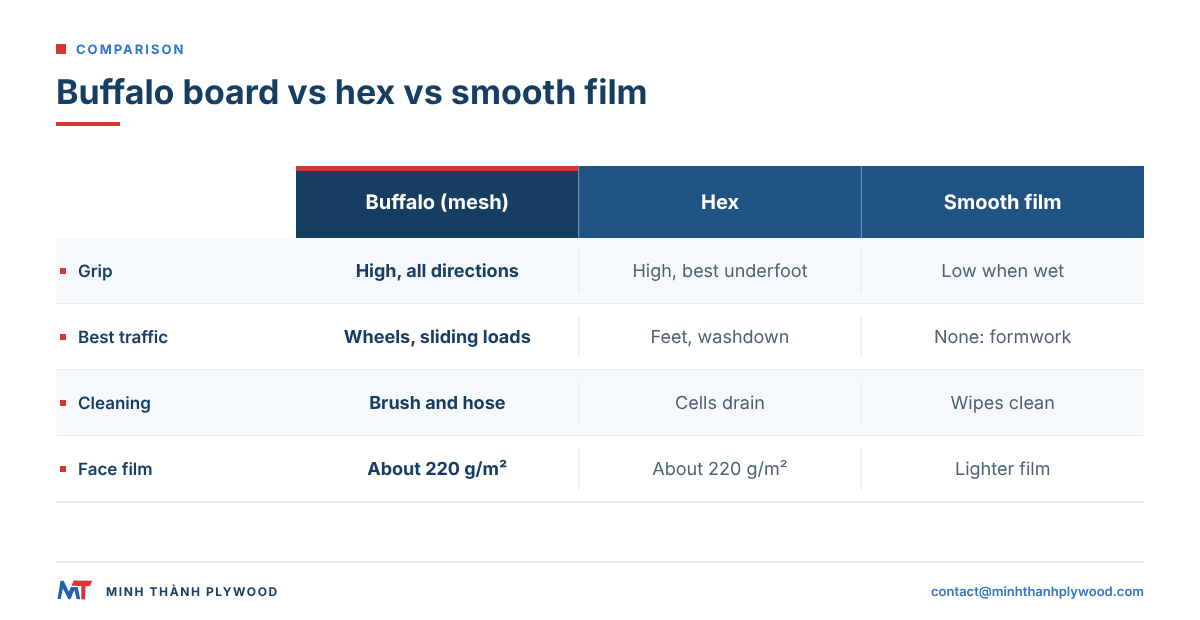
Buffalo board, hex board and smooth film plywood are the same family: phenolic film faced plywood. They differ only in the face pattern, and the pattern decides the job.
| Metric | Buffalo board (wire mesh) | Hex board (hexagon) | Smooth phenolic film |
|---|---|---|---|
| Face pattern | Fine criss-cross mesh moulded into the film | Raised six-sided cells | Flat, glossy or matt |
| Grip | High, in every direction | High, best under foot | Low; slippery when wet |
| Best traffic | Wheels, pallet trucks, sliding loads | Feet, washdown floors, stages | No traffic: formwork, panels |
| Cleaning | Brush and hose; grit can lodge in mesh | Cells drain and clean out | Wipes clean |
| Face film | About 220 g/m² | About 220 g/m² | Lighter film for formwork |
| Back | Smooth film | Smooth film | Smooth film |
| Bond | Phenolic WBP / EN 314-2 Class 3 | Phenolic WBP / EN 314-2 Class 3 | Phenolic WBP for concrete reuse |
| Typical buyer | Trailer and van builders | Stage, walkway and platform builders | Concrete contractors |
Verdict by use:
- Trailer, van and horsebox floors: buffalo board. Wheels and dragged loads grip on the mesh in every direction.
- Stages, walkways and wet floors: hex board. The cells shed water and are easier to keep clean.
- Formwork and smooth panels: smooth film. Grip is not wanted on a concrete face.
The anti-slip film we press is around 220 g/m², heavier than the film on formwork panels, because a floor wears from above every day while formwork wears only at each pour.
Buffalo board vs plywood: what changes on a trailer floor?
A plain exterior plywood sheet and a buffalo board can share the same core and glue; the difference is the face. On an untreated plywood floor, water soaks into the face veneer, the face checks and splits, and the surface turns slippery once it is wet or oily. A buffalo board’s film seals the face and holds its grip pattern.
| Point | Plain exterior plywood | Buffalo board |
|---|---|---|
| Face | Wood veneer, needs paint or oil | Phenolic film, sealed in the press |
| Grip when wet | Poor unless painted with grit | Moulded mesh grip |
| Maintenance | Recoat every season | Hose, brush, reseal cuts |
| Water at the face | Soaks in, face checks | Sheds water |
| Cost per sheet | Lower | Higher, for the film and pressing |
Plain plywood is the cheaper first fit for a covered trailer floor that will be carpeted or rubber-matted. For an open trailer, a ramp or any floor that gets wet and walked on, buffalo board earns its extra cost in fewer recoats and fewer replacements. Our best plywood for trailer floors guide compares the other options, including marine and hardwood decks.
Birch buffalo board or a Vietnamese hardwood-core equivalent?
Both carry the same mesh film and exterior bond; the choice is the core. Birch buffalo boards are the UK merchant standard, with many thin birch plies and a long track record in trailer floors. A Vietnamese anti-slip panel uses a eucalyptus or acacia hardwood core under the same film.
| Point | Birch-core buffalo board | Eucalyptus or acacia core (our build) |
|---|---|---|
| Core | Birch plies throughout | Eucalyptus 650–750 kg/m³ or acacia about 580 kg/m³ |
| Face film | Mesh phenolic | Mesh or hexagonal phenolic, about 220 g/m² |
| Back | Smooth film | Smooth film |
| Bond | Phenolic, exterior | Melamine-fortified or phenolic WBP, by order |
| Sizes | 1220 × 2440, 1250 × 2500 mm | 1220 × 2440, 1250 × 2500 mm |
| Thickness tolerance | Mill tolerance | ±0.5 mm |
| Buying route | Merchant stock, sheet by sheet | Factory direct, by the 40HC |
Buy birch buffalo boards by the sheet when you fit a few trailers a year and need stock tomorrow. Buy a container of hardwood-core mesh panels when you build trailers, vans or platforms in series: one 40HC carries several hundred sheets in mixed thicknesses, and the price per sheet drops with the merchant margin removed. For outdoor floors order the phenolic WBP bond; the melamine-fortified bond suits covered floors.
How is a buffalo board made?
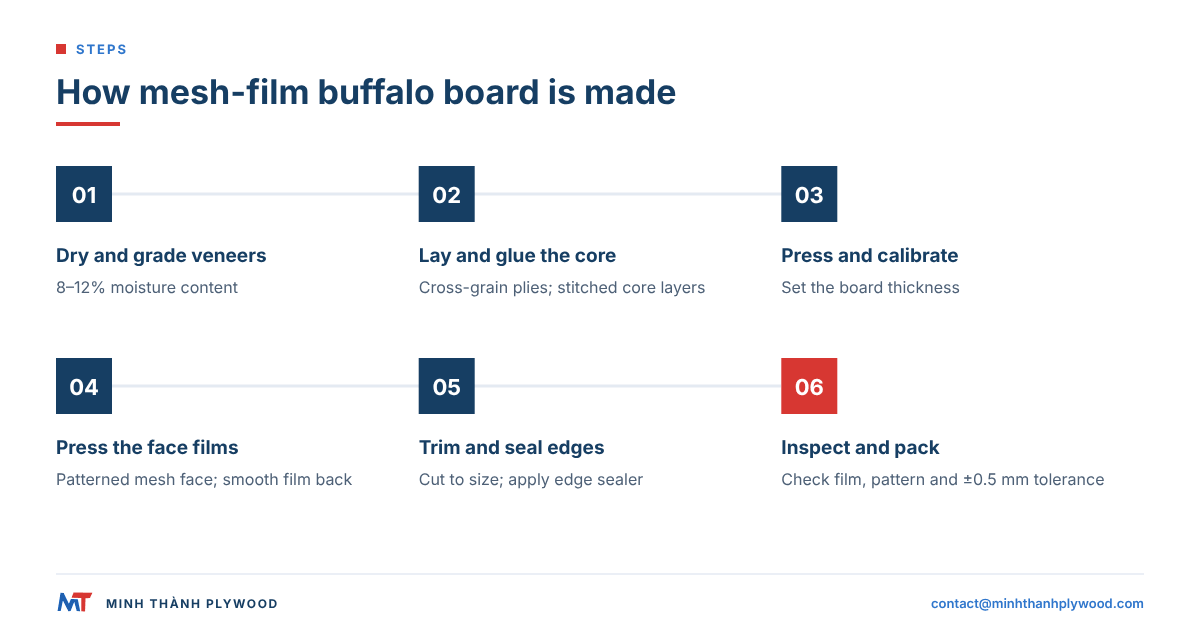
A buffalo board is a finished plywood panel with film pressed onto both faces, made in six steps:
- Core veneers are dried to 8–12 % moisture content and graded, so the glue line cures evenly.
- The core is laid up in cross-grain plies with phenolic or melamine-fortified glue, and core layers are stitched both ways to control gaps and overlaps.
- The board is pressed, cooled and calibrated to thickness.
- The films go on. A phenolic film for the face and a smooth film for the back are laid on the calibrated board and pressed against a patterned plate, which moulds the mesh into the face film.
- Sheets are trimmed to size, and the edges are painted with an edge sealer.
- Each sheet is checked for pattern depth, film adhesion and sealed edges, and thickness is measured to ±0.5 mm before packing.
Pressing the film onto a calibrated board, rather than onto a raw lay-up, keeps the face flat and the pattern even across the whole sheet.
Which bond and grade should a buffalo board have?
A buffalo board for an open trailer or outdoor ramp needs a bond specified for exterior conditions. The adhesive name alone does not establish a tested class. EN 314-2 sets bonding-quality requirements according to end use. Specify the required class and supporting test report.
The panel service specification is separate: EN 636 covers plywood for dry, humid or exterior conditions. Match that service condition to the trailer or walkway, including its exposure to water.
Write the bond and the emission class as two separate lines on your order. The bond tells you how the glue line handles water; the emission class tells you how much formaldehyde the panel releases. A trailer floor is outdoors, so its buyers ask mostly about the bond; an indoor walkway or stage may need both.
The core grade matters more than the face grade on a buffalo board, because the film hides the face veneer. Ask for a core without open gaps or overlaps, since a void under the film is where the floor first dents under a wheel.
How slippery is buffalo board? Slip tests and ratings
A mesh pattern alone does not establish slip resistance. Test the selected panel under the wet or contaminated conditions expected in use; a profiled surface may need measurements in several directions. Two methods appear on floor specifications:
- Pendulum test (EN 13036-4 in Europe, BS 7976 in the UK): a rubber slider swings across the surface, dry and wet, and gives a pendulum test value. The UK Health and Safety Executive’s floor slip-resistance guidance explains pendulum testing and the need to assess profiled surfaces in different directions.
- Ramp test (DIN 51130): a person walks on the surface on a tilting ramp, and the angle at which they slip gives the R9–R13 rating used across Europe.
Most trailer buyers order buffalo boards on the pattern alone. When your specification names a test, tell us the method: we arrange third-party testing through SGS on the constructed panel.
What thickness of buffalo board for each use?
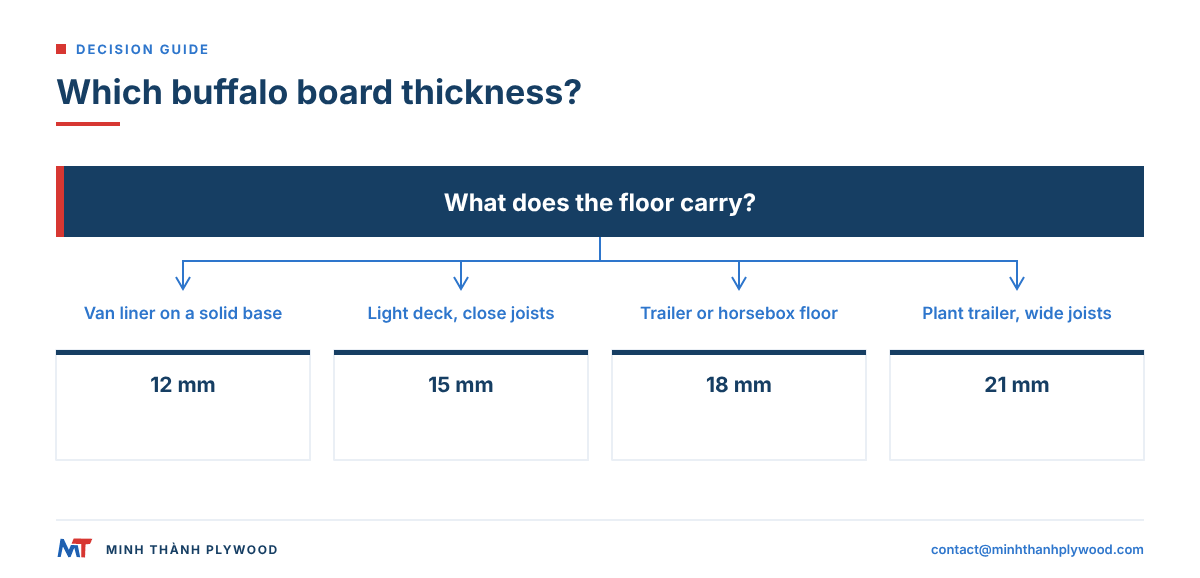
Choose the thickness from the support spacing and the load, not from the sheet price. As a starting point:
| Use | Common thickness | Why |
|---|---|---|
| Van floor liner on a solid plywood or metal base | 12 mm | The base carries the load; the board gives grip and wear |
| Light trailer deck, close cross-members | 15 mm | Enough stiffness for foot traffic and light wheels |
| Car transporter, flatbed and horsebox floors | 18 mm | The standard trailer floor sheet |
| Plant trailers, heavy decks, wider joists | 21 mm | Stiffer between supports, longer wear life |
| Ramps and walkway steps | 15–18 mm | Short spans, frequent foot traffic |
Your trailer drawing or the vehicle maker’s specification sets the final value. Order sheets in the length that lets joints fall on a cross-member, and add the fixing pattern to the drawing.
Buffalo board trailer flooring: fitting and sealing
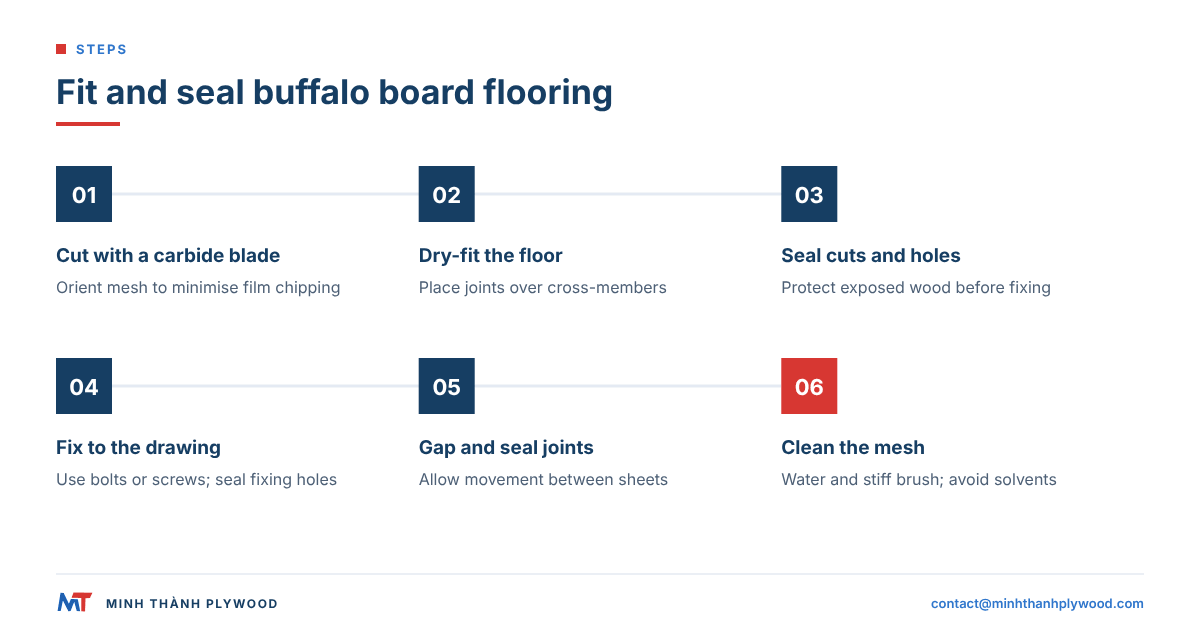
Buffalo board trailer flooring lasts as long as water stays out of its edges. Fit it in this order:
- Cut mesh side up on a table saw, or mesh side down with a track saw, using a fine-tooth carbide blade to limit chipping of the film.
- Dry-fit every sheet so joints land on a cross-member and the mesh runs the same way across the floor.
- Seal every cut edge and drilled hole the same day with an edge sealer or exterior paint. Cut edges are open end grain and take in water fast.
- Fix with countersunk bolts or self-drilling screws at the spacing on the trailer drawing; seal the holes before the fastener goes in.
- Leave a small gap at sheet joints for movement, and seal the joint line.
- Clean with water and a stiff brush, scraping grit out of the mesh; keep solvents off the film.
Store unused sheets flat, off the ground and under cover until fitting.
How long does buffalo board last, and how do you repair it?
A buffalo board floor with an exterior bond and sealed edges gives years of service; the first wear appears in the wheel tracks, where the mesh slowly flattens. Damage to the core comes almost always from water at an unsealed cut, hole or impact dent.
Check the floor at each service:
- Flattened mesh in wheel paths: grip is falling; plan a sheet swap at the next service.
- Film lifted at an edge or around a bolt: dry it, reseal, and watch it; spreading lifts mean water is in the core.
- Soft or swollen spots: the core has taken water; replace that sheet.
Reversible panels with mesh film on both faces can be turned over once the top face is worn, which extends their service life. Order them as a separate build, with both faces stated.
Where else are buffalo boards used?
Beyond trailer floors, buffalo boards go anywhere a wood panel must give grip when wet:
- Van and pick-up bed liners, over the factory floor.
- Horsebox and livestock floors, where the floor is hosed out after each trip.
- Loading ramps and dock plates, under foot and pallet truck traffic.
- Scaffold platforms and site walkways, as a gritty, wet-weather surface.
- Stage decks and event platforms, where hex boards are also common; see our guide to plywood for stages and walkways.
- Container and truck body floors, alongside the heavier hardwood floors covered in container flooring plywood.
Each of these is the same panel with a different thickness and fixing; the order line below covers them all.
What this means for your buffalo board order
Buffalo boards from a merchant suit small, urgent jobs. Trailer and van builders who use several hundred sheets a year buy the same mesh-film panel factory direct. From us that means:
- MOQ one 40HC, with several thicknesses in one container by agreement.
- Production 15–45 days after the 30% deposit; balance 70% against the scanned B/L, or an irrevocable L/C at sight.
- FOB Hai Phong, CFR or CIF to your port.
- Container planning by weight. Film-faced sheets weigh a little more than plain panels, so the sheet count per 40HC is set against a planning payload of 28,000 kg, or your booking if lower, and sent with the quote.
- Free samples of the mesh film and the hex film, so your fitters can compare them on the floor.
The anti-slip plywood product page lists the full specification. For the wider family of floor, transport and industrial panels, start at our industrial plywood guide.
How to specify buffalo boards on an RFQ
Send one line per thickness, in this form:
Buffalo board (anti-slip plywood), 18 mm, 1220 × 2440 mm, mesh phenolic film about 220 g/m² face, smooth film back, eucalyptus core, phenolic WBP bond, edges sealed, quantity in sheets, CIF your port.
Add the use (trailer, van, ramp, stage), the slip test method if your specification names one, the colour of the film, and whether any sheets need mesh on both faces. We reply within hours with the build, the container plan and a price.
Buyer questions, answered
What is buffalo board?
Buffalo board is a UK trade name for anti-slip plywood: a plywood panel faced with phenolic film pressed into a wire-mesh pattern on the working side, usually with smooth film on the back and an exterior bond. It is used for trailer floors, van floors, ramps and walkways.
Is buffalo board the same as phenolic plywood?
It is one type of it. All buffalo boards are phenolic film faced plywood, but the name means the textured mesh face. Smooth phenolic film plywood, sold for concrete formwork, has no grip pattern.
How much does an 18 mm buffalo board weigh?
It depends on the core. A 1220 × 2440 × 18 mm sheet on an acacia core weighs about 31.1 kg from the core density alone, and about 34.8 kg on a eucalyptus core; the film adds a little more. Birch-core sheets sit in the same range.
What thickness of buffalo board do I need for a trailer floor?
Most trailer floors use 18 or 21 mm sheets; van floor liners on a supported base use 12 or 15 mm. The support spacing and wheel loads on your trailer drawing decide the final thickness.
Is buffalo board waterproof?
The film face sheds water and a WBP or EN 314-2 Class 3 bond resists wet exposure, so the panel works outdoors. Water enters through cut edges and screw holes, so seal every cut and drilled hole before fitting.
Which side of buffalo board goes up?
The mesh-patterned side goes up as the walking or loading surface. The smooth side faces down onto the chassis or joists, unless you ordered a reversible panel with mesh film on both faces.
What is the difference between buffalo board and hex board?
Both are anti-slip phenolic film plywood. Buffalo board has a wire-mesh pattern that suits wheeled traffic and gritty loads; hex board has raised hexagonal cells that drain and clean out well under foot traffic and washdown.
Can you cut buffalo board?
Yes, with a fine-tooth carbide blade, mesh side up on a table saw or down with a track saw to limit film chipping. Seal the cut edge the same day with an edge sealer or exterior paint.
What sizes do buffalo boards come in?
The common sheet is 1220 × 2440 mm (8 × 4 ft), with 1250 × 2500 mm in many European ranges. Thicknesses usually run 9 to 24 mm; our Vietnamese mesh-film panel is made 12–21 mm.
How long does buffalo board last on a trailer floor?
Years of service, when the bond is exterior grade and the edges stay sealed. Wear shows first in the wheel tracks, where the mesh flattens; replace the worn sheet before the core is exposed.
Can I order buffalo board by the container from Vietnam?
Yes. Minh Thanh Plywood makes mesh-film anti-slip plywood on order, MOQ one 40HC with mixed thicknesses by agreement and production 15–45 days after the deposit. Free samples are available.